What are the common varieties of orchids? An introduction to common orchid varieties
What are the common varieties of orchids
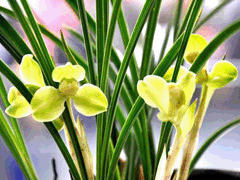 Orchidsare evergreen perennial herbaceous flowers of the Orchidaceae family, divided into two major categories: terrestrial orchids and epiphytic orchids.
Epiphytic orchids are also called aerial orchids or foreign orchids. Epiphytic orchids have aerial roots, larger pseudobulbs, broad leaves, curved or drooping inflorescences, and unusual flowers with rich colors, no fragrance or little fragrance, so they win bythecolor and shape of their flowers, and are often used as cut flowers.
Terrestrial orchids are also called Chinese orchids. They are the traditional typecultivatedin our country. They are orchids that grow in soil, do not have aerial roots, have smaller pseudobulbs, narrow and thin leaves, upright inflorescences, graceful leaf posture, and strong floral fragrance, and have always won by their color and scent. The main varieties of terrestrial orchids commonlycultivatedin our country are:
Cymbidium goeringii: Also known as Ge orchid, with narrow linear leaves, fine teeth on the leaf margins, obvious veins, and fleshy white roots. Flowers are solitary or paired, yellow-green, with some nearly white and purple varieties, and an elegant fragrance. It blooms in early spring from February to March.Cymbidium goeringiihas many varieties, usually classified by petal shape into plum-petal type, narcissus-petal type, butterfly-petal type, plain-heart-petal type and other flower types.
Cymbidium faberi: Also known as nine-joint orchid, with linear leaves that are wider and longer than those of Cymbidium goeringii, relatively upright, with rough leaf margins. The flowers form a raceme of 5-13 florets, pale yellow, with a white lip bearing purple-red spots, and a strong fragrance. The flowering period is April to May.
Cymbidium ensifolium: Also known as autumn orchid, with strap-shaped leaves about 50 cm long, and leaf margins without serrations. The flowers form a raceme of 6-12 florets. Yellow-green to pale yellow-brown, with dark purple stripes, and a strong fragrance. The flowering period is August to September.
Cymbidium sinense: Also known as New Year orchid, with leaves up to 60-80 cm long, broad, thick and smooth, upright and nearly erect. Each flower scape bears 5-10 flowers, with deep flower color and purple-brown stripes, and a light fragrance. It blooms around the Spring Festival.
Hesheng: Also known as little bee orchid, with short, broad and smooth leaves. The flower scape emerges obliquely and is shorter than the leaves. Each scape bears 5-20 flowers, small and densely arranged, with reddish-brown outer petals and no fragrance. It blooms from winter to early spring.
Cymbidium kanran: Leaves resemble those of Cymbidium ensifolium; narrow and upright. The flower scape is slender and upright, bearing 5-7 flowers, with small flowers and narrow petals, in various colors such as green, purple, peach red, white and yellow, fragrant, blooming in winter and spring.
Rabbit-ear orchid: Leaves are short, narrowly elliptical, with long petioles at the base. The flower scape is about 20 cm tall, bearing 5-6 flowers, pale green with a light fragrance. The lip is not obvious, 3-lobed, with the central lobe revolute, white with purple stripes. The flowering period is May to July.
Terrestrial orchids like warm and moist climatic conditions. They do not require very high soil water content, but they do require relatively high soil humidity. Orchids have fleshy fibrous roots, and the rhizomes also grow underground. The rhizomes that live symbiotically with mycorrhizae also need good aeration conditions. If there is too much soil moisture, they will not only grow poorly, but sometimes also wither and die.