How to Select Orchids? Practical Tips to Help You Choose Good Flowers
Key Tips for Selecting Orchids
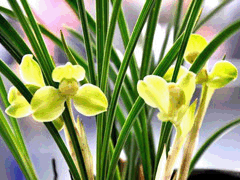 These tips mainly apply toChinese Cymbidium (Cymbidium goeringii)variety selection, and can secondarily serve as a reference for selecting Sichuan Chunjian (Cymbidium goeringii var. longibracteatum) varieties. Although other orchid species have different standards, the differences are minor. Any promising plant with a certaincultivationvalue shares common superior characteristics. When selecting, one must apply the tips flexibly in order to grasp the essence amid endless variation.
1. Requirements for orchid leaves: The leaf base (petiole) should be hard, slender and upright; the middle section of the leaf should be broad and thick, vigorous yet supple, with the tip slightly drooping, and the very tip blunt-rounded, hard, cupped, and slightly upturned - this is superior. The leaf tissue should have a fine, glutinous sand-like haze that is dense and translucent; the blade should be semicircular with a central groove, waxy and slightly glossy, feeling smooth as jade to the touch; the overall leaf color should be pure and uniform, with new and old leaves showing consistent color and minimal difference, with tender green being first, emerald green second, and old green inferior. The main leaf vein should be bright and translucent, with lateral veins shallowly entering and emerging flat, seeming hidden yet revealed, each fine vein long and reaching the leaf tip. The leaf margin should have a distinct white or yellow translucent edge, and the leaf tip should be white or yellow and transparent, with a pointed peak being superior.
2. Requirements for the basal sheaths (foot sheaths): The foot sheaths should be tall, robust and upright, tightly rounded and shaped like the base of silvergrass, with many sheath segments that are short, broad and rounded; the sheath tips should cling tightly to the leaf bundle without splaying out in a V-shape - this is superior. If the sheaths are long, large, sharp, thin and hard, that is also acceptable. The sheath color must be vivid and pure, accompanied by a sand-like haze resembling pearls or powder, or unusual colorful mottled haze, progressing from bottom to top and from pale to gradually deeper toward the tip; sheaths with snow-white peaks, green peaks, bright red or unusually colored peaks are superior. If the peak tip curves inward into a hook, that is even more superior. The sheaths must be glossy; those with glossy veins and sand are even more superior.
3. Requirements for the pseudobulbs: The pseudobulbs should be large, round and solid, white or emerald green and crystalline in color, shaped like water chestnuts, arrowhead corms, or garlic bulbs - these are superior.
4. Requirements for orchid roots: Orchid roots should be smooth and plump, uniform and straight whether thick or thin, fine in texture, and pure white in color. For Chinese Cymbidium, fine and round roots are superior; for Sichuan Chunjian, thick, large and square roots are superior.
5. Requirements for grass worms (buds): Newly sprouted grass worms should be shaped like pearl lotus or hemispherical domes, very plump; it does not matter if the protective bud membrane sheath tips are long. They will surely produce good petal-type flowers. Before the grass buds differentiate into leaves, changes in sheath, veins and color that go from pale first to deep later indicate relatively stable flower color. For specific sheath, vein and color details, please refer to the second tip above.
6. Requirements for flower worms (buds): Flower buds that after more than a month above ground are swollen, tight and large will mostly produce petal-type or unusual flowers. If the bud sheath is plain or lightly mottled, it will mostly produce plain-color flowers or light-colored mottled flowers. If the bud sheath color is heavy and the mottled sand is intense, it will mostly produce halo-mottled flowers, colorful-centered flowers and heavily mottled flowers. If when you feel the bud sheath (bell) it is tight, round and large with the upper half hollow and a flat top, it will produce plum-petal flowers; if the bell is olive-shaped, it will produce lotus-petal flowers; if the sheath tip has a white head or the sheath margin bears an unusual colored halo, there is hope. If the bud shape is unusual and strangely wrinkled, one may hope for unusual flowers. If the sand haze and unusual colors cover the entire sheath, intensely forming velvet and wrinkles, there is hope for butterfly-type flowers.
7. Requirements for delicate colors (gorgeous hues) inflowers: Delicate-colored flowers mostly come from pale, light-colored foot sheaths, and the leaf color is also relatively pale and uniform. Leaves that are emerald and translucent like tender green sheaths, emerald blue-green, white with emerald green showing through, or pale white-yellow with silver-red sheath showing through will mostly produce pure-colored red, white, pink, emerald blue-green and other delicate-colored flower varieties. Deep red sheaths, old silver-red sheaths, yellow with purple-red showing through, and ginger-yellow sheaths with red veins showing through will mostly produce ivory-yellow, ginger-yellow, golden-yellow and other delicate-colored flower varieties. Deep blue-green mottled sheaths, deep purple mottled sheaths, and those with thin, sparse sand haze will mostly produce deep blue-green and purple mottled halo-colored flowers. If the sheath tip has various colors extending to the left and right, one may hope for variably colored delicate mottled flowers.
8. Requirements for hybrid and variant orchids: Hybrid orchids often produce variant flowers, and the leaves must clearly show essence-accumulating characteristics. Such leaves mostly have thick but relatively soft, drooping veins, a waxy glossy surface, and a crystalline or grayish powdery color. The hybrid variant characteristics are obvious, with the foot sheath sand haze showing floral spots and blocky cloud patterns, and the sheath veins fine, short and appearing intermittent. Those with thick leaf veins but fine round roots, or Chinese Cymbidium crossed with thread orchids, will mostly produce petal-type flowers. Those with fine leaf veins but thick, large, square roots, or Chinese Cymbidium crossed with other orchid species, will mostly produce variant flowers.
All eight tips above are for selecting promising varieties. You should know that any plant that either lacks or already possesses characteristics different from ordinaryorchid grass- as long as the characteristics are obvious and it has individuality - can be selected for trial cultivation. Some grasses match none of the standard indicators, yet may precisely produce good flowers and be rare fine specimens. This fully demonstrates theorchid's unpredictable genetic variation and mysterious alluring charm, which is often very hard to judge.