Three key points for cultivating Cymbidium kanran, teaching you to easily grow orchids well
Orchids -- Three key points for cultivating Cymbidium kanran
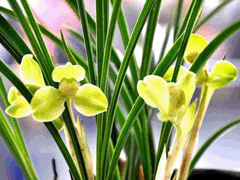 People haveCymbidium kanrancultivationlong had the saying of "a narrow escape from death". In fact, as long as you master the key points, the propagation rate is not lower than that of Cymbidium goeringii andCymbidium faberi. In my more than three years of cultivating wild-collected Cymbidium kanran,its seedling emergence rate is about 50% or more. I now share with orchid friendssomebits of experience from the cultivation process.
I. Planting
Cymbidium kanran mostly grows under dense broad-leaved forests on steep slopes, with little light, shallow roots, and the roots covered by a thin layer of humus soil, with good water permeability. Therefore, when planting, choose a high-footed purple clay pot, with the bottom third of the pot lined with coarse-grained bricks and foam plastic blocks, the middle part mixed with mushroom soil, coarse wood chips, weathered stone, Zhijinshi, pond foundation stone, and brick granules the size of soybeans up to one third of the pot, and the upper part mixed with weathered stone and brick granules the size of rice grains plus a small amount of humus soil. The planting medium should be loose, breathable, well-drained, and strongly heat-retaining. In particular, note that if only hard planting medium, wood chips, humus soil, etc. are used for cultivation, the survival rate, seedling emergence rate, and flowering rate are all not high.
II. Cultivation
Because Cymbidium kanran's growing environment differs from that of Cymbidium goeringii and Cymbidium faberi, its cultivation methods should differ slightly. First, the shading degree and temperature are similar to those forCymbidium sinense. Especially in high-temperature seasons with strong light, more attention should be paid to shading and moisture retention. In addition, on sunny days, leaf surfaces should be sprayed with water every morning or evening, with a shading degree of about 80%. This way the leaf texture is glossy and there is less disease; in high-temperature seasons, I place Cymbidium kanran on the lower layer of the orchid rack, withCymbidium goeringiiand Cymbidium faberi on the rack blocking the light, and the effect is quite good. Second, wind protection and freeze protection. In autumn and winter, avoid strong winds, and on frosty days cover them for warmth. Third, fertilizing. Cymbidium kanran planted with the above planting medium generally can be given little or no fertilizer, or from April to June a high-nitrogen fertilizer can be sprayed on the leaves, such as Huabao No. 4, B1 budding agent, etc. From August to October, phosphorus- and potassium-containing fertilizers can be sprayed, such as flowering fertilizer, Huabao No. 3, potassium dihydrogen phosphate, etc.
III. Care
Whether Cymbidium kanran can bloom, bloom well, and give off a delicate fragrance, care is crucial. For dark-colored flowers, light should be slightly stronger, and for plain-centered ones, light should be slightly shadier. From when the flower scape begins to elongate until before blooming, if plant protection is not paid attention to, the flower buds easily become stuck and rot. For this reason, Cymbidium kanran's flower buds are also easily infested by mites; this pest's color is similar to that of the flower buds and is often not easy to find. Once found, it must be controlled promptly, otherwise the flowers will not bloom. Therefore, spraying insecticides such as Huakang No. 1 and fenvalerate can effectively control it. Cymbidium kanran mostly opens in late autumn and early winter, when the weather gradually turns cold, and people often feel the fragrance is faint and the qi insufficient. In order to make Cymbidium kanran's delicate fragrance waft, during the flowering period it should be exposed to more sun, so that even at night the light fragrance fills the air. Cymbidiumkanranhas fragrant form and beauty, brightly colored flowers, scapes rising above the leaves, leaves upright and arching, well-spaced, elegant and floating, soft yet firm, leaves and flowers both elegant, and among Chinese cymbidiums it has unique charm and will be valued.