How to grow orchids in northern China? Practical care tips shared
How to grow orchids well in northern China
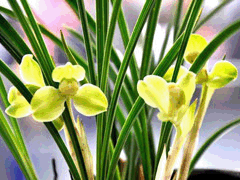 How to grow them well in northern Chinaorchids, so thatorchidsproduce more flowers and do not fail to bloom, one should start from the following aspects.
1. PotsGrowing orchidsThe key to success or failure lies in air.Growing orchidsFor flowers, clay pots are preferable, because they have good drainage and aeration, while purple clay pots have poor water permeability and aeration, making root rot and poor flowering easy. Choose suitable earthenware pots, make 10 to 12 holes with a diameter of 1 cm in the pot wall, enlarge the hole at the bottom of the pot, and add more pieces of broken tiles or charcoal blocks to increase water permeability and aeration.
2. Watering and spraying When watering orchids, one should grasp the principle of "not dry in summer and autumn, not wet in winter and spring." In the north, the water is mostly neutral, and long-term watering makes the potting soil somewhat alkaline. Therefore, for watering orchids, rainwater or snow water is best, and hard water or alkaline water containing too many minerals must not be used. To grow orchids well, in addition to keeping the soil moist, the environmental humidity should also be raised. During the summer growing season, more water should be sprayed on the pot surface or the ground to maintain a relative humidity of 45% to 65%, but the humidity must not be too high, so as to avoid causing diseases. In northern China, winter and spring are dry, so they must not be made too dry; in autumn, spraying can be stopped, and it is appropriate as long as the potting soil is not dry.
3. Fertilizing Fertilizing orchids is very particular.CultivationOrchids rarely use base fertilizer; most are top-dressed with liquid fertilizer, and during the growing period, a thin, well-rotted liquid fertilizer is applied once every 5 to 10 days. Do not apply fertilizer in midsummer and severe winter, and it is not suitable to fertilize before and after flowering. Overall, one should grasp the principle of "frequent but light is preferable, and sudden heavy application must be avoided." In addition, fertilizing should mostly be done in the evening or when there is no wind and no rain, and the next morning water once with treated clean water at a suitable temperature, spraying the leaf surface.
4. Suitable shading Orchids are semi-shade plants, but if too shaded they do not bloom or bloom less, and the degree of shade tolerance varies by species.Cymbidium sinensehas strong shade tolerance,Cymbidium ensifoliumis next,Cymbidium faberineeds sufficient light.
5. Pest and disease control Grasp the principle of prevention being more important than treatment. During the rainy season and high temperatures, southern blight is prone to occur, and Bordeaux mixture or thiophanate-methyl can be used for prevention. When scale insects occur, pesticides such as dimethoate can be used for control.