How to manage water control in orchid cultivation
Water control in orchid cultivation
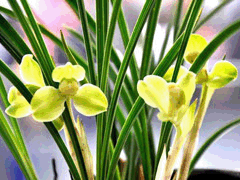 Orchidsare native to mountain forests, where they mostly grow in clumps on northwest-facing slopes that open to the southeast, in places with abundant stone debris and humus. Mixed coniferous and broadleaf forests provide them with shade, the ventilation is neither strong nor weak, and air with a certain humidity often flows through. The stone debris and humus drain well, are not prone to waterlogging, and can also retain a certain amount of moisture and nutrients. Therefore,orchidsare not xerophytes or hygrophytes, but rather neutral plants that lean toward dryness. Orchid roots and stems can store a large amount of water, while the cuticle of orchid leaves can reduce water evaporation, soorchidsdo not need too much water.
The suitable relative humidity for orchids is around 80%, and the potting soil humidity is around 50%. If the potting soil is too dry, the roots shrivel; if the potting soil is too wet, the roots rot. The experience ofgrowing orchidssummarized by predecessors is that "orchids like moisture but fear wetness, like dryness but fear aridity." Therefore, orchidcultivationmust be adapted to local conditions, and one must never copy things blindly. It should be grasped and applied flexibly according to different seasons, environments, varieties, growth stages, and different pots and soils.
Different seasons
Seasonal changes cause temperature changes, and as temperature changes, the water requirements of orchids also change. At the same time, because of temperature changes, the speed of water evaporation also changes. Therefore, the frequency and amount of watering orchids must inevitably change.
First, watering must change with the times, and the amount of watering should be determined according to the speed of the plant's absorption and evaporation. In summer, the temperature is high, orchids grow vigorously, and they need more water. At the same time, water evaporates quickly, so they should be watered in both the morning and evening, and misted to increase air humidity. Spring is the best growing season for orchids, and they need a lot of water, but evaporation is relatively slow, so the amount of watering can be gradually increased in sequence from early spring, mid-spring, to late spring. In autumn, the amount of watering can be gradually reduced in sequence from the beginning of autumn, mid-autumn, to late autumn. However, during dry periods in autumn, water evaporates relatively quickly, so a moderate amount of extra watering is needed. In winter, the temperature is low, evaporation is slow, and orchids need less water, so watering should be reduced. Reducing the water content in orchids' bodies in winter can also increase the concentration of cell sap and enhance their cold resistance.
Second, watering times differ at different temperatures. In summer, when the daytime temperature is above 30°C and the nighttime temperature is around 25°C, watering should be done when the temperature is at its lowest. In spring and autumn, when the daytime temperature is around 20°C and the nighttime temperature is around 10°C, watering in the morning is better. In winter, when the daytime temperature is around 15°C and the nighttime temperature is around 5°C, watering can be done at noon. Simply put, water in cool times in summer and in warm times in winter, and make sure to: be sufficient in spring, adequate in summer, not dry in autumn, and not wet in winter. Also note that you should water more on sunny days, less on cloudy days, and not at all on rainy days.
Different environments
In the process of growing orchids, air humidity and watering are very closely related. This is because in places where orchids areartificially cultivated,there is rarely an environment and conditions identical to their native habitat. If ventilation is good and air humidity is low, water on orchid leaves and in the pot evaporates quickly, so the amount of watering should be increased; if the ventilation conditions are poor, excessive watering will lead to excessively high humidity, and at such times the amount of watering can be appropriately reduced; if the temperature is high and orchids grow in a stuffy, hot environment, a large amount of watering will make them sick, causing scorched leaf tips and black spots on the leaves; on cloudy and rainy days, humidity is high, and if ventilation is good, even if the potting medium is dry, it is acceptable not to water; when cultivated outdoors, they can be allowed to receive rain so as to save the effort of watering, but if a sudden shower falls under blazing sun and they are allowed to be rained on, it is easy for heat to accumulate inside; cold rain in early spring and late autumn must not be allowed to fall on them.
Different plants
Different orchid varieties require different amounts of water.Cymbidium goeringii、Cymbidium faberi、Cymbidium kanranhave a suitable temperature of 18°C to 24°C, whileCymbidium sinense、Cymbidium ensifoliumhave a suitable temperature of 25°C to 28°C. Therefore,Cymbidium goeringii、Cymbidium faberi、Cymbidium kanranshould be watered less, whileCymbidium sinense、Cymbidium ensifoliumshould be watered more.
Orchid plants can be divided into large and small, strong and weak, and orchids with different growth vigor also need different amounts of water. For newly transplanted orchids, because of repotting and division, the plants will have some wounds, so watering should not be too frequent. Small seedlings, weak plants, and old plants have a poor ability to tolerate environmental changes, so the range of dry-wet fluctuation should be small, and keeping them appropriately moist is enough. From the time new shoots begin to grow until they mature, the amount of watering should gradually increase, and as the new shoots mature, the amount of watering should slowly decrease again. At the beginning, the increase in watering should be determined by the growth rate of the new shoots. After the new shoots grow up, the purpose of reducing watering is to promote the enlargement and maturation of the pseudobulbs. During new shoot growth (vegetative growth), water should be sufficient, while when flower buds are forming, the water supply should be relatively reduced, and plants that already have flower buds should especially avoid being too dry or too wet. After flowering, the amount of watering should also be slightly reduced, keeping the potting medium relatively dry so that the orchids can rest and recuperate.
Different pots and soils
Pots and soil are the dwelling place of orchid plants, and as the saying goes, "to grow orchids, first grow the roots." Commonly used pots include clay pots, purple clay pots, plastic pots, and so on. Relatively speaking, clay pots dry the fastest, perforated plastic pots are next, and purple clay pots dry the slowest. Orchids in clay pots should be watered thoroughly every time, while for orchids in purple clay pots and plastic pots, watering and misting should be combined, watering one day and misting the next.
Soil is the growing medium for orchids and plays a key role in orchid growth. Generally, orchid growing media are required to be loose, breathable, and well-draining, but each region should manage this differently. Mountain soil in the Jiangsu-Zhejiang area has relatively poor aeration and water permeability, so watering should not be too frequent; Emei Immortal Soil has good breathability and is not prone to waterlogging, so more watering is acceptable; Yunnan humus soil has good breathability and dries easily, so it should be watered in time.