How do Chinese orchids such as Cymbidium goeringii and Cymbidium sinense propagate by division?
How do Chinese orchid types such as Cymbidium goeringii and Cymbidium sinense propagate by division
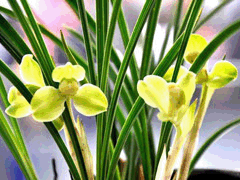 The vast majority of terrestrial Chinese orchids are clump-forming types, but the size of the pseudobulbs varies considerably. Old pseudobulbs usually have no leaves, and from the base upward there are several ring-like bands (nodes). If you observe carefully, you can see 1 bud eye at the base, while at the opposite position on the second ring there is another bud eye, and on the opposite side of the next ring above there is also one, but the higher up they are, the smaller the bud eyes become. Because the pseudobulbs are pressed tightly together, it is difficult to cut them while they are in the pot, so they must be taken out. The method for taking out the plant is: first press one hand on the potting soil at the base of the plant, then with the other hand turn the pot upside down and shake it gently so that the growing medium separates from the pot wall, then take it out and wash it clean, being careful not to damage the young buds. After that, look for the place with the largest gap and make the cut there, and after division plant them into small pots. For old pseudobulbs without leaves, you can wrap them tightly with moist sphagnum moss and place them in a slightly warm place; after a few weeks, once you see the bud eyes growing, transplant them into small pots.