How to grow Cymbidium goeringii well in the north
How to grow Cymbidium goeringii in the north
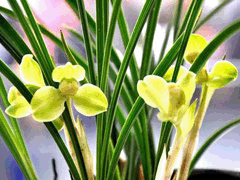 Cymbidium goeringiiis one of the most difficult fine-leaved terrestrial orchid varieties to cultivate. In the Jiaodong region, getting it to grow lush leaves and abundant flowers is no easy task, no wonder friends often sigh: "Flowers the first year, grass the second year, and nothing left by the third year."
I. Potting medium The potting medium for planting Cymbidium goeringii should not be too coarse. Use mountain topsoil mixed with oak leaves (commonly known as Mongolian oak) or larch leaves, composted for one year and then sifted for use. The slightly coarser soil material remaining after sifting is used to line the bottom of the pot. The ratio of soil to decomposed leaves should be 3:5, with a sieve mesh of 1 cm. The humus content in the potting medium must not be too high. According to analysis, potting medium with too much humus also has greater air circulation, which is highly desirable in the humid and warm south. But in the north, except for the high-temperature and humid July and August, the remaining months are dry and cold, which creates a situation where moisture is not retained in spring and autumn and warmth is not retained in severe winter, extremely unfavorable for the growth of orchids.
II. Fertilizer Cymbidium goeringii is the slowest-growing species and has low fertilizer requirements. As long as the potting soil is changed once every two years, the natural nutrients in the potting medium can fully meet the growth needs of the orchid plant. When the ancients saidorchidsneed no fertilizing, I think this is exactly what they meant. If too much fertilizer is applied, causing nutrient salts to accumulate, it can very easily lead to root rot and withered leaves in the orchid plant. Changing the potting soil once every two years is the best way to solve nutrient deficiency in Cymbidium goeringii. As the saying goes: "Frequent repotting grows shoots and buds, delayed repotting only produces flowers." Even if fertilizing is necessary, it should be little and dilute, especially applied to the leaves. If fertilizing is absolutely required, from April to July each year water with gold soup, and from August to November apply silver soup; do not fertilize in the remaining months. Apply once a month, and it must be dilute. The manifestation of fertilizer damage in Cymbidium goeringii is also very slow. When you notice scorched tips and yellow leaves, it is already too late, and you should immediately change the soil and replant.
III. Water Many people, influenced by "dry orchids, wet chrysanthemums," let the orchid plant become excessively dry, resulting in scorched and withered orchid leaves and thin, small orchid buds. Dryness is sometimes more harmful to orchids than too much water. Except that from late June to early August each year the orchid plant may be kept slightly drier, in all other months water must not be lacking, including the cold winter. Rainwater and snow water are best; tap water and well water need to be exposed to the sun for several days to let the chlorine evaporate. If some purslane or green grass is placed in the water, the water quality will be even better.
IV. Temperature and light Cymbidium goeringii is a relatively cold-tolerant strain, able to withstand low temperatures around zero degrees, and grows best in an environment of 16-25°C. However, because this strain has small plants and thin leaves, seasonal temperature changes can very easily scorch the orchid leaves. Unless it is to encourage the flower scape to grow taller when the orchid buds bloom, from mid-October each year the orchid plant should be moved into the cellar, and the time for taking it out should also be later, not until early May, to encourage the orchid plant to sprout and produce shoots earlier. From mid-September each year to early June of the following year, the orchid plant can be given all-day sunlight; in the other months, about 70 percent shading can be applied. With suitable light, the orchid leaves will be thick and glossy, and the shoots produced will be numerous and strong.
V. Care Caring for this strain is somewhat more difficult than for other strains. When the orchid buds emerge from the soil, even greater care should be taken: when watering and fertilizing, do not splash onto the leaf buds, to prevent bud rot and leaf rot. If heavy rain occurs, when there are only a few plants move them indoors (into a shed) to shelter from the rain; when there are many and moving them is inconvenient, immediately after the rain rinse off the mud splashed on the orchid leaves with clean water, then use a household hair dryer to dry the orchid plant as quickly as possible. After the orchid buds emerge from the soil, if they are covered with light-blocking paper, they grow extremely fast; after they grow to two inches, the paper cover can be removed. In July and August, most of the flower buds of Cymbidium goeringii have already emerged; depending on their vigor, remove the weaker flower buds. Green-floweredflowerorchid plants can have their flower buds shaded, which is expected to make them bloom more purely; red and yellow flowers, when exposed to more light, bloom more vividly.