A Detailed Guide to the Cultivation Techniques and Care Methods of Cymbidium goeringii
Cultivation and Care of Cymbidium goeringii
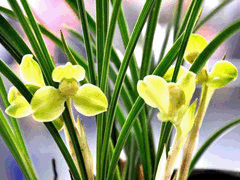 Cymbidium goeringiialso known as Caolan, isan orchidof the orchid family.
The pseudobulb is slightly spherical; 4-6 leaves are clustered together, narrowly strap-shaped, 20-60cm long, a few can reach 100cm, 0.6-1.1cm wide, with fine serrations along the edges; flowers are solitary, rarely 2, the scape is upright, with 4-5 sheaths, flower diameter 4-5cm.
Pale yellow-green, green-white, yellow-white, fragrant; sepals 3-4cm long, 0.6-0.9cm wide, narrowly oblong, apex acute or rounded-obtuse, tightly edged, with purplish-brown stripes at the base of the midrib; petals ovate-lanceolate, slightly curved, slightly wider and shorter than the sepals, with reddish-brown streaks in the middle of the base; the lip is 3-lobed but not distinctly so, shorter than the petals, apex recurved or short and hanging down, pale yellow, with or without purple-red spots, the lip has 2 ridges.
Flowering period is February to March.
[Cultivation]
Based on the author's several years ofgrowing orchidsand flowerspractical experience, it is believed that potted Cymbidium goeringii is best done in late autumn. If you buy Cymbidium goeringii plants that have been on the market for many days, or plants shipped from afar by mail, such plants are mostly already damaged, especially the roots, which suffer even greater damage. After washing, trimming, and disinfecting the roots, stems, and leaves of such orchid plants, then planting them in an orchid pot, after a winter of recovery and growth, by early spring they will still grow plump roots and lush leaves and produce good flowers. The author now briefly introduces the planting, growing, and management methods as follows:
1. Washing, Disinfection, and Trimming of Orchid Plants
Place Cymbidium goeringii plants that have been sitting for a long time into a basin of clean water and soak for 4-8 hours; the orchid roots will recover to their full plumpness. At this point, take the plants out, let them dry slightly, prune the withered, diseased, damaged, broken, and rotted orchid roots, and after pruning the withered, yellow, and dry leaves of the plant, place them into a potassium permanganate aqueous solution to disinfect for half an hour. Take them out, let them dry, and they are ready for planting.
2. Choosing Pots and Potting Soil
For the orchid pot, it is best to use a new clay pot, but it must be soaked in clean water for several hours to remove the firing heat before use. If using an old clay pot, it must be cleaned thoroughly and disinfected before use. The size of the pot should be such that the orchid roots can spread out comfortably inside. For the potting soil, orchid soil sold at flower markets is the best. If unavailable, you can use a self-made mix of half leaf mold and half vegetable garden soil, then mix in an appropriate amount of culture soil made from wheat-grain-sized sand particles or coal cinder particles and sawdust; this soil is slightly acidic and has good permeability. Absolutely avoid using saline-alkaline soil.
3. Potting and Planting
First place a piece of tile over the drainage hole at the bottom of the pot, then spread a layer of coarse sand particles or coarse coal cinder particles to facilitate drainage and ventilation. On top of that, spread a layer of culture soil, then seat the Cymbidium goeringii plant on the soil, arrange the roots naturally and spread them out, fill soil until half full, then gently lift the orchid plant while gently shaking the pot so that the orchid roots and potting soil are closely combined, then continue filling soil up to the rim of the pot, gently press the potting soil, and leave a 3cm water gap at the rim so that when applying fertilizer solution and watering, it does not flow outside the pot.
4. Care
After potting, first water thoroughly once, place in a slightly sunny and warm spot for half a month to let the plant recover, and after about half a month of care it will regain its vitality. At this time the weather turns cold, so the pot can be moved indoors to a spot that regularly receives sunlight for care and management. Throughout winter and early spring, keep it indoors to protect it from the cold and overwinter. During the winter, the indoor temperature should not be too high; as long as the room temperature stays below 10°C and above 0°C, it can grow vigorously and normally form buds and bloom.
5. Appropriate Watering and Fertilizing
After the first thorough watering following planting of Cymbidium goeringii, depending on whether the potting soil is dry or wet, generally follow the principle of "water when dry, stop when wet"; watering should be less in winter, and normally it is best to keep the potting soil slightly moist. Only when the soil in the pot is relatively dry should you water thoroughly once. Water around noon, and when the water temperature is the same as or close to room temperature, pour slowly along the edge of the pot; do not splash water on the leaf surface or leaf center, so as to avoid rotting the flower center. Orchids normally should not be given strong fertilizer, especially newly planted orchids; generally, no fertilizing is advisable within one year. After 1-2 years of cultivation, when new roots are dense and strong and the plant is growing vigorously, only then may a thin fertilizer solution be applied. Fertilizing should be done in the evening, and the fertilizer water should also be poured along the edge of the pot onto the potting soil, without contaminating the orchid leaves; after fertilizing, rinse once with clean water early the next morning to aid absorption of nutrients.
6. Bud Thinning
If the original Cymbidium goeringii plant carries many flower buds, appropriate bud thinning should be done before planting into the potting soil; generally, keeping 2-3 buds is sufficient. Keeping too many wastes the plant's nutrients in vain and affects the normal growth of the orchid plant. By the Spring Festival or early spring, the Cymbidium goeringii will have verdant green leaves and blooming flower buds, filling the room with a delicate fragrance and adding much color to the festival.