What Types of Chinese Orchids Are There? A Guide to Common Varieties
What Types of Chinese Orchids Are There
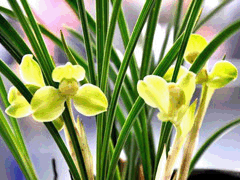 Plant taxonomy divides the Orchidaceae into family, subfamily, genus and species, variety or subspecies. According to this classification, Chinese orchids include the following species:
1)Cymbidium goeringii
Cymbidium goeringii, also known as caolan, shanlan, duoxiang, or simply lan, was called ruojiao by the ancients. Villagers in orchid-producing mountain areas call it xiaolan.
Cymbidium goeringii is the most widely distributed and most resource-rich of Chinese orchids,cultivationwith a relatively long history, and the most extensively bred horticulturalcultivationvarieties oforchid. It has a small plant body, relatively narrow and slender leaves, and an upright flower stalk about 6-25 cm tall, bearing 1 flower; the ancients called one stem with one flower "lan". A few bear doubleflowers,called bingdilan (twin-tipped orchid), meaning auspiciousness. Although the Cymbidium goeringii plant is small, its flowers are relatively large, with a spread diameter generally of 4-6 cm, and a maximum diameter of up to 8 cm. The flower color is usually mainly green and yellow-green, with purple-red stripes or spots on the tepals. The flowering period is about one month (mid-February to mid-March). Most Cymbidium goeringii are fragrant, a scent known as youxiang (delicate fragrance).
Cymbidium goeringii has different characteristics depending on the place of origin, and can be divided into major groups such as Jiangsu-Zhejiang Cymbidium goeringii, Henan Cymbidium goeringii, Hubei Cymbidium goeringii, Yunnan-Guizhou-Sichuan inland Cymbidium goeringii, and southern Cymbidium goeringii.
2) Huihua
Also known as jiuhualan, jiujielan, jiuyulan; villagers in orchid-producing mountain areas call it gaolan, dalan, niulan, shanglan. The ancients called one stem with nine flowers "hui", and also called it huihua rather thanCymbidium faberi. In a few areas it is called xialan or songchun.
The huihua plant is generally taller, with 5-13 leaves, leaf length about 35-80 cm, leaf width 0.5-1.5 cm, leaf veins thick, numerous and obvious, leaf margin serrations obvious and relatively coarse, and pseudobulbs not obvious. The flower stalk is upright; thick stalks are 1 cm in diameter, thin ones are like incense sticks, standing tall and level with or above the leaf canopy, generally about 35-80 cm tall. It bears 5-30 flowers. The flower spread diameter is about 3.5-8 cm. The flower color is mostly yellow-green or emerald green, with green velvety moss on the lip and many purple-red dots and patches; the flowering period in its native place is April to early May, and occasionally it blooms once more in autumn. Huihua is relatively widely distributed, and is also found north of the Qinling Mountains. Its native habitat is at a higher altitude than that of Cymbidium goeringii, and it is relatively cold-tolerant, drought-tolerant and sun-loving.
Huihua from different places differs slightly in leaf shape and flower quality, and is divided by place of origin into Jiangsu-Zhejiang huihua, western Anhui and Hubei huihua, Yunnan-Guizhou-Sichuan inland huihua, and southern huihua.
3)Four-seasonorchid
commonly known asCymbidium ensifolium, also known as xialan or qiulan. Some also call it yuhualan, junhelan, xionglan, or cilan. The four-season orchid does not bloom in all four seasons; its first flowering period generally begins in June and ends at Hanlu (Cold Dew), during which it can bloom many times.
The four-season orchid has a relatively wide range of origin, found in mountain forests south of 30°N in China, generally growing in groups in mixed forests at an altitude of 300-400 m. Because of its wide range of origin and long cultivation history, four-season orchids from different places have different plant forms. Some people divide them into many series, such as: Junhe series, Yuzhen series, Xionglan series, Cilan series, Yuzhen series, and Suxin series.
4)Cymbidium sinense
Also known as baosuilan, baisuilan, fengsuilan. Cymbidium sinense has broad leaves, generally 2-4.2 cm wide and about 25-80 cm long. 2-5 leaves grow on the pseudobulb. The pseudobulb is relatively large, 1.5-2.5 cm in diameter. The leaves are glossy, with a cross-section appearing as a shallow "V" shape or with a flat leaf surface, and the leaf margins usually have no serrations. The flower stalk is upright, generally taller than the leaf canopy. It is a raceme bearing 5-20 or more flowers, with a flower spread diameter of about 2.5-5 cm. The sepals and petals are usually narrowly lanceolate, and the lip hangs down and curls back. The flower color is mostly light purplish-brown, adorned with dark purplish-brown stripes. The flowering period runs from late autumn to February of the following year, with a sweet fragrance.
Cymbidium sinense grows south of 26°N in China in Fujian, Guangdong, Guangxi, Taiwan, Jiangxi, Yunnan, Hainan, Sichuan and southern Guizhou. Cymbidium sinense from different places has different characteristics, and can be divided by these characteristics into Taiwan baosuilan, Daming series Cymbidium sinense, Guangdong Cymbidium sinense, Yunnan Cymbidium sinense, Jiangxi Cymbidium sinense, and so on.
5)Cymbidium kanran
It has only thirty or forty years of cultivation history in China. Its flowering period is usually in winter. Today, Cymbidium kanran blooming from July to September has been found in southern Zhejiang, Huili in Sichuan and northern Yunnan, known as "summer Cymbidium kanran"; Cymbidium kanran also blooms from July to September in the Lishui area of Zhejiang.
The leaf texture of Cymbidium kanran is between that of Cymbidium goeringii and Cymbidium ensifolium; the cuticle layer on the leaf surface is slightly thicker than that of Cymbidium goeringii but thinner than that of Cymbidium ensifolium, and it is glossy. The leaf character is close to that of Cymbidium goeringii. The leaf surface is smoother than that of Cymbidium goeringii. The plant is relatively tall, with leaf length 30-100 cm and width 1-2 cm, and the leaf canopy is taller than that of Cymbidium goeringii. Leaves grow in clusters of 3-5, rarely 6-7. The pseudobulb is large, long ovoid, smooth, and the roots are thick. The flower stalk is slender, upright and straight. It is a raceme bearing 3-12 flowers; the sepals are narrowly lanceolate, about 2-4 cm long and only 0.2-0.35 cm wide. The flower spread diameter is 3.5-8 cm, and the petals are shorter than the sepals, generally 1/3-1/2 of the sepal length, pointed-elliptical in shape, with a well-developed and brightly colored lip. By flower color, Cymbidium kanran is generally divided into seven types: qingqing kanran (green stalk, green flower), qing kanran (purple stalk, green flower), zi kanran (purple stalk, purple flower), red-flowered kanran, white-flowered (suxin) kanran, yellow-flowered kanran, and gengsha (variegated) kanran.
Cymbidium kanran is relatively widely distributed; native Cymbidium kanran is found in Taiwan, Guangdong, Fujian, Guangxi, Jiangxi, Yunnan, Sichuan, Guizhou, Hubei, Hunan, Anhui and southern Zhejiang. Cymbidium kanran is divided into broad-leaved and fine-leaved, and can also be divided into erect-leaved and soft-leaved; fine erect-leaved Cymbidium kanran is relatively rare, accounting for only about one-thousandth in its native place. Fine erect-leaved Cymbidium kanran has narrow, thick and hard leaves, a large pseudobulb, thick roots, and obvious leaf margin serrations.
6)Lianbanorchid
Also known as xiaoxuelan or biyalan. Its distribution area is very narrow, with native species only in western Yunnan and the high mountain areas of Taiwan, China.
The lianban orchid has narrow and slender leaves, with leaf length 50-80 cm and leaf width 0.5-1.2 cm. Leaves grow in clusters of 6-9, and the pseudobulb is small, generally only about 1 cm in diameter, but the roots are sturdy, up to about 0.5 cm in diameter. The flower stalk is upright, slender, round and straight, bearing 2-3 flowers; the petals are relatively thin, the hidden stripes on the tepals are obvious, and the flower spread diameter is about 3.5-6 cm. The sepals are lanceolate, the petals are long ovoid, and the lip hangs down and curls back. The flowering period is from January to March; when the flowers open, the fragrance is rich and yet ethereal. Representative varieties include "Daxuesu" and "Xiaoxuesu". The lianban orchid is famous for flower colors as white as snow, forming a striking color contrast with its bright emerald green leaves.
7) Duohualan
Also known as tailan, mifenglan, pulan, jinlengbian, fanglan; in some places of origin it is called shilan.
Duohualan mostly grows on mountain rocks, and some are epiphytic on the branches of large trees. The plant is generally 25-40 cm long, with leaf width 1.2-2 cm, blunt-pointed leaf tips, thick leaf texture, and an obvious cuticle layer on the leaf surface. Leaves grow in clusters of 4-6, mostly soft and drooping; the pseudobulb is small, the flower stalk is 15-30 cm long and tends to slant out or droop, densely bearing 12-40 flowers; the flowers are small, the sepals and petals are both short and round, long ovoid in shape, and the lip hangs down and curls back. The flower color is reddish-brown, and the flowering period is May to early June. In recent years, horticultural varieties with white flowers and suxin, with a slight fragrance, have appeared.
8) Chunjian
The main resource areas of chunjian are Sichuan and Guizhou. The chunjian plant is tall, with leaf width 1-2.2 cm and leaf length 40-100 cm, and the leaf texture resembles that of Cymbidium goeringii. Its flowering period is also the same as that of Cymbidium goeringii, with 2 to 5 flowers per stem, a flower spread diameter of 4-8 cm, rich and varied flower colors, relatively thin petal texture with obvious hidden stripes on the petals, and a good delicate fragrance. Strong plants generally have 5-10 leaves. The root system is thick and sturdy. Traditional famous varieties include "Dahong Zhusha", "Yin'gan Su", "Longchang Su", and "Xishu Daoguang". In recent years, a large number of new varieties have been selected, forming the characteristics of Sichuan orchids.
9) Xianye chunlan
Also known as doulan, yinggelü, etc. Its main production areas are Guizhou, Sichuan and Yunnan provinces, and its habitat is generally in relatively dry mountain forests at an altitude of 500-2000 m. The leaf shape is relatively narrow and slender, 40-60 cm long and 0.6-1 cm wide; the cross-section of the leaf blade is mostly "V"-shaped, the leaf margin serrations are fine, and the number of leaves is 5-7. The flower stalk is relatively tall, generally about 15-25 cm tall; the petals are relatively thick, the flower shape is regular, and they all open as flat-shouldered flowers; the flowering period is from January to March, and under normal circumstances the flowers show no sign of withering even after 40 days. The flower colors are rich, including vermilion-gold, peach red, purple red, yellow, compound color, white, purple-black, green, etc. Most have no fragrance; in recent years a few fragrant xianye chunlan have been discovered.