Appreciation of Orchid Butterfly Flowers and Fantastic Flowers: A Gorgeous and Fragrant Scenic Line
A gorgeous and fragrant orchid scenic line - the appreciation of butterfly flowers and fantastic flowers
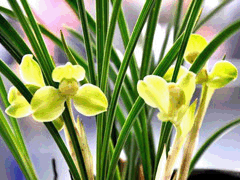 In the world of flowers with countless forms, it is hard to find a flower like Chineseorchids, whose flower shapes and colors are ever-changing and unpredictable. In Chineseorchids, the diversity and variability of flower shapes and colors are most notable in butterfly flowers and fantastic flowers.
What is a butterfly flower? In orchids, when the petals (petals) or sepals are partially or fully transformed into a lip (labellum) or lip-like form, opening into a shape and color like a fluttering butterfly, it is called a butterfly flower. What is a fantastic flower? In orchids, when individual flowers open with more or fewer petals or columns (nose) than conventional orchid flowers, or are unusual, and some flower types or petals also show obvious changes, such flowers, which are extremely rare among orchids and have ornamental value, are called orchid fantastic flowers.
Butterfly flowers and fantastic flowers can be said to beorchids'a gorgeous and fragrant scenic line, greatly noticed by orchid enthusiasts.
In the appreciation of Chinese orchid flower shapes and colors, the appreciation of butterfly flowers and fantastic flowers is generally later than that of colored flowers, plain-heart flowers, and general petal-type flowers, and also later than the Japanese appreciation of orchid leaf variegation. According to orchid historical records, the earlier high-grade butterfly flower to appear wasCymbidium goeringiiSixi Butterfly (appeared in Jiangsu and Zhejiang around the 1920s, see "A Brief History of Orchids"), and the multi-petal fantastic flower wasCymbidium goeringiiLüyun (tradition says that during the Tongzhi reign of the Qing Dynasty, around 1869, a Mr. Chen of Liuxia Town in Hangzhou collected it from nearby Wuyun Mountain andcultivatedit). (The Qing Dynasty "First Fragrance Notes" and "Four Discussions on Orchid Cultivation" mention forms resembling bees and butterflies, but without flower names.) At the same time and afterward,Cymbidium goeringiibutterfly flowers also included Yangshi Sudie, Ruidie, Yu Hudie, Wudie, Zhendie, Xiaohudie, Yingchundie, and so on, establishing the ornamental status of butterfly flowers among orchids. The large emergence of fantastic flowers with multiple petals, multiple columns, and multiple noses came later. It can be said that the appreciation of orchid butterfly flowers and fantastic flowers originated with Jiangsu and Zhejiang Cymbidium goeringii, and by the latter half of the 20th century, when orchid culture flourished greatly in Taiwan, China, it spread toCymbidium sinense、Cymbidium ensifolium(such orchids are produced in greater quantity in Taiwan, China and Fujian), and there appearedCymbidium sinense(New Year orchid) butterfly flowers Wenshan Qidie, Qiankun Die, Huaguang Die, Wenhan Qidie, and fantastic flowers Datun Qilin, Yu Shizi, Guoxiang Mudan, Fucui, and so on, followed byCymbidium ensifoliumbutterfly flowers Baodao Xiannü, Fuxing Qidie, and so on. After the reform and opening up of mainland China, with the massive development of various orchid resources, large numbers of ornamental butterfly flowers and fantastic flowers also appeared inCymbidium sinense、Cymbidium ensifolium, Cymbidium goeringii,Cymbidium faberi、Cymbidium kanran、Cymbidium tortisepalum, Douban orchid, Chunjian, Songchun, and so on. At this point, butterfly flowers and fantastic flowers became a great wonder in the orchid world, and their ornamental value and trade prices also led the field because of their butterfly-like and fantastic qualities, often selling for over a thousand to tens of thousands per plant. The field of orchid appreciation also greatly expanded. In orchid butterfly flowers and fantastic flowers, thecultivatedvarieties also became more and more butterfly-like and more and more fantastic, often being fine specimens pursued and admired by orchid colleagues.
For the appearance of so many orchid butterfly flowers and fantastic flowers, looking at the ecology of this plant, there are three factors: First, orchids are insect-pollinated flowers and rely on insects for pollination; to effectively attract insects to pollinate them, during their evolution the inner three petals, with the lowest petal, evolved into a lip (labellum), and developed colored spots and stripes resembling an insect's body or wings, causing insects to mistake it for their own kind and fly toward it; in the process of collecting nectar, orchid pollination is also completed, or the orchid's pollinia are carried to other orchids, causing cross-pollination. This phenomenon was already described in the great biologist Darwin's work "The Fertilisation of Orchids." In recent years, British botanists have also discovered that the shape and color of the lip of some orchids have evolved to resemble a certain female insect, in order to lure males of the same kind to come and mate, and pollination occurs during their mistaken mating activity. Some botanists have also observed that orchid lips often grow flat and extended forward or form a pouch-like shape like a platform for a helicopter to land, allowing insects to land smoothly, or remain in the pouch, better to collect nectar and pollinate. From this, we can reason that in order to enhance their attraction to insects, orchids during evolution further caused their sepals or petals to also become lip-like, so that insects could be attracted from farther away, and thus butterfly flowers appeared. Second, precisely because orchids are insect-pollinated flowers, the flowering periods of various orchids often cross or overlap. Various insects fly among various orchid clusters, making cross-pollination between different flowers more likely, and under natural ecological hybridization, diverse butterfly flowers and fantastic flowers also easily appear. Third, atavism. According to Mr. Yang Diqing, a botanist from Zhejiang, because orchids are insect-pollinated flowers, insect pollination increases their reproductive rate, and during evolution the number of flowers can be reduced to save the plant's own materials and energy. Therefore, looking at orchid flower evolution overall: the inflorescence goes from panicle to raceme to solitary flower; the flowers go from many to single; the flower type goes from sepals and petals being the same shape to petals evolving into a petal shape different from the sepals, and then the lowest petal further evolving into a special lip (labellum). Some orchid butterfly flowers and fantastic flowers we see today, such as tree-type flowers, clustered flowers, multi-petal lip transformation, multi-petal whorled forms, and so on, are mostly phenomena of certain atavism in orchids. Nature is just so wondrous, producing so many species variations. Orchids are just so marvelous, able to produce so many diverse flowers for us to admire.
Butterfly flowers can generally be divided into outer butterflies (sepals transformed into a lip, including skirt butterflies - the lower sepal transformed into a lip and elongated downward like a skirt), inner butterflies (petals transformed into a lip, including three-heart butterflies - column butterflies, four-heart butterflies, five-heart butterflies, cat-ear butterflies with upright petals, rabbit-ear butterflies, tiger-ear butterflies), inner-outer complete butterflies, plain butterflies, strange-petal butterflies, petal-type butterflies, and so on. Fantastic flowers can generally be divided into ordinary multi-petal, multi-lip, multi-nose fantastic flowers, peony, chrysanthemum, water lily petal multi-petal fantastic flowers, mother-child flowers, tree-type flowers (branched flowers), strange-petal flowers, plain fantastic flowers, few-petal flowers, and so on. In short, those that are both ornamental as butterfly-like and admirable as fantastic are fine specimens; those that are neither ornamental nor admirable are inferior. Generally speaking, flowers that bloom relatively consistently every year, that is, with fixed patterns, or whose changes still reveal a pattern, are mostly good flowers. Those that appear accidentally and unstably are inferior. Butterfly flowers and fantastic flowers combined with leaf variegation are fine specimens with multiple ornamental qualities in both flower and leaf. The above can serve as a reference for selecting butterfly flower and fantastic flower varieties.