The Beauty of Lotus: Notes from Lanfeng Tang - Appreciating Lotus
Notes from Lanfeng Tang - Appreciating Lotus
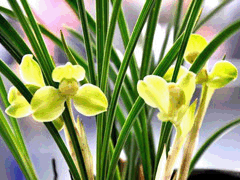 Cymbidium goeringiiAmong the selection criteria for flowers, the lotus-petal type is the most stringent. Old cultivars of lotus-petal type that have survived to the present day can be counted on one's fingers, which shows how rigorous the old method of selecting lotus-petal orchids was. Below I willCymbidium goeringiidiscuss the evaluation methods for selecting lotus-petal orchids, and share my understanding and experience of the old method from my years of studying orchids.
(1) Petals: The three outer petals should have constricted bases and flared angles. The attachment point of the three petals is noticeably narrowed, and from the middle-rear portion of the petal toward the petal tip it noticeably widens. Generally, the petal width reaches half the petal length or slightly more than half. From the middle of the petal toward the tip, the edge is tightly rolled, and at the very tip it suddenly narrows to form a pointed angle. Some lotus-petal orchids have an angle that is barely perceptible; if there is no obvious flared angle, it can be called a round petal. However, the tight edge of a lotus-petal is very different from the tight edge of a plum-petal. The tight edge of a lotus-petal is generally caused by thickening of the outer petal edge, which is quite different from the plum-petal.
(2) Sepals: Short and round sepals are superior. The attachment point of the sepals is also noticeably narrowed, widening at the middle, with a round head. The length-to-width ratio can also follow that of the outer petals. If the sepal edges are relatively tight, the sepals will be round and convex like a chime opening; if they resemble a clam shell, even better.
(3) Lip: A large, round lip is superior. A large round lip that curls slightly is the best; the Liu Hai lip is second. Symmetrical red dots are best. The lip base should be pure white, and the red dots should be vivid.
(4) Texture: Lotus-petalflower'spetal texture is extremely important. Thick and glutinous is superior. Petals with good fleshiness will open when lightly pinched and will crack when dropped on the ground.
(5) Scape: The flower scape of lotus-petal flowers is slightly thicker and shorter than that of other petal types, but if the plant is grown robustly and pre-flowering techniques are properly applied, the scape can still be drawn taller.
(6) Form: The open form should be round and upright. Generally, the three outer petals of a lotus-petal flower are arranged in equal divisions, but if the width of the side petals reaches grade, it can still open with level shoulders and look equally beautiful. The center should be round, upright and open, like a person's heart and mind. The best open form of a lotus-petal flower is like Cui Gai: the three outer petals arch and embrace into a circle, the center forms a circle, and the open form resembles a large sphere embracing and protecting a small sphere, which is truly beautiful.
(7) Staying power: With lotus-petal flowers, one cannot judge only by the initial open form. The flower must remain unchanged or change only slightly over a long period of blooming. If it becomes uglier the longer it opens, it shows that the flower's structure and stamina are poor.
(8) Color: In the old method of flower selection, pure green was considered superior, and muddy color inferior. In present-day selection, purity of color can be considered superior; pure green is precious, but other colors, as long as they are clean and vivid, are also top-grade.
(9) Type: Those with sufficient texture but slightly insufficient form can be called lotus-type, and are also acceptable.
(10) Shape: Those with sufficient form but slightly insufficient texture can be called lotus-shape, and are equally acceptable.
All of the above are my personal views, for reference only. Corrections and additions are welcome. Thank you.