Some Thoughts on the Selection and Use of Growing Media
Thoughts on Growing Media
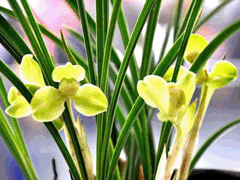 Nowadaysin orchid growing, every grower has his own tricks: some use "fairy soil," some use volcanic rock, some use mud. No matter what, they fall roughly into two major schools: the traditional soil method and the modern granular method. Which is actually better is sometimes enough to make one waver back and forth, unable to decide. What is the most suitable growing medium for oneself has actually become a puzzle for those who have reached a certain level in orchid cultivation. Let us savor the similarities and differences among various growing media. Because of environmental factors, such as the dryness of the climate, the different materials of the pots (here we also count the planting pots as part of theorchid'sexternal growing environment), and the different plants being grown (mature plants, wild-collected plants, re-exported seedlings), these determine the premise for choosing which growing medium. As everyone knows, plastic pots, porcelain pots, and fine dense purple-clay pots, because of their innate shortcomings in ventilation and air permeability, force us to choose granular media to avoid the distress of root rot and scorched tips. But with clay pots there is no such worry. However, because the appearance and beauty of various pots differ, some people find it hard to choose, so it depends on whether you want style or temperature. As for differences in plant quality, re-exported seedlings and wild-collected plants need a longer adaptation period in thecultivationenvironment, while the good permeability of granular media shortens their adaptation and optimization time in the growing medium to the minimum, so thatorchid plantsneed only deal with the tests from climate and geography. This makes people choose granular media without hesitation. For traditional old plants, this layer of consideration is saved. The above is spoken only from the perspective of pureorchidcultivation,while as for the relationship between growing medium and flower quality, this humble one believes that growing medium is the key factor determining flower quality, and this will be discussed later. As for considerations on how to choose growing media, the ancients had actually already seen the coexistence of granular media and orchid mud, and had analyzed the excellence of granular media. For example, Wang Wei of the Tang Dynasty recorded, "Raise it with beautiful stones, and after many years it becomes ever more flourishing," and Huang Tingjian of the Northern Song Dynasty argued, "Plant it with sand and stones and it thrives; water it with tea and it becomes fragrant." The "beautiful stones" and "sand and stones" here are part of what we now call "granular media." These two literary sages also already clarified the advantages of using granular media, namely "after many years it becomes ever more flourishing" and the plants "thrive." Is this not wonderfully similar to our present practice that granular materials such as fairy soil easily promote plant growth? When speaking of needing the flowers to be fragrant, one must "water it with tea," which conversely shows that with only granular growing media such as "sand and stones" and "beautiful stones" and without "tea" to water it, it is hard to make the flowers' "fragrance" satisfactory. Everyone knows that in ancient Chinese, "fragrance" mainly refers to scent. Today, orchid growers have replaced tea with modern chemical fertilizers, but because chemical fertilizers have a single nutrient composition, some people also use various organic humic substances to seek more comprehensive nutrients, with the sole aim of achieving the coexistence of thriving plants, beautiful flowers, and floral fragrance. But at the same time this brings another problem: mastering fertilizer concentration and timing has become tuition that some must pay in the process oforchid growing. It is hard to hear of anyone who has used fertilizer and never once overdosed. Although people constantly say to apply thin fertilizer frequently, a brief lapse in attention brings fertilizer damage that leaves one not knowing whether to laugh or cry, and one cannot even tell others, because as long as one is anorchid grower, even someone who started growing orchids only a few days ago knows this principle and will lecture you on what to do, which is truly a scratching-the-head problem of swallowing one's broken teeth. Thus, some mud granules containing humic substances appeared and became the primary choice of orchid growers. This kind of mud granule, no matter where it is obtained from (some say from hundreds of meters underground, some say from special strata), because it both satisfies the permeability requirements of orchid roots planted in fine pots and can maintain relatively comprehensive nutrients, is widely used for all kinds of orchids. And because of industrial production, the smooth and dense surface greatly reduces its moisture retention, and the embarrassment of water rushing straight out the bottom of the pot when watering makes the orchid grower's desire for the growing medium to be "moist" almost drop to zero. If soaked for a period of time, then not long after being potted, its granules turn into true mud again. Instead, this makes people lose their vigilance about air permeability for orchid roots. In fact, since it is a granular material made of mud, if it does not disintegrate after long soaking in water, there is no way to achieve this other than the physical method of firing and hardening or the chemical synthesis of adding coagulants. Then for this granular mud that remains stubbornly intact after long immersion in water, whether its organic components and nutrients still exist, and whether they can still act onorchids, becomes a question in people's minds. Therefore, to solve this problem, orchid growers add various other stone granules to the mud granules in order to seek balance on all sides. This achieves both good permeability so that more shoots can be produced, and relatively comprehensive nutrients for enjoying good flowers. Thus this kind of granule composed of multiple materials has become the most fashionable and effective means of growing orchids today. In this way, the growing medium granules for orchids have become larger and larger, and the choice of orchid types has extended to all Chinese orchids. Even some orchid growers in the Jiangsu-Zhejiang area, who have always prided themselves on traditional orchid growing, have abandoned the orchid mud used for hundreds of years for cultivating SpringCymbidiumflowersandswitched to granular growing media such as pond foundation stone, fairy soil, and volcanic rock. Granular media seem poised to unify the world. Then, are granular media wholly beneficial and without any harm? When planting orchids, besides being able to accelerate air flow, does the granules' ambiguous, non-intimate contact with orchid roots have any other effects (including side effects)? Or rather, does it lose much of the support that the growing medium should provide toorchid plants? Has the ancients' famous saying when planting orchids, "one root loose, one root empty," already become a retrospective of history? Now to speak of the charm of granular media. Indeed, for the pot adaptation of newly introducedorchid plants, and for the recovery of various weak diseased plants with inexplicable illnesses, granular media have their own unique excellence. In other words, for orchid enthusiasts who have not yet solved the life and growth of orchid plants, using granular media should be a wise and easy choice. At least it can help us escape the entanglement of the so-called "three years of skill in watering" in orchid growing and enable us to step easily into the new world of orchid growing that outsiders see as difficult and troublesome. Whenever you see the pot surface is dry, then just pick up the watering can and water. No need to worry, as long as there is water in your watering can. In this way, according to our pot material, according to our orchid type, according to the maturity of our orchid plants, after growing them contentedly for a few years, suddenly we will discover such a situation: after my orchid blooms, how is it that for the same kind of orchid, the petals are thinner than those grown by others, the color is more astringent, and the fragrance is lighter? Seeing orchids grown by others, with thick petals, round central petals, verdant color about to drip, that glutinous smoothness, that spirit, that vitality, looking exactly like a lively chubby baby. One cannot help but feel envy. And those introduced re-exported plants, after being grown for several years, still do not change their foreign traces; "small flowers, dark color, little fragrance" remains as before. Congratulations, if you have discovered this, then your level of orchid growing has been raised again. Because you can already clearly recognize that the same kind of flower has differences in flower quality. That is, you can understand why for the same 'Song Mei,' some people can grow it to open as a lotus-form narcissus petal, some can grow it to open as a true plum petal, and some can grow it to open as a plum-form narcissus. You understand why for the same 'Long Zi,' some people grow it with both shoulders slanting and collapsing, its head like a landlord overthrown during land reform, drooping listlessly, while others grow it with head held high and chest out, full of spirit, like a stirred-up youth. Let us first set aside other factors affecting flower quality and talk about the influence of growing medium on flower quality. Because we have long been accustomed to the convenience of picking up the watering can and watering the highly permeable granular media, we have neglected their innate defect: most granular media lack some trace elements essential to orchids. We only know that plants grow too weakly because of nitrogen deficiency; that they easily get sick and need potassium; that they only grow leaves and do not bloom because there is no phosphate fertilizer, so we quickly give more sun and control water more. What we do is not wrong, and it is also the most basic. But it has little effect on flower quality. The level of flower quality mainly depends on your balanced intake of trace elements. And these are very difficult to obtain through fertilization. Everyone knows that plant growth requires the presence and interaction of various elements, but as for orchids, exactly which elements' involvement can enhance color and fragrance and obtain some of that glutinous smoothness that can only be intuitively understood? Even if one knows a certain effect of a certain component, what about its dosage and its combined effects with other elements? For example: iron, manganese, copper, zinc, chlorine, molybdenum, boron, and other elements. Some people may know their individual effects, but what would it be like when combined with other elements? If one knows that one of these elements is lacking, do you know how much to supplement? All of this makes it something that ordinary orchid growers can only think about and, when discussed, can only be pure armchair strategy; truly applying it in orchid growing practice leaves one completely helpless. Then, those who can grow orchidflowersthat delight the eye and gladden the heart, could they have some enormous ability?! No, no. There is no secret. Let us part the emerald cloud grass or pebbles covering the pot surface, lift that layer of covering, and look at what their growing medium is. Ah, it is exactly the orchid mud that has been used for hundreds of years. That kind of humus soil found everywhere in orchids' native habitats, aside from being sifted so that soil as fine as powder returns to nature or adding coarse granules to orchid mud to increase permeability, has almost still been repeating the same topic for hundreds of years: "I am the best at growing orchids!" Indeed, that is right. Orchid mud exists for orchids. It is just that the modern pace, the desire to save trouble, and the ease of promotion and acquisition have made people forget it. Yet people in orchid-producing areas have always regarded it as the first choice because it is convenient to obtain and low in cost. I have always had a wish, which is to hope that someone can make a comprehensive analysis of these orchid muds: exactly how many inorganic elements they are composed of, and what organic components exist. Why is it that using it to grow orchids makes orchid fungi easy to multiply? Although we must thank those who strive for the orchid cause and create one after another thing beneficial to orchids for us to enjoy, and orchid enthusiasts in Taiwan even invented an active soil that can produce orchid fungi in three or four days, compared with the growing media that nature has given us, born for orchids, these additives, each fighting its own battle, must lower their noble heads. The heaviness of the petals, the fresh verdure of the color, and the pure richness of the fragrance make us face the predicament of reconsidering the growing medium we use most often and most easily overlook, and also force orchid growers who pursue flower quality to rekindle old feelings for orchid mud. Since it cannot be clearly explained how much role growing medium actually plays in flower quality apart from other cultivation techniques, but in practice orchids grown in orchid mud are obviously more likely than those in other growing media to achieve a higher level of flower quality, then what reason do we still have not to choose the orchid mud that orchid growers have been using for hundreds of years? Of course, you must first master the use of that growing medium.