A Detailed Guide to the Methods and Key Points of Appreciating Cymbidium kanran Petal Types
Appreciation of Cymbidium kanran Petal Types
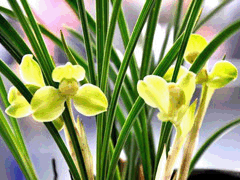 Lihé The traditional petal-type theory was established on the basis of long-term observation ofCymbidiumflower forms. For the flower forms of other Chinese cymbidium species, apart from some differences in flower diameter compared withCymbidium goeringii, there is not much difference in their sepals, petals and lips, so the petal-type standards for judgingCymbidium goeringiiplum, lotus and immortal types can be fully used for appreciation. However, when we observeCymbidium kanran, we all find that:Cymbidium kanran's proportions among sepals, petals and lip are vastly different from those ofCymbidium goeringiiand other Chinese cymbidium species.Cymbidium kanran's sepals are much longer than its petals, generally 2 to 3 times the length of the petals; moreover, the length-to-width ratio of the sepals themselves is even more different from that of Cymbidium goeringii and other Chinese cymbidiums, with their length being more than 10 times their width. For example, if a sepal is 0.4 to 0.8 cm wide, its length is often more than 4 to 9 cm, so Cymbidium kanran's sepals are commonly called "chicken-claw-shaped" petals. At the same time, Cymbidium kanran's lip, compared with its petals, is mostly longer, wider and larger, unlike other Chinese cymbidium varieties, whose lip is basically similar in size to the petals, or even slightly smaller. In view of this characteristic of Cymbidium kanran's flower form, if we use the traditional petal-type standards for judging Cymbidium goeringii's plum, lotus and immortal types for appreciation, it would probably be rather far-fetched. Therefore, I believe it is necessary, when appreciating Cymbidium kanran's petal types, to build Cymbidium kanran's own view of petal types on the basis of borrowing the Cymbidium goeringii petal-type theory and according to the unique characteristics ofCymbidiumflower form, so as to be more in line with the reality of Cymbidium kanran's flower form in the process of aesthetic appreciation.
How should Cymbidium kanran's view of petal types be established? The creation of any theory comes from practical experience, and the establishment of the Cymbidium kanran petal-type theory is of course no exception.
First, let us look at the various names people have given in the process of appreciating Cymbidium kanran flower forms, combining them with the various flower forms of Cymbidium kanran,
such as: "Startled Magpie on Another Branch", "Divine Bird", "Dance of the Colored Ribbon", "White Spider", "Jade Swallow", "Swan", "Broidered Bird", "Yellow Bird", "Blue Bird", "White Bird", "Green Parrot", "Yellow Crane", "Returning Wild Goose", "Purple Swallow", "Dancing Immortal", "Dance of the Crane" and so on. It is not hard to see that most of the above names are related to the postures of flying birds, which is obviously because the vast majority of Cymbidium kanran's sepals are especially narrow and long and display various twisted shapes, and because the lip is also especially long, wide and large.
Second, let us look at the awkward situation in which quite a few Cymbidium kanran flowers have been named using the petal-type standards of Cymbidium goeringii's plum, lotus and immortal types. For example, "Green Water Immortal" (see picture 214 in Xu Dongsheng's *Chinese OrchidCultivationand Appreciation*): its petal type has a slight pocket, but the three sepals are completely just three bamboo leaves. Another example is "Cymbidium kanran Plum" and "Cymbidium kanran Green Flower Plum" (see Liu Qingyong's *Illustrated Dictionary of Famous and Precious Chinese Orchid Varieties*, p190, p200): the reason for their naming is none other than that the column has a hard pocket and the petals have a pocket and become thickened and fleshy, and thus they look quite awkward. Another example is "Small Colored Lotus" on p151 and "Cymbidium kanran Lotus Form" on p152 in Peng Changrong's *New and Rare Orchid Varieties*: although both also show a slight "lotus posture", if measured by the lotus-type petal standard of Cymbidium goeringii, they seem very far-fetched, because the width-to-length ratio of their sepals is above 1:3.5, with not the slightest bit of lotus shape. From the above examples it can be seen that, as far as the currently observed flower forms of Cymbidium kanran are concerned, using the Cymbidium goeringii petal-type theory to define Cymbidium kanran's petal types is inadvisable.
Third, let us look at a special example: the "New Cymbidium kanran Variety" published on p152 of Peng Changrong's *New and Rare Orchid Varieties*. Its introductory text says that this flower has "sepals with tightly held edges and pockets, edged with crystal (crystal rims), the main petal folded forward like a crane (head), the crystal edge especially obvious, and the lip also pocketed." In the third issue of *Chinese Orchid* in 2004, Li Kaineng proposed that this type of flower be designated as "crane-type petal" flower. After carefully observing the picture, I found that the recommended flower indeed has a form quite similar to a crane's head, especially when viewed from the front, and therefore I completely agree with designating this type of flower as a "crane-type petal" flower.
In summary, I believe that according to the characteristics of Cymbidium kanran's flower form, the petal types ofCymbidium kanranflowers can be named after the forms of birds and insects, without having to rigidly apply the plum, lotus and immortal petal-type theory of Cymbidium goeringii, thereby establishing Cymbidium kanran's own petal-type theory. Besides the "crane-type petal" mentioned above, we can also cite some examples to support this. For example, the "Forked-petal Strange Flower" on p150 of Peng Changrong's *New and Rare Orchid Varieties*: its flower looks exactly like a gliding swallow; could this type of flower form be named "swallow-type petal"? And the "European Cymbidium kanran Rongdie" on p144 of the same book is completely a flower spider baring its fangs and brandishing its claws. And the "Hooked-petal Yellow-flowered Cymbidium kanran" and "Hooked-petal White-flowered Cymbidium kanran" on p195 of Liu Qingyong's *Illustrated Dictionary of Famous Chinese Orchid Varieties*: because the lateral sepals of the twoflowersboth encircle and hook inward, greatly resembling the posture of a shrimp or crab waving its large claws, they could perhaps be named "shrimp-type petal" or "crab-type petal". Excerpted from *Orchid Treasure Canon*