What Types of Orchids Are There? An Introduction to Common Varieties
What types of orchids are there
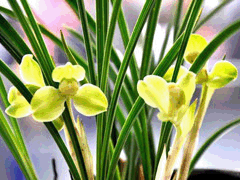 Cymbidium goeringii Also known as caolan, shanlan and duoxiang, or simply lan.
Cymbidium goeringii is the most widely distributed and most resource-rich of the Chinese orchids,cultivationwith a long history, and the most extensively selected and bred for horticulturalcultivationof all orchidorchids. It is small in size, with relatively narrow, thin, ribbon-shaped leaves, generally about 20-35 cm long and about 0.5-1 cm wide, with clearly serrated leaf margins. It has bulbous pseudobulbs, and relatively thin fleshy roots about 0.4 cm in diameter. The flowering period lasts about one month (mid-February to mid-March). The flower stalk is upright, about 6-25 cm tall, and bears 1 flower; the ancients called one stem with one flower a lan. The few that bear twoflowersare called bingdi lan, meaning auspicious. Although the plant of Cymbidium goeringii is small, its flowers are relatively large, generally 4-6 cm across when fully open, with a maximum diameter of up to 8 cm. The flower color is usually mainly green and yellow-green, with purplish-red stripes or spots on the petals, and some are green with a purplish-red tint showing through. Most Cymbidium goeringii are fragrant, a scent people call youxiang. There are many varieties. Because Cymbidium goeringii has different characteristics depending on its place of origin, it can be divided into major groups such as Jiangsu-Zhejiang Cymbidium goeringii, Henan Cymbidium goeringii, Hubei Cymbidium goeringii, Yunnan-Guizhou-Sichuan inland Cymbidium goeringii, and southern Cymbidium goeringii.
Huihua is also known as jiuhua lan, jiujie lan and jiuzi lan. The ancients called one stem with nine flowers hui, and also called it huihua rather thanCymbidium faberi。
Huihua plants are generally taller, with leaves longer, broader and larger than those of Cymbidium goeringii, and the leaf surface is rough. There are 5-13 leaves, about 35-80 cm long and 0.5-1.5 cm wide, with thick, numerous and obvious veins and obvious, relatively coarse serrations along the leaf margins. The pseudobulbs of Cymbidium faberi are not obvious, and the roots are thick and long, with branches. The flowering period is between April and May. The flower stalk is thick and long, upright, 1 cm in diameter in thick ones and as thin as incense sticks in thin ones, tall and erect, reaching level with or rising above the leaves, generally about 35-80 cm tall. It bears 5-10 or more flowers. The flowers are about 3.5-8 cm across when fully open. The flower color is similar to that of Cymbidium goeringii, but the bud sheaths have more colors than those of Cymbidium goeringii, and the lip is well developed, with green velvety moss on the lip adorned with many purplish-red dots and patches, mostly purplish-red. At the base of each flower's small stalk there is a lan gao, sweet and mellow in taste, and when the flowers open the fragrance is youxiang. Huihua is relatively widely distributed, and is also found north of the Qinling Mountains. It is relatively cold-tolerant, drought-tolerant and sun-loving. Huihua from different places differs slightly in leaf shape and flower quality, and by place of origin it is divided into Jiangsu-Zhejiang huihua, western Anhui and Hubei huihua, Yunnan-Guizhou-Sichuan inland huihua, and southern huihua. The original habitat of huihua is at relatively high altitude, so introducing it is relatively difficult. Its variability is relatively great.
Cymbidium kanran Cymbidium kanranis similar toCymbidium ensifolium, but its leaves are narrower, especially at the base.Cymbidium kanranis being cultivated more and more in our country, and there are quite a few varieties. The leaves grow in clumps of 3-7, strongly upright, 35-70 cm long and 1-1.7 (2.5) cm wide, entire or sometimes with fine teeth near the tip, and slightly glossy. The flower scape is upright, level with or taller than the leaf surface, with sparsely arranged flowers, more than 10 per scape. The sepals are about 4 cm long and 0.4-0.7 cm wide; the petals are short and broad, with a purplish-red midvein; the lip is not obviously 3-lobed, yellow-green with markings; there are 2 parallel lamellae, yellow and hairless. It is fragrant.
The flowering period varies by region; flowers begin to open from July onward, but are generally concentrated from November to January of the following year. It is distributed in Fujian, Zhejiang, Jiangxi, Hunan, Guangdong, Guangxi, Yunnan and other places. It is also widely distributed in Japan.
Four SeasonsOrchidUsually called Cymbidium ensifolium. Also known as xia lan, qiu lan and junhe lan.
The pseudobulb of Cymbidium ensifolium is smaller than that ofCymbidium sinense, oval in shape. The leaves grow in clumps, with -6 leaves per clump, and the leaf posture is mostly upright or semi-upright, with a few varieties slightly drooping in a semi-arched form. Cymbidium ensifolium leaves are about 1 cm wide and 40-60 cm long, sword-shaped and glossy. The flowering period runs from June until Cold Dew, during which it can bloom many times. It is richly fragrant, with relatively broad petals shaped like bamboo leaves, and an upright flower stalk that is often lower than the leaf surface. It bears many flowers; the stalk and petals are mostly pale yellow, and the lip has dark purplish-red dots and patches. The flowers are delicately fragrant. It grows vigorously and is highly adaptable.
Cymbidium ensifolium has a relatively wide range of origin, found in mountain forests south of 30 degrees north latitude in our country, generally growing in groups in mixed forests at 300-400 m altitude. Because of its wide range of origin and long history of cultivation, Cymbidium ensifolium from different places varies in plant form. Some people divide it into many series, such as: Junhe series, Yuzhen series, Xionglan series, Cilan series, Yuzhen series, and Suxin series.
Cymbidium sinense is also known as baosui lan, baisui lan and fengsui lan.
The leaves of Cymbidium sinense are large and bright, generally 2-4.2 cm wide and about 25-80 cm long. 2-5 leaves grow on the pseudobulb, sword-shaped, with the upper half spreading outward. The pseudobulb is relatively large, oval, 1.5-2.5 cm in diameter. The roots are thick and long. The leaves are glossy, with no serrations along the margins. The flower stalk is upright and rises above the leaves. It is a raceme bearing 5-20 or more flowers, with small buds and nectaries at the base. The flowers are about 2.5-5 cm across when fully open. The sepals and petals are usually narrowly lanceolate, and the lip hangs down and curls back. The flower color is mostly pale purplish-brown, marked with dark purplish-brown stripes. The flowering period runs from late autumn to March of the following year, with a sweet fragrance. Cymbidium sinense grows in Fujian, Guangdong, Guangxi, Taiwan, China, Jiangxi, Yunnan, Hainan, Sichuan and southern Guizhou, south of 26 degrees north latitude in our country. Cymbidium sinense from different places has its own characteristics, and by these characteristics it can be divided into Taiwan, China Cymbidium sinense, Daming series Cymbidium sinense, Guangdong Cymbidium sinense, Yunnan Cymbidium sinense, Jiangxi Cymbidium sinense and so on. Cymbidium sinense has a long history of cultivation in our country, and there are also many varieties.
LianbanOrchid, also known as xiaoxue lan, has native species only in western Yunnan and the high mountain areas of Taiwan, China.LianbanOrchid leaves are narrow and thin, 50-80 cm long and 05.-1.2 cm wide.LianbanOrchid leaves each have a lateral vein on either side of the midvein; the lateral veins are bright, and the edges of the lateral veins are dark green. Between the lateral veins and the midvein, and between the lateral veins and the leaf margin, there are also two secondary lateral veins, but these are not visible to the naked eye. Lianban orchid leaves are moist and glossy. The leaf texture is fine and delicate, rich in elasticity, the sheath tightly clasps the leaf base, and the plant form is compact. One scape bears 2-5 flowers, and the flowering period is January to March. It is delicately fragrant, and the flower colors are bright and fresh, commonly lotus-root color, pink, white, red and so on.
Chunjian is mainly produced in Sichuan and Guizhou. Chunjian plants are tall, with leaves growing in clumps, 5-10 leaves, 1-2.2 cm wide and 40-100 cm long, sword-shaped, with rough margins and fine teeth, gradually pointed at the tip, with an obvious midvein, strongly upright, and a leaf texture similar to that of Cymbidium goeringii. Its flowering period is also the same as that of Cymbidium goeringii. The flower stalk is upright, 20-35 cm tall, and one stalk bears 2-5 flowers. The flowers are 4-8 cm in diameter, with rich and varied colors, and have a fairly good delicate fragrance.