How should variety identification be done? Keep these three key points in mind
Variety identification requires the "three looks"
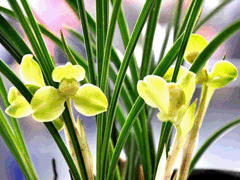 Variety identification is the appraisal oforchids' overall qualities, and it is the branch of learning that best demonstrates the skill of orchid cultivation. Therefore, orchid masters of every generation have been especially cautious about this, never jumping to conclusions, and always adhering to the "three looks" principle.
First, look at leaf shape
"View the flowers for a time, admire the leaves all year round." In the flowerless season, the main basis for identifying famous orchid varieties is looking at leaf shape, including leaf buds, plant form, and so on. Most traditional famous orchid varieties are relatively stable, and their leaf shapes also follow certain patterns. Through long practice, orchid growers can generally identify by eye alone which variety a plant is when its leaf shape features are obvious, such as the upright-leaf Wang Zi, Tai Su, and Lao Jipin, and the ring-drooping-leaf Song Mei, Da Yipin, and so on. However, because orchids are grown in different environments, their leaves are not the same year after year, so orchid growers often also need to look at the flower buds together with the leaves to identify the variety.
Second, look at flower buds
Traditional famous orchid varieties not only have their own leaf shape characteristics, but their flower buds are also distinctive. Therefore, when identifying them, people must look at both leaf shape and flower buds. Regarding the identification of flower buds, predecessors summarized the "nine shapes and eight forms" of cymbidium head shapes and the "five gates and eight forms" of cymbidium small bud clusters. These valuable experiences are of great benefit to us in identifying varieties and are worth thoroughly digesting and absorbing. All things develop and change. In the practice of orchid cultivation, people have found that even for the same pot of orchids, the color of the flower buds sometimes differs in different years, and even within the same year. I have experienced this myself. After many years of observation, Icultivatethe famous orchid cymbidiums such as Dafugui and Yuan Zi, and their flower buds sometimes differ in different years; in some years the flower buds are darker in color, and in other years lighter. According to Mr. Chen Yaoming of Wuxi, the Ji Yuan he grows and keeps sometimes sends up scapes that are "deep crimson red," and sometimes sends up scapes that are "purple seen within green." One year, a large pot of his Ji Yuan put up five scapes: three were red, and two were purple seen within green. It can be seen that judging varieties purely from the color and shape of flower buds has its limitations, and one must also look at how they bloom.
Third, look at the bloom
The most direct and effective way to identify cymbidium varieties is to look at their bloom, and this is also the main reason why introduced varieties should be introduced when in flower. Generally speaking, as long as the bloom is up to standard, one can identify which variety it is once it flowers. But everything has its particularity, and the same cymbidium variety often produces different blooms depending on the growing method. For example, Song Mei can produce four or five flower forms, and Lu Yun and Xi Shen can also produce several different flower forms, but we cannot conclude that they are different varieties just because their blooms differ. Hence the orchid master Wu Enyuan said: "Because growing methods vary in quality, blooms vary in quality." This is exactly the principle being stated.
Variety identification is true learning. The identification of orchid varieties should be viewed dialectically and comprehensively; one should not let a single leaf block the view and miss Mount Tai, nor jump to conclusions. The correct method should be to look at leaf shape, look at flower buds, and look at the bloom.