Appreciation of flower forms: experiencing the unique beauty of different flower forms
Flower form appreciation
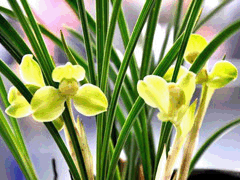 (1) Plum petal: The three outer petals are short and round, thick in texture and symmetrical. The shape resembles a plum blossom, the inner petals form a hood, have a white tip and clasp tightly, and the lip is spread out, firm and not rolled back. Song Mei is the typical example of the plum petal.
(2) Lotus petal: The three outer petals are plump and thick, broad and smooth, shaped like lotus petals, with a contracted base and flared corners. The inner petals do not form a hood and resemble a slightly open mussel shell, and the lip is broad and large, either thrust forward or rolled back. The flower forms are divided into large, medium and small types; Tong He and others belong to the large lotus petal flowers, Huanqiu Hedding belongs to the medium lotus petal flowers, and Gai He belongs to the small lotus petal flowers. Tong He and Gai He are the typical examples of the lotus petal.
(3) Narcissus petal: The three outer petals are longer than those of the plum petal, and the petal tips are slightly pointed; the inner petals have a deep or light hood, and the lip hangs down or rolls back, with Wang Zi Yi Pin as the representative.
The variants of the narcissus petal include plum-type narcissus and lotus-type narcissus.
The characteristics of the plum-type narcissus are: the three outer petals are slightly longer than those of the plum petal, and the main and secondary petals have a tight base, with the main petal being especially obvious. The inner petals form a hood or a slight hood. Xi Shen, Cui Wen and others are plum-type narcissus.
The characteristics of the lotus-type narcissus are: the three outer petals are broader and resemble lotus petals, and the inner petals form a hood or a slight hood. Long Zi and Narcissus Da Fu Gui are lotus-type narcissus.
(4) Strange petals: Any form in which the lower part of the outer secondary petals and the inner petals have transformed into the shape of a lip, or in which the petals are multiple or missing, or in which there are multiple lips, is called a strange petal:
1. Butterfly petal
Divided into two types: outer butterfly and inner butterfly.
When the lower half of the secondary petals has become lip-like, it is called outer butterfly. When the lip transformation extends deep into 1/2 of the secondary petals, it is called full butterfly. A full butterfly with both secondary petals rolled backward is called flying butterfly, and it is an excellent variety among butterfly petals, such as Wu Cai Hu Die and Xiao Hu Die. When the lower part of the secondary petals shows narrow or intermittent lip transformation, it is called half butterfly; when the three outer petals and the inner petals are narrow and long in a half butterfly, it is called grass butterfly. Half butterflies and grass butterflies are not very ornamental and are rarely kept for propagation.
A strange petal in which both inner petals have become lip-like is called inner butterfly, also known as rui die. Historically, rui die were not valued, and therefore fewer were kept for propagation. Recently, China has paid more attention to the discovery of rui die varieties, and therefore a large number of rui die have been found, especially in the Zhoushan area in recent years. From the ornamental point of view, outer butterfly should rank above inner butterfly.
2. Multiple petals
When the number of petals (including the lip) exceeds six, reaching seven petals, eight petals or even several dozen petals, they are collectively called multiple petals. For example, Lu Yun, Yu Hu Die and others; the number of petals of this type varies from year to year, and there is no fixed flower form. However, the outer petal type remains unchanged, for example Lu Yun is lotus-type and Yu Hu Die is bamboo-leaf type. Most new multiple-petal flowers are unstable and very easily change form, and therefore, apart from old multiple-petal varieties, new varieties are generally rarely kept. In recent years, chrysanthemum-petal multiple-petal types and peony-type multiple-petal types such as Qiandao Zhi Hua and Duo Duo Die have been found, with petals growing upward layer by layer like a chrysanthemum, and with more petals than traditional multiple-petal flowers. Such flowers have attracted the attention of orchid enthusiasts at home and abroad.
3. Multiple lips
When the three outer petals and the inner petals are complete in number and there are two or more lips, it is called multiple lips or multiple tongues. Because such flowers are unstable and also irregular and ungraceful in form, they are rarely kept for propagation.