Plum Blossom Appreciation Series: Random Notes from the Orchid Wind Hall, Part One
Random Notes from the Orchid Wind Hall: Appreciating Plum Blossom Orchids (1)
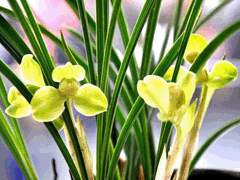 Song Mei. Appraising flowers is difficult; appraising plum blossom orchids is even more so. Whether the many variations in the pairing of petals, sepals, and tongue have an inevitability to them, I do not know; but beyond that there must also be coincidence, and so I dare not make rash judgments. Of the old varieties that have come down to us today, there are nearly fifty plum blossom types. Dense lotus-form structure and loose plum-form structure are the old standards. How to appraise plum blossom orchids, I can only venture to attempt.
(1) Petals: A petal resembling plum blossom is only round, not elongated - this is the first point; the petal must have tightly rolled edges and not splay outward - this is the second point; the petal must be of glutinous texture with a white rim or tip - this is the third point; the petal must taper to a narrow base or form a rounded base - this is the fourth point; the petal must have a round tip and not spread into corners - this is the fifth point. The difficulty of judging and grading plum-form petals, though none of the elders have stated it outright, becomes deeply felt when one looks at the registers and the flowers.
(2) Sepals: Among plum-form orchids, soft and glutinous sepals are supreme; soft pocket-shaped silkworm-moth sepals are supreme; Guanyin pocket sepals and semi-hard silkworm-moth sepals also belong to the fine grade. But if the sepal petals are too hard, they easily stick together and cannot open into the form of five distinct petals in separate compartments, and so are graded inferior or poor.
(3) Tongue: For plum-form orchids, the tongue paired with the sepals should ideally be the Liu Hai tongue; the small round tongue and the ruyi tongue also belong to the fine grade. But no tongue shape may hang down or curl backward. There are those with hard sepals paired with a small tongue, but because the tongue easily hangs down or the sepals and tongue all stick together, they can only be graded inferior or poor.
(4) Texture: The texture of plum-form orchids must be glutinous and moist, with good fleshy quality. But generally the outer petal edges of plum-form flowers are thinned and have a white rim; as long as the edge is tightly rolled, it is a top-grade flower. The sepals must also be glutinous in texture, and the sepal tips must be round, neat, and smooth; whether white or colored only affects the grade.
(5) Flower stalk: The flower stalks of plum-form orchids must all be slender, straight, and upright; thick and short stalks are of inferior grade.
(6) Bearing: The blooming quality of plum-form orchids should be judged by the whole flower. The old standard says that when the main petal slightly covers and overlaps it is called "deficient," and when the main petal lifts its head it is called "proud"; in truth this is merely judging flowers by human character. A flower is always best when its face is large and well-proportioned - what does it matter if a flower has a little pride? But if the three petals splay and stumble, or the center compartment sticks together, then it is beyond the pale.
(7) Holding: A good plum-form flower does not easily change when open for a long time. If after being open for a few days the outer petals elongate and the sepals lift while the tongue hangs down, this is a very poor hold.
(8) Color: The color of plum-form orchids is always best when clear and glutinous; muddy color is inferior. Clear green is top grade; for other colors, as long as they are clear and vivid they are also top grade. But fine varieties are hard to find nowadays, and color is not the first or second criterion in selecting flowers; only when comparing color among the same flower does one judge superior from inferior.
The above is purely my personal view, for reference only. Corrections and additions are welcome. Thank you.