Why is Daxuesu hailed as the foremost of Yunnan's four traditional famous orchids?
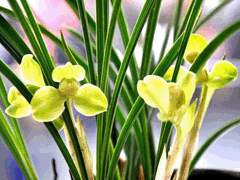 Daxuesu Daxuesu
Daxuesu is one of the most representative outstanding varieties among Yunnan's cultivated orchids, ranked first among Yunnan's "four traditional famous orchids" (the other three being Xiaoxuesu, Zhushalan, and Tonghai Jianlan), with over a thousand years ofcultivationhistory. The "Nan Zhong You Fang Lu," an important work in the history of Yunnan orchid development written during the Ming Dynasty, records: Daxuesu "blooms in the first month of the lunar year, two to three chi in height, with leaves curving in the middle; those that remain unbroken when bent are considered superior; the scape is taller than the flowers; the flowering period runs from the twelfth lunar month to the twentieth day of the first lunar month; it fears frost; mostly three flowers, sometimes five; the Duan family of Menghua Prefecture and officials and commoners alike mostly grow this flower; when spring comes they place it in the reception hall, and the more pots the better, with dozens of pots placed under the eaves of the central hall to show off their abundance..."
Daxuesu leaves are about 40-80 cm long, about 1-1.5 cm wide, with about 5-8 leaves per plant; the leaf color is emerald green with fine serrations along the edges, prominent veins, and the upper-middle portion of the leaf surface lying flat; the pseudobulb is relatively large, with some plants even as big as a garlic bulb; young shoots are white-green, with tiny red dots at the leaf tips when first emerging from the soil; the leaf sheaths are blue-green, rather flamboyant, and the healthier and more robust the plant, the taller, wider, and more outward-spreading the leaf sheaths become, extremely imposing and displaying boundless vitality; some plants (such as the Weishan type) have arc-shaped leaves in a phoenix-tail form, elegant and graceful; other plants (such as the Shigu type) are mighty and tall, robust and grand.
Daxuesu blooms around the Spring Festival, with flowers rising above the leaves; each scape bears 3-7 flowers, mostly bamboo-leaf petals, with a soaring posture; the flower diameter is large, reaching about 6-7 cm; the petals are white with light green, marked with pale green veins; the column tip is slightly yellow; the lip is recurved, generally bearing water-stain marks of varying intensity, with some plants showing a faint peach blush; the fragrance is delicate, clear and pleasant, refreshing to the heart; the flowering period lasts over a month.
Daxuesu originated in Dali Prefecture, Lijiang City and other places in western Yunnan; its main domestication sites are Weishan County and Heqing County in Dali Prefecture, Dali City, Lijiang City and other places; it is now widely cultivated throughout the province (mostly in Heqing, Dali, Weishan, Lijiang, Kunming, Yuxi and other places), and has also been introduced to Guangdong, Zhejiang, Jiangsu, Anhui, Shandong, Hebei, the three northeastern provinces, and has spread to some overseas countries and regions.
Daxuesu, also abbreviated as Dasu, is otherwise known as Kuanye Suxin, Da Suxin, Da Suxin, Fengwei Su, Yuandan Lan (among which some orchid growers further distinguish between Da Yuandan and Xiao Yuandan), etc. Based on plant height, leaf width, leaf length, flower size, the intensity of the water-stain mark on the lip, and the verticality of leaf posture, it is divided into the Dali Weishan type, the Lijiang Shigu type, the Heqing Hualong type (Hualong being a village in Heqing County) and five or six other types.
Another classification method used by some orchid growers in previous years divided it into three types based on different plants and scape heights: tall-scape, medium-scape, and short-scape; however, people now believe that the height of the plant and scape generally results from differences in cultivation environment, planting and management conditions, so this classification method is no longer popular.
Yet another classification method, within a relatively small area of Heqing, locally divides Daxuesu into Hualongsu and Caiyuansu based on differences in leaf shape. (See "Two Topics on Famous Flowers of Heqing," published in Yunnan CPPCC Daily, author Liang Bo.)
Whether Daxuesu is a single variety or a series of multiple varieties remains a matter of differing opinions in Yunnan's orchid circles. Some orchid growers believe that Daxuesu is simply one single variety, and that differences in leaf width, plant height, flower color and the intensity of the water-stain mark, pseudobulb size, etc. are merely differences caused by cultivation environment, management methods, and growing media.
But some orchid growers (including the author and some friends around him) believe that the above external factors can hardly cause such differences, and that the five or six or even more somewhat different Daxuesu plants currently spoken of among enthusiasts should be several broad-leaf suxinlianbanorchids with roughly similar traits; that is to say: Daxuesu is domesticated from several different broad-leaf suxinlianbanorchid original species, and after more than a thousand years of domesticated cultivation, they have all become horticultural cultivars with fixed traits.
The author introduced Daxuesu as early as 1993, and has collected and grown five somewhat different Daxuesu plants. After many years of cultivation and careful observation, the author finds it difficult to conclude that they share the same "ancestor."
But none of the above has affected the spread and promotion of the Daxuesu brand, nor will it cause confusion in the recognition of this variety -- because any one of these plants is outstanding, and these plants are highly consistent with the most basic traits of the Daxuesu variety; that is to say, among them "similarity" is the mainstream and "difference" is the tributary; even where there is "difference," the "different" traits are not inferior, and can also meet the needs of different aesthetic preferences.
Daxuesu is highly domesticated and easy to grow; its roots are plump and thick, and the relatively large pseudobulb can store more nutrients; it prefers a quiet, well-ventilated, well-drained growing environment, and has considerable adaptability to temperature and humidity. For example, over the years the author has, at the request of orchid friends outside the province, mailed it to the northeast, Zhejiang, Guangdong, Guangxi, Shandong, Anhui, Jiangsu and other provinces and regions, and feedback by letter or phone indicated that it can adapt to local environments and grow, send up shoots, and bloom normally; especially now that granular media are mostly used for cultivation, adopting a semi-natural growing environment makes it even more effortless, worry-free, and safe.
Like other lianban orchids, Daxuesu has the characteristic of sending up shoots twice a year, in spring and autumn; if grown in a greenhouse, there is no obvious seasonality to shoot production, and it can send up shoots year-round; if cultivated properly, the shoot production rate can reach over one hundred percent, with some reaching two or three hundred percent.
Because of its outstanding traits, Daxuesu is widely loved and has a high degree of marketization; for a considerable period it was a relatively safe and secure investment variety, so in the late twentieth century and around 2001 and 2002 in this century, there was even a saying that "if you want to get rich, grow Daxuesu," and it was the bellwether and barometer of the Yunnan orchid market, with prices at their peak reaching over ten thousand yuan per seedling. At that time Daxuesu was easy to convert to cash and could almost always be sold on the market at any time, with only the price varying; its price fluctuations were also relatively small, generally with few dramatic rises and falls. Now the price of Daxuesu is already relatively low, generally several hundred yuan per seedling, and buyers are mostly ornamental growers; moreover, orchid growers outside the province have introduced it more than before (in the past year or two the author has frequently mailed it out of the province at the request of orchid growers outside the province), making it one of the most traded varieties in the Yunnan orchid market.
Daxuesu won a gold award in 1987 at the 12thOrchidExposition in Tokyo, Japan, and to this day it continues to win various honors at orchid shows at all levels and of all kinds in China, making it an outstanding variety worth treasuring and enjoying.