The orchid brings together floral fragrance, historical fragrance and cultural fragrance in one.
Orchids: floral fragrance, historical fragrance, cultural fragrance
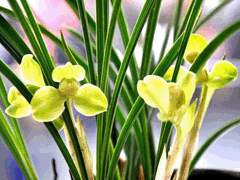 However you put it,the orchid, within the entire ever-growing floral clan, including its lines, collateral lines, cousins, distant cousins, distant relatives, sworn relatives, hereditary relatives, third-degree kin, six-degree kin and ninth-degree kin,the orchidis merely a frail woman in this extremely vast clan. Just as Lin Daiyu is merely a lowly, frail woman among the noble clan of more than 400 characters in the whole of "Dream of the Red Chamber."Does the orchidhave the boldness and passion of the fiery red kapok (hero tree, panzhihua)? Does the orchid have the fragrance that fills the fields like the osmanthus tree or the Aglaia odorata (Meliaceae plant)? Does the orchid have the colorful splendor of bougainvillea, azalea or rose? None of these. However you put it, the orchid is merely a frail woman in the entire vast floral clan. Just as Lin Daiyu is merely a frail woman in the vast noble clan lineage of the Rongguo and Ningguo mansions. Yet it is precisely this frail woman who became an artistic archetype famous through the ages; the fragrance and charm of a single "Song of Burying Flowers" drew tears from countless lovers. The orchid, however, stands out among the many flowers by virtue of the rich fragrance and outstanding temperament of its floral fragrance, historical fragrance and cultural fragrance.
As for the orchid'sfloralfragrance, it is not merely a fragrance sensed by ordinary smell; it is a mood, a character, a realm. Marshal Zhu De, who spent most of his life in military campaigns and loved orchids all his life, wrote a poem that offers a plain and accurate praise of orchid fragrance. The poem goes:
In Yuexiu Park's woods of flowers and trees,
a hundred flowers bloom together, each vying for spring.
Only the orchid's fragrance is just right,
for a time its fame ran through the Five Rams City.
The phrase "the fragrance is just right" here is not only that orchid fragrance is the purest and best, but also that the quality of its fragrance and the character of the orchid can be compared to the purity and goodness of human character.
As for orchid history, orchid history is fragrant too. This is related to the Chinese people's long-standing passion for history. Among the four ancient civilized countries of human society, only China has a rich historical record that has continued unbroken and grown ever richer. In the past it was said that China's history spans five thousand years; now, based on field excavations, some say eight thousand years and some say ten thousand years or more; in any case, China's history is long and deep in origin. China's orchid history is likewise long and deep in origin. When the cultivation andcultivationappreciation of Chinese orchids began is much debated. Among these, four views are debated rather fiercely. First, the potted plant from 7,000 years ago unearthed at Hemudu in Yuyao, Zhejiang. One view says the plant is Calanthe, another says the plant has reticulate leaf veins and is not an orchid family plant. Second, in Yuan Kang's "Jue Yue Shu" of the Eastern Han, "Goujian planted orchids at Lanzhu field." One interpretation of this sentence says it should be "Goujian planted orchids," another says it should be "Goujian planted at Lanzhu" (with Lanzhu explained as a place name). Third, stone carvings from field archaeology in Sichuan; based on the content of the carved text, it is conjectured that by the Han dynasty there was already a fashion in Shu for planting orchids for appreciation. Fourth, the great Song scholar Song Xi, the great Ming pharmacologist Li Shizhen, and some modern botanists hold that the "lan" of the era of Confucius and Qu Yuan was not the orchid spoken of later, but fragrant herbs such as Ze Lan and Agastache. In recent years some researchers hold that it is possible orchids were already cultivated in the era of Confucius and Qu Yuan. The reason these various views are so fiercely debated and no consensus has been reached is that most are isolated evidence or indirect proof or inferential proof, lacking sufficient ironclad evidence and a large amount of corroborating evidence, and lacking sufficient basis in physical orchid remains. There is also the claim concerning Yunnan that the "Nan Zhong You Fang Lu" is said to have been compiled by a Ming dynasty person, indicating that the theory of petal types already existed in the Ming dynasty, and some also doubt this. Having recently read it repeatedly, the author suspects this historical material is a handwritten copy, and its style of writing does not resemble a Ming dynasty person's manner of expression. It is suspected to have been compiled by someone in the late Qing or early Republic of China based on predecessors' legends. In the Northern and Southern Dynasties and the Sui and Tang, there were already rather many poems and prose specifically describing orchids, and by the Song there were already orchid manuals; planting and appreciating orchids had gradually become a fashion in southeastern China. Through the continuous excavation of orchid history and the compiling of a large number of folk legends and anecdotes about orchids, people's understanding of this national treasure among flowers has deepened continuously, and consequently the refined interest it inspires has grown ever stronger. The whole of orchid history is an elegant history of the orchid; historical fragrance sets off orchid fragrance.
As for the fragrance of orchid culture, this too is hard for the culture of any other flower to match. Orchid culture can be divided into orchid ontology culture concerning the orchid itself and orchid derivative culture that emerged in the course of historical development. The ontology culture of the orchid is mainly the culture formed in people's cultivation and appreciation of orchids, characterized by ingenuity, refinement and elegance in cultivation and appreciation. Because the orchid is a small-statured herbaceous flower, in macroscopic appreciation it cannot compare with arborescent, large-liana or giant-leaf flowers, so people strive to extol its strengths and avoid its weaknesses in cultivation and appreciation, historically forming its cultural characteristics of refinement, elegance and ingenuity. Appreciating the plant, appreciating the leaves, appreciating the flowers - cultivation and appreciation alike emphasize ingenuity and elegance. Taking flower appreciation as an example, besides appreciating orchid fragrance, one also appreciates flower shape and flower color. Flower colors include plain heart, colored heart, and colored flowers of various hues. Flower types include petal-type flowers, lip-type flowers, and strange flowers. Among those extraordinary in both form and color are butterfly flowers; butterfly flowers further include outer butterflies, skirt butterflies, inner butterflies, three-heart butterflies, four-heart butterflies, stamen butterflies, cat-ear clasp butterflies, tiger-ear, rabbit-ear, **-ear, ox-ear, dog-ear clasp butterflies, and so on. In short, the appreciation of orchid flowers has become ever more elegant and ever more refined, which is not found in the appreciation of other flowers. The ontology culture of the orchid has become ever richer. As for the derivative culture of the orchid, such as personifying the orchid, using it to symbolize a virtuous person or a gentleman, using it to express certain ideal realms and spiritual qualities of people, that is, elevating the orchid into a cultural symbol, this is even more absent in other flowers. The derivative culture of the orchid includes the construction of orchid gardens, the holding of orchid exhibitions, the establishment and activities of orchid organizations, the culture of the orchid industry, and also the related culture of orchids with other art categories, craft design, architectural decoration, and so on. The cultural fragrance of the orchid has historically merged into certain aspects of the material and spiritual life of the Chinese nation and the descendants of the Hua-Xia people.
The orchid's floral fragrance, historical fragrance and cultural fragrance have risen like steaming clouds and glowing mists, cloaking this plant in a sacred halo, a mysterious halo, a wondrous halo, giving people's cultivation and appreciation of orchids and participation in orchid-related activities a richer connotation of spiritual life. In today's world, where material life has become ever richer, people attach greater importance to the enjoyment of spiritual life, and in tending flowers and growing plants they are more selective; therefore, more and more people have come to like orchids. In the past, the orchid grew in deep valleys and did not cease to be fragrant because no one was there; today, the orchid enters thousands of households and will surely be even more fragrant because people are there. Let the orchid, the flower with the most distinctively Chinese national character, carry its fragrance across the four seas and spread its fame across the five continents.
Summer of the Guiwei year, east of Yujing, Luoxi, Guangzhou -- Lanshi Study