Identification Methods and Stability Analysis of Ruidie (Multi-petal Butterfly Orchids)
Identification and Stability of Ruidie (Multi-petal Butterfly Orchids)
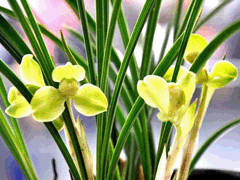 In today's orchid circles, everyone wants to own a high-grade butterfly orchid, especially Ruidie and multi-petal butterfly orchids, but their variability is hard to predict. Setting aside the famous butterfly orchids in the orchid world, whenever a new one appears, it is often difficult to judge its quality and stability, especially for beginners. I dare not claim to be an expert, but having occasionally gained some small insights, I offer them here for verification.
Wheneverorchidpetals, in whole or in any part, transform into lip-type structures, this is the phenomenon of labialization, called a butterfly orchid. It is a type of mutation inorchids.
Whenever an orchidflower'spetals (the inner perianth segments) are all labialized, it is a Ruidie (Three-star butterfly orchid).
Mutations such as Ruidie and multi-petal butterfly orchids: some appear by chance with unstable traits that do not reappear the following year, while others have stable traits and the newly propagated shoots also bloom with this mutation.
The key to identifying whether it is truly a Ruidie is to examine the labialization phenomenon of the petals (inner perianth segments):
1. All petals (inner perianth segments) must be labialized.
2. The labialized portion should be true lip transformation.
3. The labialized portion should have brightly colored patches or spots (except for plain-colored butterfly orchids).
Some so-called Ruidie appear to have three lips, but upon closer inspection, the petals (inner perianth segments) are no different from normal petals, with no obvious labialization phenomenon, only some moss-like color patches on the petals. This type of "butterfly orchid," commonly known as "painted face," is not a true Ruidie.
The emergence and stability of butterfly orchids remains a mystery to this day.
Among butterfly orchids, the most unstable are Ruidie and multi-petal butterfly orchids, especiallywild-collected orchids。
Having grown orchidsfor many years, I occasionally gain some small insights, which I offer for fellow orchid enthusiasts to consider together.
1. Column (nose) deformity: This is an important indicator of stability in Ruidie and multi-petal butterfly orchids. Column deformities include double heads, tiny heads, columnar heads (matchstick heads), fused heads, etc. Among these, the most valuable is when the column becomes columnar, and the smallest is the best. If the column is normal, the likelihood that the butterfly form will not reappear the following year is greatest.
2. Symmetry: The labialized portions of the two petals (inner perianth segments) should be symmetrical. Disordered and asymmetrical labialized butterfly orchids are mostly those that appear by chance.
3. Even arrangement: For multi-petal butterfly orchids, in addition to all parts being symmetrical, emphasis is placed on the symmetrical and even arrangement of the labialized petals.
4. Multi-lipped butterfly orchids also emphasize column mutation, with tiny, columnar columns being the finest.
5. The labialized portion should have a low base, an upward top, and penetration through - this is also one of the criteria for judging the quality of butterfly orchids.
Of course, these are not absolute, and must still be combined with other references, such as plant type (odd orchids, butterfly orchids, dragon orchids, etc.), multiple flowers (odd butterfly) on the same plant, as well as one's personal orchid-growing experience and knowledge.
In short, the butterfly orchid is a mystery - whoever solves it, possesses it.