The Legend and Origin of 'Green Cloud' - How Much Do You Know?
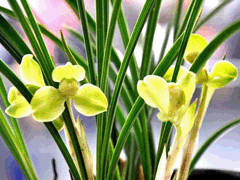
"Green Cloud" isChinese Cymbidiuma rare and precious famous cultivar among the lotus-petal type. Its three petals are short and round, broad and large, with mussel-shell-shaped clasping petals and a liu-hai (banged fringe) tongue. The petals and lip vary enormously, sometimes producing many petals, many clasps, many lips, and many flower forms; it is truly a marvelous lotus-petal variety, and was listed as a supreme treasure in the Qing Dynasty's "Lan Hui Tong Xin Lu" (Record of Orchid and Hui Conformity).
Rare and preciousorchidsalways have beautiful legends. Legend has it that a widow lived on Wuyun Mountain in Hangzhou. Her uncles and brothers-in-law bullied her for being alone and wanted to swallow up her house and land. She went to Hangzhou to file a lawsuit, and on the way through the mountain wilds she smelled a faint fragrance. Following the fragrance she found a clump oforchid grass, casually picked a flower and stuck it in her hair, then hurried on her way straight to Drum Tower. Passing by Hangzhou's most renowned Shao Zhiyan writing-brush shop, theorchidin her hair was spotted by the shopkeeper, who was a passionate lover oforchids. He hurriedly blocked her path and pressed her about the origin of the orchidflowershe wore on her head. The widow had business on her mind and was burning with anxiety, so she ignored him and kept going straight ahead, yet the shopkeeper clung on stubbornly. In the end they reached an agreement: the lawsuit had to be won through the shopkeeper's efforts, and only then could the widow go back to seek the grass. The result was predictable - a lawsuit backed by money is ultimately won, and naturally the shopkeeper also got the orchid he wanted. That orchid was indeed delightful: eight or nine thick, broad, tender-green petals slightly opening and closing, embracing a slightly curled white round tongue marked with an upward-woven U-shaped vermilion patch and a somewhat deformed creamy-yellow column tip. Everyone who saw thisflowercould not help blurting out how strange it was, crying out in unison: "A perfectly lifelike miniature lotus blossom!" I dare not conclude from this that the discovery of this flower was the origin of the lotus-petal type in orchids, but one thing can be said: among the lotus-petalflowersrecorded in currently published books, not one has a discovery date earlier than this flower's. Successive wars destroyed many precious varieties, and legend says this lotus treasure that everyone loved once disappeared. Later the wars subsided and peace and prosperity prevailed. As more people sought to display wealth and affect refinement, naturally more people also went into the mountains to seek orchids to exchange for silver to support their families. It is said that two brothers went into the mountains to collect orchids and came upon a secluded valley with a cliff. On the cliff they saw a clump oforchid grasswith twisted leaves and no flower buds. The brothers went around to the top of the cliff, lowered themselves down by rope, brushed aside the decayed soil beside the orchid roots, and carefully lifted that clump of orchid. Suddenly they discovered that a thin gold chain was tangled around the interlacing roots of that orchid, and on the gold chain hung a gold plate half a cun square. The brothers were astonished beyond measure and hurriedly brought the gold plate close to look; on it were clearly engraved the two characters "Green Cloud." The brothers were utterly baffled. Back home, the greedy elder brother kept the gold chain and gold plate and tossed that clump of orchid to his younger brother. The younger brother did not argue with his elder brother and planted that clump of orchid. When the villagers learned of it, some said the elder brother's heart was too black, to treat even his own brother that way, and others said the younger brother was too foolish, to give up gold and want instead that grass without even a flower bud. Hearing this, the younger brother merely smiled. Several years passed, and the younger brother's clump of grass finally bloomed. When it flowered, it also unveiled a mystery: that flower was the lotus that had disappeared amid the wars and had captivated countless high officials, nobles, scholars and literati. For this, the younger brother obtained silver worth a thousand times the value of the gold chain and gold plate, and the younger brother also spoke the words he had kept in his heart for years: anorchid grassworthy of a gold plate must certainly be worth more than gold; gold has a price, but a precious orchid grass is priceless. The years validated the truth of the younger brother's words, and orchid growers' devotion to orchids also allowed the precious orchid "Green Cloud" to continue and be passed down. Let us set aside for now whether these two legends are true or false; the "Green Cloud" orchid is real, and she remains just as enchanting, just as changeable and mysterious. Of course, for this reason it also filled the regret of the ancients that "a lotus is nowhere to be found."
With the reform and opening up, people's understanding of flowers and plants changed, and the orchid market prospered; the seemingly extinct "Green Cloud" seemed to be brought forth overnight. I was fortunate enough to buy two seedlings. After five years of painstaking cultivation, with grasses declining and sprouting, it finally budded and bloomed; the excitement and joy were truly beyond words. In order to enjoy the full unfolding of "Green Cloud" blooming, I let the flower bloom and fade, and only when the flower wilted and the grass collapsed did I regret it too late! The decline of the potted grass verified the ancient saying that "when a flower blooms too long, it must harm the grass."
All things in the world are full of spirituality; as long as you truly pour your affection into her, she will give back to you without reservation the love you have for her. This is so for all things, and even more so for orchids. If not for the mischief of a craving for the exotic, a lover of orchids could possess this orchid, cultivate it carefully, and each year not only savor its ever-changing floral beauty and smell its delicate fragrance, but also look forward to next year's surprises. This is truly one of life's great pleasures. And if through your cultivation and your photography you could leave to the world a beautiful image of "Green Cloud" blooming with a dozen or more petals, I think that for a true orchid lover, this life would surely be enough.
screen.width-500)this.style.width=screen.width-500;" border=0>
screen.width-500)this.style.width=screen.width-500;" border=0>Related images for this topic are as follows:
screen.width-500)this.style.width=screen.width-500;" border=0>
screen.width-500)this.style.width=screen.width-500;" border=0>Related images for this topic are as follows:
screen.width-500)this.style.width=screen.width-500;" border=0>
screen.width-500)this.style.width=screen.width-500;" border=0>Related images for this topic are as follows:
screen.width-500)this.style.width=screen.width-500;" border=0>
screen.width-500)this.style.width=screen.width-500;" border=0>Related images for this topic are as follows:
screen.width-500)this.style.width=screen.width-500;" border=0>
screen.width-500)this.style.width=screen.width-500;" border=0>Related images for this topic are as follows:
screen.width-500)this.style.width=screen.width-500;" border=0>
screen.width-500)this.style.width=screen.width-500;" border=0>Related images for this topic are as follows:
screen.width-500)this.style.width=screen.width-500;" border=0>
screen.width-500)this.style.width=screen.width-500;" border=0>Related images for this topic are as follows:
screen.width-500)this.style.width=screen.width-500;" border=0>
screen.width-500)this.style.width=screen.width-500;" border=0>Related images for this topic are as follows:
screen.width-500)this.style.width=screen.width-500;" border=0>