A Record of the Premium Cymbidium goeringii Variety Wumeng Mudan
Premium Cymbidium goeringii: A Record of Wumeng Mudan
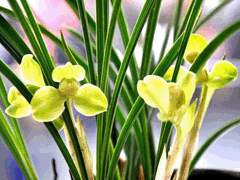 At the end of December 1995, Shi Ke, a 14-year-old farmer's child from Yachi Town, Bijie, and Ma Jun, his cousin of the same age from Lishu Town, went together to dig on the pine-forested hillside of Chenjiazhai near the Shuiniutun Power Station in Lishu Townorchids. When they returned in the afternoon, Shi Ke had dug upCymbidium goeringiia rare flower, one clump of ten shoots, with seven buds not yet open; after peeling them open, it was already clearly possible to identify how many lip petals there were. This rare flower was the one that later became famous in orchid circles as "Wumeng Mudan" (Wumeng Peony).
Shi Ke was young and inexperienced. After returning home, he asked his older brother Ma Jingui to take this rare flower into Bijie city to sell. Early the next morning, Ma Jingui brought the rare flower to Bijie and sought out several buyers, but could not agree on a price with any of them. Finally, at the Bijie Hongshan Hotel, he agreed to sell the whole lot for 1,000 yuan to Zhu Hongzhi, Zhu Hengyang and others who worked at the hotelto cultivate. After the deal was made, for other reasons, the two Mr. Zhu gave Ma Jingui an extra 100 yuan. After Ma Jingui returned home, he falsely told Shi Ke that it had sold for only 600 yuan. Of that 600 yuan, Shi Ke received only 380, Ma Jingui received 200 yuan, and Ma Jun received 20 yuan.
From February 27 to March 2, 1996, the Second Guizhou Provincial Orchid Exposition was held in Jinsha County. Zhu Hongzhi and the others entered the flower in the exhibition and it won a gold medal. After the exhibition, back in Bijie, Zhu Hongzhi, Zhu Hengyang, Zhao Yuejin and several other orchid friends working at the hotel divided the rare flower into divisions and cultivated them themselves.
This rare flower has semi-soft drooping leaves, with the leaf bases held tightly together and the upper parts slanting upright in an arc. The leaves are 250 mm long and 8 mm wide, thick and glutinous in texture, with a V-shaped cross-section. Weak shoots have only three to four leaves; only strong plants have five leaves. In Gulin, Sichuan, the author saw that this rare flower's leaves could grow to 320 mm long, while the leaf width showed no obvious increase, presumably due to climatic factors.
The outer three petals of this rare flower are unremarkable, bamboo-leaf-shaped petals, pale green with a purple flush, either waving or merely curled. But the column has degenerated and become flat, and the petals are all lip-petalized, up to as many as nine, opening upward, with vivid V-shaped bright red stripes, extremely gorgeous, and the fragrance is pure and subtly distant, making it a treasure among rare Cymbidium goeringii flowers. Orchid friends in Bijie, based on the flower'sbloomingform, vividly likened this rare flower to "baoguhua" (corn flower), that is, like the popcorn blown out of corn kernels in a heated expansion machine.
In later cultivation practice, this rare flower showed many advantages: easy to cultivate, strong resistance topests and diseases, a high flowering rate, and an extremely strong sprouting rate. In one year, it can send up one round of shoots in spring and autumn; autumn shoots can grow to four leaves by the end of December, and another spring shoot can send up one autumn bud and grow into a large plant by the end of December. In that same year, one shoot of the plant added two spring shoots and three autumn shoots.
After this rare flower bloomed and won awards, far-sighted Bijie orchid friends Yang Tianzhi, Wu Chaoxin, Wang Dingxian and others had Ma Jingui and Shi Ke successively search at and near the place where the rare flower was discovered and find several hundred wild-collected plants and dragon-root seedlings to cultivate separately. Through later cultivation practice, a rather peculiar phenomenon appeared: among the wild-collected plants obtained within a narrow, long area of 600 sq m at the place where the rare flower was discovered, most blooms showed abnormal developments such as hardened petals, lip-petalized petals, or multiple lips, and there even appeared striped-variegated plants with multiple-lip rare flowers. As a result, among Bijie orchid friends there later circulated terms such as "second corn flower," "yellow corn flower," and "glutinous corn flower," all referring to the various mutant new Cymbidium goeringii varieties from the place where this rare flower was discovered. Later, when some out-of-town orchid friends introduced this rare flower in Bijie, perhaps they did not obtain the original native species or seedling plants connected to the original species by dragon roots, so it is only reasonable that when they re-bloomed, the flower did not match the bloom of this rare flower.
From March 1 to 3, 1997, the Third Guizhou Provincial Orchid Exposition was held at the Bijie Library, and this rare flower won a gold medal again. In late February of the same year, Mr. Li Guoxiang, a Bijie orchid friend who has since passed away, entered this flower in the East China Six Provinces and One City (Jiande) Orchid Exhibition and won a gold medal. Then in early March he entered this rare flower in Hangzhou for the Tenth China (Spring) Orchid Exposition. When exhibiting in Hangzhou, Mr. Li Guoxiang reported the name of this rare flower as "Wumeng Qidie." When filling out the form, his handwriting was somewhat scribbled, and the registration staff wrote it on the label as "Gumeng Qidie." At the time, Mr. Li Guoxiang thought the name "Gumeng Qidie" was also quite good, so he tacitly accepted it. After judging, "Gumeng Qidie" was the only gold medal won by Guizhou Province's orchids exhibited at that session of the orchid exposition. It is confirmed that this was also the first time a Cymbidium goeringii native to and cultivated in Bijie won such an honor. On page 15 of the Archive of Famous Chinese Orchid Varieties (Cymbidium goeringii), compiled by Mr. Liu Qingyong and Mr. Wu Senyuan, is the elegant appearance of "Gumeng Qidie" at that time. After "Gumeng Qidie" won the national gold medal in Hangzhou, Mr. Peng Liangzheng of Sichuan bought it back for cultivation in Sichuan.
In February 2001, Bijie orchid friend Mr. Lu Shilun entered this rare flower under the name "Wumeng Mudan" in the Eleventh China (Guiyang) Orchid Exposition, where it won a gold medal and a silver medal. Afterward, Mr. Su Li of Yunnan introduced this rare flower from Mr. Lu Shilun to Yunnan, and Mr. Zheng Liang of Yunnan took a special photograph of this rare flower. After Mr. Su Li introduced this rare flower, he published the photo in several publications and called this rare flower "Qicai Yunnan."
In the autumn of the same year, Mr. Lu Xiufu of Zhejiang came to Bijie and introduced more than twenty shoots of this rare flower from Zhu Hengyang, Zhu Hongzhi, Zhao Yuejin and several other orchid friends at the Hongshan Hotel. On page 130 of A Precious Collection of New Chinese Cymbidium goeringii and Cymbidium faberi Varieties, edited by Mr. Zhan Shulun, this rare flower is again called "Yaochi Mudan," also known as "Jinling Mudan." In fact, the photo of this rare flower published in that book should be the earliest photo of this rare flower; that photo was published twice, on pages 43 to 44 and pages 51 to 52 of Guizhou Orchids, jointly edited in 2001 by the Guizhou Provincial Forestry Department and the Bijie Prefecture Administrative Office.
Around this time, Mr. Zhang Cuineng and others, orchid friends from Guiyang in the province, and Mr. Xie Xiang and others from Dafang, also introduced a certain number of rare flower seedlings in Bijie.
In February 2002, Mr. Lu Shilun again entered this rare flower under the name "Wumeng Mudan" in Sichuan for the Twelfth China (Chengdu) Orchid Exposition, where it won another silver medal.
At this point, Bijie orchid friends and some out-of-town orchid friends basically accepted that this rare flower should be called "Wumeng Mudan," and in local calendar production and pictorial publicity, they unified the name of this rare flower as "Wumeng Mudan." Of course, in casual after-meal chats, Bijie orchid friends still recount how glamorous "baoguhua" is.
"Wumeng Mudan" has so far not been formally registered. At present, whatever its cultivators and owners call it is beyond reproach. The author records the origin of "Wumeng Mudan" only to provide orchid friends with the true original information about this rare flower. In some publications, the author has seen that some orchid friends possess both "Qicai Yunnan" and "Wumeng Mudan," and does not know where the varieties came from. The author of course also hopes that when some orchid friend formally registers it, he can register and name this rare flower "Wumeng Mudan." Origin plus form is also quite apt.
Mr. Lu Xiufu is one of the most successful people to have introduced "Wumeng Mudan." In addition to rapidly increasing the quantity to more than one hundred shoots, he has also gained abundant economic returns, and his cultivation and management skills are even more extraordinary. In February 2004, Mr. Lu Xiufu again named this rare flower "Wumeng Mudan" and entered it in the Yuetu Cup Zhejiang Provincial (Wenzhou) Sixth Orchid Exposition, where it won a gold medal. The color photo was published in Lanhui (2004, Issue 3, page 42). In the color photo, the outer petals of "Wumeng Mudan" had already partially become butterfly-like, a level not seen in cultivation in Bijie or other regions and one they had not been able to achieve. Also published in Lanhui (July 2004, page 108) is the best bloom of "Wumeng Mudan" cultivated by Mr. Lu Xiufu.
The author has, together with orchid friends, climbed several times to the place where "Wumeng Mudan" was discovered to investigate. The place where "Wumeng Mudan" was discovered is only 10 km from the Bijie urban area, at an altitude of 1,360 m, facing south with its back to the north, surrounded by mountains on three sides, with layered green pine forests, and Jurassic purple sandy shale red loam soil, with a small river flowing down from the Bijie region at the foot of the mountain. To this day, Cymbidium goeringii seedling plants still occasionally emerge on the nearby hillsides, except that as soon as an orchid seedling comes up, it is quickly dug away by those in the know. At the place where "Wumeng Mudan" was discovered, there is already a rectangular pit 3 m long and 1 m wide; those who dug for dragon roots and dragon eggs even sifted the soil. At the time, the dragon roots and dragon eggs sifted out still filled a large handful, but how could they cultivate them into plants?
After nearly ten years of cultivation and development, "Wumeng Mudan" is already grown by more than twenty orchid friends in Bijie. Orchid friends in the province in Dafang and Guiyang, and out of town in Sichuan, Jiangsu, Zhejiang, Yunnan and Taiwan, China, have also introduced and cultivated it one after another, and "Wumeng Mudan" has spread its fragrance across the four seas. Although in the short term "Wumeng Mudan" will still maintain a certain high price, with the improvement of cultivation standards and the extremely strong sprouting rate of "Wumeng Mudan," it is believed that this rare Cymbidium goeringii flower native to Bijie will enter the orchid sheds of millions of orchid friends at a reasonable price. (Repost)