Detailed Guide to Cultivation Methods and Care Techniques for Variegated-Leaf Orchids
Cultivation of Variegated-Leaf Orchids
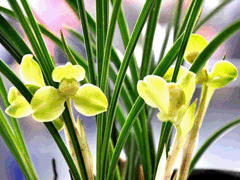 Appreciating Variegated Orchids
If you have ever gone up the mountain to collect orchids, you would know that the temperature, humidity, light, and basic growing conditions orchids prefer are mostly in sunny, well-ventilated, semi-shaded forest environments, on relatively favorable terrain, in places that are moist but not soggy. This isorchids'basic growing environment and conditions. Whether variegated or ordinary plants, there is no special growing environment, but after being brought down from the mountain, the environments created artificially are wildly varied, from simple garden plots, under tree shade, artificial PC boards, semi-greenhouses, balconies, greenhouses...., there is every kind imaginable; and there is also the environment inside the pot: Japanese volcanic rock, pumice, Satsuma stone, Tangshan stone, river stones, brick and tile, perlite, charcoal, osmund fiber, coconut shell, pine bark, longan bark, peanut shells... etc.; pots include ceramic, plastic pots, osmund fiber pots, clay pots, plus artificial watering, fertilizing, spraying, sterilizing, etc. Is this not thoroughly artificial? With the two compared side by side, it becomes even easier to understandorchids'basic growing environment and conditions; so after being brought down from the mountain, how to create the same growing environment and conditions as in the mountain forest is also an essential element for success in growing flowers!
In the cultivation of variegated-leaf orchids, under normal management, giving normal temperature, humidity, light, and ventilation is enough, and there are no special care conditions. If distinctions or attention are truly needed, they are explained in the following points:
1. Root maintenance: Only with healthy roots can the plant's leaf variegation continue to evolve and thrive; only with healthy roots can it bring you wealth. If the roots are not grown well, no matter how much money you spend or how high-grade the flowers you plant, in the end it will still come to nothing, and you will not be able to obtain the benefits you should get; therefore, on [root maintenance], special effort must be made to develop it!
2. Appropriate pot: In planting orchidsthepot, personal experience is that it should be somewhat small but not too small, that is, better small than too large. For example, in Taiwan, what is generally used is mostly long-footed pots between 4.5~5 inches, very suitable for controlling water and fertilizer!
3. In terms of planting materials: use a slightly higher proportion of mineral ore + inorganic materials for planting. Mineral ore contains large amounts of minerals and trace elements, and can relatively stimulate changes in leaf variegation. Inorganic materials drain well and will not provide excessively high nitrogen fertilizer components. Under intentional control of fertilizer components, the expected effect can be achieved!
4. Regular insect and fungus control: For appreciating leaf variegation, maintaining perfect, flawless leaf variegation is something that must be noted, so in addition to regular insect and fungus control, this work must also be supplemented after continuous rainy weather!
5. Buy healthy plants: If you consider yourself decent at growing flowers, buying healthy plants is already standing in an invincible position. This is a very important point; only healthy plants can save unnecessary losses!
6. Even highly skilled growers must not divide the plant into too few divisions; it is best to keep 1~2 growths or more connected as the basis for cultivation, so that the roots can normally transport the necessary water and nutrients, enabling the plant to be normal, with beautiful leaves and delicate flowers. Otherwise, the plant will become smaller and smaller, and the variegation will also gradually regress!
7. Among the various variegation types (claw, deep claw, crown, crane, center variegation, center translucent, rimmed, crystal, dawn variegation, tiger stripe), crown, crane, yellow-striped variegation, and tiger stripe are relatively more afraid of strong light, so shade should be provided at appropriate times (such as strong summer light)!
With attention to the above points, no matter what flower variety, under normal management, you can handle it with ease, grow robust orchid plants, and with no flaws on the leaf surface, greatly raise the level of variegation appreciation!!cttu