An Informal Discussion on Wild-Collected Orchids, Part One: Getting to Know Wild-Collected Orchids
An Informal Discussion on Wild-Collected Orchids, Part One
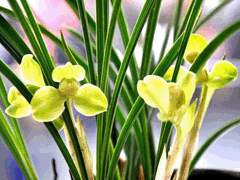 Wild-Collected Orchids, as the name suggests, are orchid species found on the mountains that have not yet been domesticated through human cultivation. They are also the only choice for new varieties. Their innate uniqueness is invariably tied to fame and profit, whether it be money at the least or a place in orchid history at the most, and thus they have always been valued by orchid growers. Therefore, attention must be paid to domestication and cultivation. When first obtained, one can observe the leaves. If the leaf color is deep and dark, and the form is relatively long or broad and thick, they generally come from a shaded location. If the leaf color tends toward yellow, and the form resembles cultivated grass or is relatively stiff and robust, they generally come from a sunny location. Judging their origin in this way is truly a matter of keeping a clear mind for balancing yin and yang in future care. If they lean toward shade, then cultivate them in the opposite direction, leaning toward sun, but this must be done gradually and not too hastily.
Second, cleaning: Before planting, the seedlings should be cleaned, dead sheaths and rotten leaves removed, and decayed and rotten roots pruned, with cuts made smooth.
Third, division: Division depends on the size of the orchid clump. If large, it can be divided along its natural gaps, but one must never force a division, lest the orchid plants suffer further harm that outweighs the gain. For small clumps of seedlings, even if the seedlings are vigorous, they must not be forcibly divided. One should know that fine varieties are not easy to come by, and survival should always be the guiding principle, which also helps them adapt to the pot.
Fourth, disinfection: After cleaning and division are complete, give them disinfecting treatment. If conditions do not allow, the orchid plants can also be placed in the sun to dry, with the cuts facing the sun to help the wounds heal. The leaves can be covered with something like newspaper to prevent dehydration. If conditions allow, use medication for sterilization, then dry in the shade until ready for use.
Fifth, choosing a pot: For new wild-collected seedlings, a new pot is best. People of earlier times also said that mountain seedlings adapt easily to a new pot, while cultivated grass adapts easily to an old pot, and this is quite reasonable. This is generally because new pots have stronger fire qi, and their rapid absorption and rapid drying far exceed old pots, while wild-collected orchids, whose root function has not yet recovered, most fear excessive moisture. Compared with pots for cultivated grass, the pot body should be on the smaller side to aid permeability.
Sixth, choosing the medium: Most people today use granular xiantu, which should first be sterilized with boiling water and soaked through. The mixed medium should always be primarily permeable and moisture-retaining (I generally use a medium one size smaller than normal for cultivation).
Seventh, placement: Once the grass has been placed in the pot, it must be kept in shade for a period of time, depending on the condition of the grass. If the grass is vigorous, it can be put on the shelf for management after ten days to half a month. Weak seedlings should be given a suitably longer period. Choosing the placement location should also take into account the species and nature of the orchid and the vigor or weakness of the seedlings, as appropriate. New plants in the pot should be oriented toward the sun, with southeast being best, to help the new plants gather yang and gain qi, thereby enabling them to quickly adapt to the pot. Before new roots have grown, moving them is what should be avoided most.