What exactly is the significance of guan zhong and qiao zhong?
The significance of guan zhong and qiao zhong
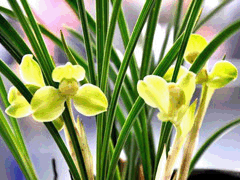 The significance of guan zhong and qiao zhong
From JINXIANG XUYU (Recent Fragrant Whispers) - On "Narcissus"
Thanks to Zhou Jianjun for tirelessly uploading the two ancient manuals LAN HUI TONG XIN LU and LAN HUI XIAO SHI, enabling us to read these
"complete editions" carefully. Great joy!
Both books' "Portraits of Ten Lost Famous Hui" include a variety called "Chen Xiu Su." The postscript to LAN HUI TONG XIN LU says: "Originated in Jiaxing
. It is a guan zhong narcissus; iron-wire leaves, bud form slightly long, small and flat-cut; soft pouch holding the heart, large spread tongue, lotus-form bamboo petal, also among plain hui
a superior grade. This variety was only possessed by the Chen family, and became extinct in the early Daoguang period." Since the book calls "Chen Xiu Su" both a "guan zhong narcissus" and a
"lotus-form bamboo petal," why is this? Because "guan zhong narcissus" does not mean "guan zhong narcissus petal" - a difference of one word makes a great distinction.
I have often said: the ancients originally had no "narcissus petal" petal type. This is clear evidence! Otherwise, how could there be a flower that belongs to both bamboo petal and narcissus petal
? Moreover, in merely forty-odd characters, it contradicts itself - how could Mr. Jilou be so muddled?
Everyone thinks the terms lotus and plum petal are quite vivid, yet the so-called "narcissus petal" type is far removed from the appearance of the narcissus flower
; the selected flowers' petals are mostly not as short and broad as narcissus sepals, and no amount of analogizing still fails to grasp the point. The ancients' use of "narcissus"
did not refer to how the outer petals are, but to the "form" in which the inner and outer whorls of the flower are separated! As is well known, lotus and plum sepal-petals grow
adjacent to each other and are hard to distinguish; but lan and hui are similar to narcissus, with sepals and petals growing separately, having a clear distinction between inner and outer whorls, namely
the inner holding petals and outer petals. The ancients, our predecessors in growing orchids, when they saw among lan and hui those whose outer petals resembled lotus, called them "lotus"; or those whose outer petals
were round and close to plum petals, called them "round petals" or "plum petals"; and those surpassing bamboo leaf, chicken foot, and line types yet not reaching lotus
or plum could also enter the ranks, called "surpassing petals." These all discuss petals. Yet lan and hui after all are not of the lotus or plum kind - their forms are mutually different
, so the name "narcissus" was borrowed to designate their form, and concurrently "petal" also called "form," combined as "petal type," hence there are names like "lotus-form
narcissus," "plum-form narcissus," "surpassing-petal narcissus," which borrow the forms of two flowers to fit together and describe the appearance of lan and hui
; lotus and plum represent the short, broad outer whorl form of superior lan and hui; narcissus expresses the tightly embracing inner whorl posture of superior lan and hui. This is
the ancients' extremely exquisite theory!
When the ancients judged orchids, they especially valued the inner whorl; in selecting orchids they first looked at "chong" (insect) and "su" (plain). Chong refers to the form of the central palace; su refers to the central palace's
color. Attaining either of the two qualifies for the ranks, so what is called "chong" must be "narcissus." LAN YAN SHU LUE states that among narcissus, those with
white heads are called "qiao zhong" (clever type), and those without white heads are called "guan zhong" (official type), both being superior grades. This shows that "narcissus" is not necessarily without white heads
. For example, Zheng Tong He, the so-called "lotus petal," should actually be called "lotus flower" - it is a lotus-form narcissus guan zhong. As for DI YI XIANG BI JI
stating that narcissus must have a pouch, this specifically refers to "qiao zhong narcissus"! LAN HUI TONG XIN LU records: "For narcissus, one specifically
looks at whether the holding heart has a pouch. Below plum and lotus, chicken foot and line types all have them. There is also guan zhong narcissus, with short holding petals, shallow pouch, and slightly white edges
. In general, value is judged by the outer three petals; if the petals are wide with raised corners, they are also not valuable." This shows that qiao zhong with chicken-foot or line-type outer three petals can also
be called "narcissus," though of lower grade. Therefore there should be "bamboo-petal narcissus" and "chicken-foot narcissus" in the world, but there must not be "bamboo-
leaf narcissus petal" or "chicken-foot narcissus petal"; therefore "lotus-form bamboo-petal narcissus" such as Chen Xiu Su and Jin Ao Su, judged by petal, originally
do not enter the ranks, and enter only because of their plainness - yet there is absolutely no reason to call them "lotus-form bamboo-leaf narcissus petal"! The distinction between these two, we
must carefully and closely examine.
In addition, the ancients also held that five petals in separate nests is superior, split head with joined back is secondary, and joined shoulders with joined back is inferior - this mostly refers to the qiao zhong category
. What surpasses joined shoulders with joined back is the extreme of the qiao zhong category, such as today's "Cui Tao"; while five petals in separate nests, like "soft silkworm-moth
holding," is the beginning of the qiao zhong category. Let me deduce several holding postures of the guan zhong and qiao zhong categories, using the ways of yin-yang and civil-martial to analogize:
guan zhong is yin, qiao zhong is yang. Then "opening the skylight," where inner and outer whorls are not distinguished, is no longer narcissus - neither yin nor yang, hence not
worth taking; while yin-yang balance is called "yuan." If "yuan" engenders yin, it enters guan zhong; if "yuan" engenders yang, it enters qiao zhong. The utmost yin
and utmost civil is the "cat-ear holding," which is the extreme of the guan zhong category. Next are "scissors holding," "palm-leaf holding," "clam-shell holding,"
"chime-mouth holding," "short round holding," etc., all being various states of the guan zhong category evolving toward "yuan," from no pouch transitioning to having
a pouch, all measured by the degree of resemblance to the embracing form of the narcissus inner whorl, all proceeding from the extreme of yin to the beginning of yin. And the beginning of yang, namely
the beginning of qiao zhong, is "yuan" slightly increasing yang; within the qiao zhong category, "soft silkworm-moth holding," "Guanyin holding," "bean-shell holding,"
"crab-claw holding," "hard silkworm-moth holding," "fist holding," etc., proceed from the beginning of yang to the extreme of yang, from deep pouch with slight
white head to full white head, so "fist holding" is the utmost yang and utmost martial. There are also several tongue forms, all serving as its complements. I have once listed
narcissus holding postures from the "extreme of guan zhong" to the "extreme of qiao zhong," and one can see what the ancients called superior and what they called inferior, all judged by
the doctrine of the mean. If a flower is of superior grade, it is invariably between the "beginning of guan zhong" and the "beginning of qiao zhong"! For at this time the central palace is round and broad
and the outer petals are most upright. If one seeks the two extremes, the petals all fly up with raised corners; though the petals be broad, they are not valuable. I think the most exquisite flower
should be between guan zhong and qiao zhong, at the juncture of about to transform yet not yet transformed - truly something that can only be grasped in the mind! Do such flowers truly exist in the world?
LAN HUI TONG XIN LU calls "Gai Zi" "neither plum nor narcissus" - why? Because it is "yuan"! Calling it not narcissus
refers to its not being qiao zhong; calling it not plum petal is because its petals are extremely round yet it is not qiao zhong. Looking at the portrait left by Mr. Jilou, its holding
petals are short and round, precisely at the juncture of about to transform yet not yet transformed - yin and yang generating each other, civil and martial both complete. Therefore this flower does not fit the ordinary standard yet is called "the first of
ancient and modern famous petals." It also says: "In general, value is judged by the outer three petals." Guan zhong narcissus like Xi Shen also has this appearance; its outer three petals resemble plum
, yet the palm-leaf holding has a slight white head - it should be a superior grade. This is a "guan zhong plum-form narcissus." How could there be any dispute of "plum petal" versus "narcissus
petal"?
In conclusion, today's calling "narcissus" a "narcissus petal," and saying "narcissus petal" must have a pouch and white head, and so on - is this not absurd?! This
is all taking words out of context. People today also say that the holdings of both "plum petal" and "narcissus petal" have pouches, to the point that the complexities and subtleties cannot
be distinguished; then they further say "plum petal" must have hard holdings, small tongue, not drooping, while "narcissus petal" must have soft holdings, large tongue and drooping. How could they know the
ancients precisely regarded soft holdings and large tongue as superior! A large tongue like Liu Hai's is precisely the drooping tongue posture, yet it was ranked as superior, while the dragon-swallowing tongue was placed
secondary. Therefore people today only select what Xu Jilou called "sick plum," yet place all the finest flowers into the so-called "narcissus petal" category.
!
I once said:
Without a pouch, a round petal also becomes plum,
Guan zhong and qiao zhong each have their form.
Forms divide by presence or absence of pouch,
Petals are called lotus, round, or surpassing.
Narcissus is not a petal,
The difference lies in how the holding is.
Yet in today's orchid world, the "new petal-type theory" of "lotus petal, plum petal, narcissus petal" is flourishing. One who is close to fragrance investigates ancient texts
to restore the ancients' original meaning of "narcissus," inevitably becoming heresy and heterodoxy, and also suspected of tampering with traditional petal-type theory! Moreover, regardless of who wishes
to uphold tradition, the sea of orchids is vast - is there still anyone willing to listen to such sour, pedantic words? Very well, let it be told to those who wish to hear, let those
who wish to curse curse, and those who wish to sneer sneer! Hearing it, cursing it, sneering at it - everyone gets what they enjoy. Is this not a joy?
Drafted on 2003.03.07
Completed on 2003.03.11
Appendix notes:
This argument is made based on the book LAN HUI TONG XIN LU, which synthesizes traditional petal-type theory, and may conflict considerably with other ancient orchid manuals
, because the Jiangsu-Zhejiang petal-type theory over its more than two hundred years of history has always advanced with the times and varied by region, and the concept of "narcissus" likewise
differed.
The Jiangsu-Zhejiang petal-type theory began with Bao Qiyun of Anhui's YI LAN ZA JI in the early Qing dynasty - this is generally acknowledged. Its text records: "If the petal is short
and the head round, it is plum petal; if slightly pointed, it is narcissus petal; if slightly longer than narcissus and the head broad, it is lotus petal; if broad both above and below, it is surpassing petal - these are all
superior grades." I take this sentence to mean "If the petal is short and the head round, it is plum petal; (if the petal is short and) slightly pointed, it is narcissus petal." That is,
here "narcissus petal" truly is a petal form approximating the narcissus flower's petals! Only thus can the lotus petal be "slightly longer than narcissus."
At that time and place, only petals were discussed regardless of the central palace, and it was said that plum, lotus, narcissus, and surpassing petals were all superior grades.
By the first year of the Jiaqing reign, Zhu Kerou of Suzhou's DI YI XIANG BI JI records: "For narcissus, the petals must be thick and large, the petals clean without veins, the shoulders and
tongue large and round, the holding heart like a silkworm moth or like a bean pod, the flower foot fine and tall, hook-thorns complete, sealed edges clear, white head heavy - then it is a superior grade. For lotus,
the petals are thick and have a pouch, the holding heart round, the base narrow - this is a true lotus petal; otherwise, though the petals be very broad, one must not confuse the name. A true surpassing petal has thick petals and deep pouch
, extremely narrow base, shaped like a spoon." It also says: "Plum petal is like plum, round petal is not pointed, lotus first discusses the base, thick petals are valued, for
narcissus one specifically looks at the holding heart's white head as the standard," and "For hui flowers, the holding heart is short and has a pouch; regardless of whether the outer three petals are broad or narrow, it is named narcissus. The small garment-shell petals
are pointed, all having inverted hooks; the large petals have sealed edges, the holding heart has a white head like a Guanyin pouch, and the outer petals are short and broad like narcissus - this is true narcissus." And when ranking
grades high and low, narcissus is placed before lotus petal and plum petal, showing that at that time and place "narcissus" was a qiao zhong with extremely short, broad outer petals!
While lotus petal and plum petal were both guan zhong. Thus the so-called "true narcissus" is close to what later generations call "plum petal," and the "plum petal" of that time and place
was merely guan zhong round petal! Later, Yuan Shijun of Suzhou local published LAN YAN SHU LUE, already eighty years on,
recording: "Plum petal and narcissus are judged by the holding heart's white head - named qiao zhong; without white head it is not so; separate nests not joined back; soft like Guanyin pouch
with depth is excellent; shallow is secondary; chicken-bean-shell piece likewise. Where the large petals do not raise and the head is round, it is plum; where pointed, it is narcissus; the five petals are valued for being veinless and clean,
with elegant form, level shoulders, large drooping round tongue; the large petals' edges must be tight, like a pouch reaching its foot; plum should be round, narcissus should have a narrow base - then it is a superior grade." This shows
that at this time and place there were already clearly the concepts of guan zhong and qiao zhong, and plum petal was already qiao zhong. It also says: "For lotus, the petals are thick and pointed, the foot short
with narrow base; a short scissors-shaped holding heart is secondary, clam-shell-shaped is excellent - this is true lotus. Round petal: round head, broad and short, not narrow at base; surpassing petal
: shaped like a spoon." This shows that lotus and round petal should be guan zhong, and their outer petal forms respectively correspond to the qiao zhong's narcissus and plum petal
, that is, the petals of lotus and narcissus are both "pointed" and "narrow at base"; the petals of round petal and plum petal are both "round-headed" and "not narrow at base"
. Thus lotus and narcissus, round petal and plum petal, are all merely the distinction between guan zhong and qiao zhong; if only petals are discussed, then the two pairs are alike! This
differs again from Zhu's theory.
Another eleven years later, Xu Jilou of Jiaxing published LAN HUI TONG XIN LU, discussing flowers: "Among flowers, lotus-form narcissus is foremost, plum-form narcissus
second, guan zhong narcissus next." Discussing petals: "Lotus is the highest grade, round petal is superior grade, surpassing petal is inferior grade;
moreover bamboo and willow petals and the like do not enter the ranks - such as chicken foot and line types, they are taken only for fragrance." I think it is not excessive to regard this theory as the highest peak of Chinese orchid petal-type theory
. The so-called "lotus-form narcissus" is roughly Yuan Shijun's "narcissus"; "plum-form narcissus"
is roughly Yuan Shijun's "plum petal"; "guan zhong narcissus" roughly encompasses Yuan Shijun's "lotus," "round petal,"
and "surpassing petal." This shows that from Bao Qiyun, Zhu Kerou, Yuan Shijun to Xu Jilou, Chinese orchid petal-type theory, though in one continuous line
, was not unchanging! Why do I say "at that time and place"? Because circumstances differ by time and region - who can know whether things of the same
name as described must all be the same? Xu Jilou's "such-and-such narcissus" designation names both petal form and holding type, encompassing inner and outer - this is truly scientific
classification! While the "such-and-such petal" designations in other orchid manuals refer to the outer three petals - how can they represent the whole flower's appearance? Petal type means
the petals of lan and hui and the form of lan and hui! Therefore I humbly believe "petal-type theory" was only completed at this point, while the theories of predecessors all failed to be fully adequate.
Xu Jilou's concept of "narcissus" must differ from each of Yuan, Zhu, and Bao before him, and the "narcissus petal" in today's "new petal-type theory,"
though its name also has some basis, is again different from all the above ancients' original meanings! When we read our predecessors' books, we should
take what is incisive and recognize what is inappropriate, discerning the thread of traditional culture amid the various schools' divergent theories, and gathering and incorporating them, then we can be free of confusion.