Near Fragrance Whispers: Recommended Outstanding Works
Recommendation of "Near Fragrance Whispers"
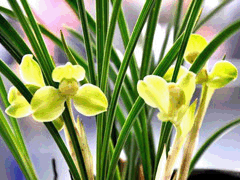 Recommendation of "Near Fragrance Whispers"
I first saw "Near Fragrance Whispers" when Moderator Yingmu posted it on the China Orchid Network during a discussion of official-type narcissus orchids. At the time I did not pay much attention, did not read it carefully, and it left no impression. During the leisure of the Spring Festival, I leafed through old posts, and when I read "Near Fragrance Whispers" again, my eyes lit up. This is a fine article with unique insights and brilliant exposition. It can stand side by side with Master Huadeng's writings. Master Huadeng's articles discuss the Way, while Master Near Fragrance's articles discuss the art. Although discussing the Way and discussing the art are different, their brilliance is the same.
After the Spring Festival, whenever I had free time I often read "Near Fragrance Whispers", reading it over and over, unable to put it down, to the point of being infatuated and intoxicated. From admiration to respect, from respect to reverence, from reverence to worship, from obsession to poisoning, I sank deeper and deeper. In just a short orchid article, in just one short month, I felt as though I had come to know petal-type flowers all over again.
In "Near Fragrance Whispers", the Way of petal types within petal types, the discussions of petal types, and the classification of petal types, though only a few words, carry profound meaning. It both inherits tradition and innovates, both emphasizes key points and covers the whole, and discusses both standards and methods. This article discusses orchids, and the novelty and singularity of its reasoning are something never seen in previous orchid books. I now recommend it to everyone for shared appreciation.
According to Moderator Yingmu's introduction, the author of the petal-type section of "Near Fragrance Whispers" is the China Orchid Network orchid friend "Near Fragrance Zhe". He no longer comes online now, and no one knows where he is from. This is truly a matter of regret. If one could read "Near Fragrance Whispers" sections on butterfly flowers, and others besides, that would certainly be a great pleasure.
"Near Fragrance Whispers" - Petal Types
◆Part One: The Way of Petal Types
Does the Way of petal types lie entirely in the Doctrine of the Mean?
When the ancients selected orchids, they first looked at the "chong" (inner center) and the "su" (plain color). The "chong" is the form of the central palace; the "su" is the color of the central palace. In handling matters, a person must first rectify his heart, so the appreciation of orchids and cymbidiums also proceeds from the inner whorl (petals) to the outer whorl (sepals), embodying the Confucian principle of "modesty and inner restraint, rectifying the self and purifying the heart". Those that are both "chong" and "su" are supreme spirit-grade flowers.
Chong orchids are narcissus orchids, and everything lies in whether the holding petals have a pouch. Those with deep, soft, and clean pouches rank highest; those without a pouch, or with a shallow pouch but with upright and presentable outer petals, are called "official type" and rank next; while those with hard pouches like joined shoulders and backs rank lowest. Therefore it may be said that the one that attains the mean of pouches is superior. The outer petals also follow this principle, always taking roundness and breadth as beautiful. Thus the roundest and broadest petals are called "round petals" and are top grade. Those that gather at the base and flare at the corners, though not as round and broad as round petals, yet have graceful curves, and whose embracing posture is most dignified and beautiful, are "lotus flowers" and are promoted as supreme grade. As for those whose length and breadth merely exceed ordinary flowers but are still presentable, they are called "super petals" and are lower grade. From this, orchid growers can know that "lotus flower" is precisely the mean choice of just the right degree. As for the scape, leaves, fragrance, and color of orchids and cymbidiums, the same reasoning extends to them.
◆Part Two: Discussions of Petal Types
When people today read the discussions of petal types recorded in ancient manuals, they mostly take what suits them, basing arguments on scattered phrases, and instead fail to understand the ancients' original intent. One should know that all things under heaven mutually generate and mutually restrain (this is what people today call systems theory), and the "chong" and "su" characteristics of orchids and cymbidiums also have corroboration. Their holding-petal form, petal form, tongue form, sheath color, leaf texture, and bud posture all match. If one could summarize and organize them, one ought not to make such theory even more complicated and difficult to express. In my humble opinion, if classified by petals, what people today call "lotus petals", "plum petals", "wild large flowers", and so on refer to their outer petals being the ancients' lotus flower, round petals, and super petals. If classified by petal type, one should discuss the whole flower. Here there should be a difference in concept. Petal type does not refer only to its petals. "Type" means narcissus, and there are distinctions between official type and clever type. Therefore what people today call "narcissus petals" is unclear. Narcissus refers to its holding petals, and there is definitely no such category of petal.
Xu Jilou stated: when judging flowers, lotus-form narcissus ranks as top grade, plum-form narcissus next, and official-type narcissus as lower grade. Can this serve as the foundation of ancient and modern petal-type theory?! The term "lotus-form narcissus" reaches both inner and outer, and this is truly a scientific generalization. Generalizing only petals without generalizing type is the deficiency of the modern classification system of "lotus petals", "plum petals", and "narcissus petals". For another example, what people today call "lotus petals" is the ancients' lotus-flower official-type narcissus; what people today call "plum petals" is the ancients' round-petal clever-type narcissus; for example, the cymbidium "Da Yi Pin" is lotus-flower clever-type narcissus; for example, the lost varieties Pin Lian and Da Jin Qian are (super-petal) official-type narcissus; for example, "Gai Zi" is round-petal official-type narcissus; and there are also several new flowers that are actually super-petal narcissus, with both official type and clever type. When some say that lotus and plum petals surpass narcissus, how is this different from saying Guan Gong fought Qin Qiong?!
Therefore Near Fragrance Zhe's discussion divides petal types into the official-type narcissus gate (no pouch) and the clever-type narcissus gate (with pouch), and each gate is further divided into lotus-flower narcissus, round-petal (plum-form) narcissus, and super-petal narcissus. Since only super petals and above can enter the ranks of quality, regardless of official type or clever type, the lower grade (super petals) is generally called narcissus, the upper grade (round petals) is called plum, and the supreme grade (lotus flower) is called lotus. Within lotus flower, plum form, and narcissus, each is further divided into upper, middle, and lower grades according to the pairing of holding petals and tongue. This is the distinction of benevolence and wisdom, and cannot be fixed. Therefore the cymbidium "Da Yi Pin" should belong to the clever-type lotus category and can be promoted as top-top grade, rather than the so-called "narcissus petal" category of the present day!
◇Modern Classification
Orchids and cymbidiums --- lotus petals, plum petals, narcissus petals
◇Near Fragrance Zhe's Classification
Orchids and cymbidiums --- official-type narcissus gate, clever-type narcissus gate
Official-type narcissus gate --- lotus flower, plum form, narcissus
Clever-type narcissus gate --- lotus flower, plum form, narcissus
At present, the orchid and cymbidium craze is rising across the country. New flowers emerge in great numbers in Bashu, Qinling, Dali, and Jingchu and other places, and many are difficult to classify. In Yunnan and other places,lotus petalmany Spring Sword orchids are called plums yet have no pouch on the holding petals, which has thus become controversial. I have tried to observe them, and they are all official-type round-petal (plum-form) narcissus, exactly like the cymbidium "Gai Zi" andSpring Orchidthe Da Jin Qian group. The theory of petal types had already spread from Jinling to Dali by the Ming dynasty, and written records survive, which is why that region preserved the ancient version of the theory. Near Fragrance Zhe investigated the ancients' original intent and combined it with current fashions, finally forming this theory, making it applicable to all orchid species. Surely it can bring all the world's fine flowers into its register?
◆Postscript
What Near Fragrance Zhe discusses was not originally intended to court popularity. To summarize traditional petal-type theory and make it comprehensible to people today is the duty of an ordinary person. With limited talent and knowledge, it is unavoidable that there may be the worry of trying to paint a tiger and failing. Writing it in classical Chinese is also not for showing off, but simply to type a few fewer characters. For any places that are unclear, I first apologize here. If you gentlemen truly cannot bear it and wish to scold me before feeling better, Near Fragrance Zhe can only laugh foolishly.
Orchid friend Xiangdong of the China Orchid Network has again posted Near Fragrance Whispers' discussion of narcissus, so I now repost it.
Below is "Near Fragrance Whispers - On 'Narcissus'" that I archived in 2004. Its content seems even richer, so I will post it to share.
Thanks to Zhou Jianjun for taking great pains to upload the two ancient manuals "Lan Hui Tong Xin Lu" and "Lan Hui Xiao Shi", enabling us to carefully read these "complete editions". Great joy! In the "Portraits of Ten Lost Famous Cymbidiums" in both books, there is a variety called "Chen Xiu Su". The postscript to "Lan Hui Tong Xin Lu" says: "From Jiaxing. Official-type narcissus; iron-wire leaves, bud form slightly long, small flat cut; soft pouch holding heart, large spread tongue, lotus-form bamboo petals, also an upper-grade plain cymbidium. This variety was possessed only by the Chen family, and was lost in the early Daoguang years." Since the book calls "Chen Xiu Su" both "official-type narcissus" and "lotus-form bamboo petals", why is that? It is because "official-type narcissus" does not mean "official-type narcissus petals". A one-character difference makes a great distinction. I have once said: the ancients originally had no petal type called "narcissus petals". This is clear proof! Otherwise, how could there be a flower that belongs both to bamboo petals and to narcissus petals? Moreover, with only just over forty characters, it contradicts itself from beginning to end. How could Master Jilou have been so muddled? People all think the terms lotus flower and plum petals are quite vivid, yet the so-called "narcissus petals" are far removed from the appearance of narcissus flowers. For the selected flowers, their petals are mostly not as short and broad as narcissus sepals, and no matter how one draws analogies, one still cannot grasp the point. The ancients' use of "narcissus" did not refer to how the outer petals were, but to the "type" in which the flower's inner and outer whorls are separated from each other! As is well known, the sepals and petals of lotus and plum grow adjacent to each other and are hard to distinguish; while orchids and cymbidiums resemble narcissus in that sepals and petals grow separately, with an obvious distinction between inner and outer whorls, namely the inner holding petals and outer petals. The ancients among the orchid-growing elders saw that among orchids and cymbidiums some had outer petals resembling lotus, so they called them "lotus flower"; some had outer petals round like plum petals, so they called them "round petals" or "plum petals"; and those surpassing bamboo leaves, chicken feet, and line petals yet not reaching lotus or plum could also enter the ranks, and were called "super petals". All of these discuss petals. But orchids and cymbidiums after all are not lotus or plum; their types are different. Therefore they borrowed the name "narcissus" to designate their type, referring both to "petals" and to "type", combining as "petal type". Thus there are names such as "lotus-form narcissus", "plum-form narcissus", and "super-petal narcissus", which borrow the forms of two flowers and interlock them to describe the appearance of orchids and cymbidiums. Lotus and plum convey the form of short, broad outer whorls of upper-grade orchids and cymbidiums; narcissus expresses the tightly embracing posture of their inner whorl. This is an extremely exquisite theory of the ancients!
When the ancients judged orchids, they still emphasized the inner whorl. In selecting orchids they first looked at "chong" and "su". The "chong" is the form of the central palace; the "su" is the color of the central palace. Attaining either one can enter the ranks of quality, so what is called "chong" must be "narcissus". "Lan Yan Shu Lue" says that among narcissus, those with white heads are called "clever type", and those without white heads are called "official type", both being upper grade. It can be seen that "narcissus" is not necessarily without a white head. For example, Zheng Tong He, the so-called "lotus petals", should actually be called "lotus flower", being lotus-form official-type narcissus. As for "Di Yi Xiang Bi Ji", it says narcissus must be one with a pouch, but that specifically refers to "clever-type narcissus"! "Lan Hui Tong Xin Lu" records: "For narcissus, one looks specifically at whether the holding heart has a pouch. Below plum and lotus, chicken feet and line petals all have them. There is also official-type narcissus, with short holding petals, shallow pouch, and slightly white edges. In all cases, evaluate rank by the outer three petals; if the petals are broad, edged, and flared at the corners, they are also not worthy of rank." It can be seen that clever-type flowers whose outer three petals are chicken feet or line petals may also be called "narcissus", though of lower grade. Therefore in the world there should be "bamboo-petal narcissus" and "chicken-foot narcissus", and absolutely no "bamboo-leaf narcissus petals" or "chicken-foot narcissus petals". Therefore "lotus-form bamboo-petal narcissus", such as Chen Xiu Su and Jin Ao Su, in terms of petals originally would not enter the ranks, and only because they are plain do they enter; yet there is absolutely no principle for calling them "lotus-form bamboo-leaf narcissus petals"! The distinction between these two, our generation should carefully and closely examine.
In addition, the ancients also had the saying that five petals with separate nests are superior, split heads with joined backs next, and joined shoulders with joined backs lower. This should mostly be spoken with regard to the clever-type gate. There are those even beyond joined shoulders and joined backs, which are the extreme of the clever-type gate, such as today's "Cui Tao"; while five petals with separate nests, such as "soft silkworm-moth holding petals", are the beginning of the clever-type gate. Let me try to deduce several holding-petal states of the official-type gate and the clever-type gate, using the ways of yin and yang, civil and martial. If official type is yin and clever type is yang, then the "open skylight" type, in which inner and outer whorls are not distinguished, is no longer narcissus; neither yin nor yang, it is therefore unworthy. The balance of yin and yang is called "yuan"; if "yuan" generates yin it enters the official-type gate, and if "yuan" generates yang it enters the clever-type gate. The most yin and most civil is the "cat-ear holding petal", which is the extreme of the official-type gate. Next, such forms as "scissors holding petals", "palm-leaf fan holding petals", "mussel-shell holding petals", "chime-mouth holding petals", and "short round holding petals" are all states of the official-type gate evolving toward "yuan", moving from no pouch to having a pouch, all measured by the degree to which they approximate the embracing form of the narcissus flower's inner whorl, from the extreme of yin to the beginning of yin. The beginning of yang, namely the beginning of the clever type, is "yuan" slightly increasing yang. In the clever-type gate, "soft silkworm-moth holding petals", "Guanyin holding petals", "bean-shell holding petals", "crab-claw holding petals", "hard silkworm-moth holding petals", "fist holding petals", and so on proceed from the beginning of yang to the extreme of yang, from deep pouch with slightly white heads to completely white heads. Therefore "fist holding petals" are the most yang and most martial. There are also several tongue forms, all paired with them. I once listed narcissus holding-petal states from the "extreme of official type" to the "extreme of clever type", and one can see that what the ancients called superior and what they called inferior were all discussed according to the Doctrine of the Mean. If a flower is upper grade, it is invariably between the "beginning of official type" and the "beginning of clever type"! For at this point the central palace is round and broad, and the outer petals are most upright. If one seeks the two extremes, the petals all fly outward and flare at the corners, and even if the petals are broad they are not worthy of rank. I think the most wondrous flowers should be between official type and clever type, at the moment of about to change but not yet changed, which truly can only be understood in the mind! Do such flowers truly exist in the world? "Lan Hui Tong Xin Lu" calls "Gai Zi" "neither plum nor narcissus". Why? Because it is "yuan"! Calling it not narcissus means it is not clever type; calling it not plum petal is because its petals are extremely round yet it is not clever type. Looking at the embroidered portrait left by Master Jilou, its holding petals are short and round, precisely at the moment of about to change but not yet changed, with yin and yang generating each other and civil and martial both complete. Therefore this flower does not fit the ordinary standard, yet is also called "the first of a thousand ancient famous petal types". It also says: "In all cases, evaluate rank by the outer three petals." Official-type narcissus such as Xi Shen also has this appearance. Its outer three petals resemble plum, while the palm-leaf fan holding petals nevertheless have slightly white edges, and it should be upper grade. This is "official-type plum-form narcissus". How can there be a dispute over "plum petals" and "narcissus petals"?
In short, to call "narcissus" today "narcissus petals" and say "narcissus petals" must have a pouch and a white head, and so on, is this not absurd?! These are all interpretations out of context. People today also say that the holding petals of both "plum petals" and "narcissus petals" have pouches, to the point that they become so complex and subtle that they cannot be distinguished. Then they further say "plum petals" must have hard holding petals and a small, non-drooping tongue, while "narcissus petals" must have soft holding petals and a large, drooping tongue. How do they know that the ancients precisely regarded soft holding petals and a large tongue as superior! A large tongue like Liu Hai's is precisely a drooping tongue form, yet it was promoted as upper grade, while the dragon-swallowing tongue ranked lower. Therefore people today select only what Xu Jilou called "sick plum", while placing all the finest flowers into the so-called "narcissus petal" category!
I once said: pouchless round petals also form plum; official type and clever type each have their type. Type is divided by presence or absence of pouch; petals are called lotus, round, super. Narcissus is not a petal; the difference lies in how the holding petals are.
However, in today's orchid world, the "new petal-type theory" of "lotus petals, plum petals, narcissus petals" is flourishing. Near Fragrance Zhe investigates ancient texts, wishing to restore the ancients' original meaning of "narcissus", and inevitably falls into being labeled a heterodox doctrine, and is even suspected of altering traditional petal-type theory! And regardless of who wishes to defend tradition, the orchid sea is vast; is there still anyone willing to listen to such sour and pedantic words? Very well, then let it be told to those who wish to hear, let those who wish to scold scold, and let those who wish to sneer sneer! Hearing it, scolding it, sneering at it, everyone gets what they like. Is that not a joy? Drafted 2003.03.07. Completed 2003.03.11.
Appendix:
This discussion was prompted by "Lan Hui Tong Xin Lu", the book that gathers the great achievements of traditional petal-type theory. It may conflict considerably with other ancient orchid manuals, because the Jiangsu-Zhejiang theory of petal types over more than two hundred years of history always advanced with the times and varied by region, and the concept of "narcissus" also differed.
The Jiangsu-Zhejiang theory of petal types began with Bao Qiyun of Anhui's "Yi Lan Za Ji" in the early Qing dynasty, and this is generally acknowledged. Its text records: "If the petals are short and the head round, they are plum petals; if slightly pointed, they are narcissus petals; if slightly longer than narcissus and broad at the head, they are lotus petals; if broad both above and below, they are super petals. These are all upper grade." I take this sentence to mean "If the petals are short and the head round, they are plum petals; (if the petals are short and) slightly pointed, they are narcissus petals." That is, here "narcissus petals" truly refers to a petal form approximating the petals of the narcissus flower! Only thus can lotus petals be "slightly longer than narcissus". At that time and in that place, they discussed only petals and not the central palace, and said that plum, lotus, narcissus, and super petals were all upper grade.
By the first year of Jiaqing, Zhu Kerou of Suzhou's "Di Yi Xiang Bi Ji" records: "For narcissus, the petals must be thick and large, clean and without veins; the shoulders and tongue large and round; the holding heart like a silkworm moth, like a bean pod; the flower foot slender and tall; hook thorns complete; the sealed edge clear; the white head heavy. Only then is it upper grade. For lotus flower, the petals are thick and have a pouch; the holding heart is round; the base gathers finely. This is true lotus petals; otherwise, even if the petals are very broad, one must not confuse the name. For true super petals, the petals are thick, the pouch deep, the base gathers extremely finely, shaped like a spoon." It also says: "Plum petals are like plum; round petals are not pointed; for lotus flower, first discuss the gathering base, and thick petals are valued; for narcissus, one looks specifically at whether the holding heart has a white head as the standard," and "Cymbidium holding hearts are short and have a pouch. Regardless of whether the outer three petals are broad or narrow, they are then named narcissus. The small garment-shell petals are pointed and all have backward hooks; the large petals have a sealed edge; the holding heart has a white head, like a Guanyin pouch; if the outer petals are short and broad like narcissus, it is true narcissus." Moreover, when ranking grades high and low, it places narcissus before lotus petals and plum petals, showing that at that time and in that place "narcissus" was a clever type with extremely short and broad outer petals! While lotus petals and plum petals were both official type. Therefore the so-called "true narcissus" was close to what later ages called "plum petals", and the "plum petals" of that time and place were merely official-type round petals! Later, Yuan Shijun of Suzhou produced "Lan Yan Shu Lue", already eighty years afterward, recording: "For plum petals and narcissus, judge by whether the holding heart has a white head. Those with it are named clever type; those without a white head are not. Separate nests but not joined backs; soft like a Guanyin pouch and deep is fine; shallow is next; chicken-bean-shell pieces are also so. Large petals that do not flare and have a round head are plum; pointed ones are narcissus; the five petals value being veinless and clean, with elegant form; shoulders level; tongue large, drooping, and round; the edges of the large petals must be tight, like a pouch down to its foot. Plum should be round; narcissus should gather at the base. Only then is it upper grade." It can be seen that by this time and in this place there were already clearly the theories of official type and clever type, and plum petals had already become clever type. It also says: "Lotus flower: petals thick and pointed, foot short and base gathered, holding heart short scissors type is next, like a mussel shell is fine. This is true lotus flower. Round petals: round head, broad and short, not gathering at the base; super petals: shaped like a spoon." It can be seen that lotus flower and round petals should be official type, and their outer petal forms respectively correspond to the clever type's narcissus and plum petals. That is, the petals of both lotus flower and narcissus are "pointed" and "gather at the base"; the petals of both round petals and plum petals are "round-headed" and "do not gather at the base". Therefore lotus flower and narcissus, round petals and plum petals, are all merely distinctions between official type and clever type. If only discussing petals, then the two pairs are of the same kind! This differs again from Zhu's discussion.
Another eleven years later, Xu Jilou of Jiaxing produced "Lan Hui Tong Xin Lu", which discusses flowers thus: "Among flowers, lotus-form narcissus is the finest, plum-form narcissus next, and official-type narcissus next again." On petals it says: "Take lotus flower as supreme grade, round petals as upper grade, and super petals as lower grade. Beyond these, bamboo, willow, and other petals all do not enter the ranks; such as chicken feet and line petals, they are taken only for fragrance." I think it is not excessive to regard this discussion as the highest peak of the China orchid petal-type theory. The so-called "lotus-form narcissus" is roughly Yuan Shijun's "narcissus"; "plum-form narcissus" is roughly Yuan Shijun's "plum petals"; "official-type narcissus" roughly encompasses Yuan Shijun's "lotus flower", "round petals", and "super petals". It can be seen that from Bao Qiyun, Zhu Kerou, Yuan Shijun, and even Xu Jilou, although the China orchid petal-type theory came down in one continuous line, it was by no means unchanging! Why do I say "at that time and in that place"? Because times differ and regions differ, who can know that things of the same name as described must all be the same? Xu Jilou's term "so-and-so narcissus" designates both petal form and holding-petal type, reaching both inner and outer. This is truly scientific classification! While other orchid manuals that speak of "so-and-so petals" refer to the outer three petals; how can that represent the appearance of the whole flower? Petal type means the petals of orchids and cymbidiums and the type of orchids and cymbidiums! Therefore I humbly believe that "petal-type theory" only became complete at this point, while the theories of predecessors were all not yet fully refined. Xu Jilou's concept of "narcissus" must have differed from those of Yuan, Zhu, Bao, and other predecessors, while the "narcissus petals" in today's "new petal-type theory", although its name also has some basis, is again different from all the original meanings of the ancients above! When we read the books of predecessors, we should take what is brilliant and know what is inappropriate, recognize the thread of traditional culture amid the diverse theories of the various schools, and summarize and organize them, so that we may be free from confusion.