Some experience in growing and caring for wild-collected Cymbidium kanran
A few tips on growing wild-collected Cymbidium kanran
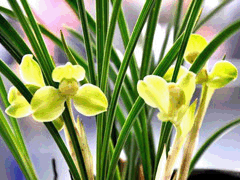 Hansusu (Wenhe). Qingtian in southern Zhejiang has green mountains and clear waters, and is a place that produces outstanding people. Along the Ou River, the mountains tower steeply, with range upon range of peaks,the four seasonsare distinct, and the climate is pleasant.Orchidresources are very abundant, especially the production ofCymbidium kanran. Some people also callCymbidium kanran"winter orchid" or "Ou orchid".
In the northwest of Qingtian County, along the tributary basin of the Ou River --- Wanshan Township. On the steep slopes of Jianfeng Mountain, at an altitude of about 400 m to 600 m, different varieties of Cymbidium kanran are found in broad-leaved forests where mountain streams flow and mist drifts. There are green-stemmed green-flowered, purple-stemmed purple-flowered, summer Cymbidium kanran, and others.
At the original habitat where the Cymbidium kanran was introduced, I roughly carried out seasonal temperature and humidity measurement and recording. In winter there is snow on the mountain peaks, yet the temperature in the broad-leaved forest is still 8°C; in summer during hot weather, the temperature under the broad-leaved forest is still 28°C, with a gentle breeze and fresh air. The relative humidity is 75%. Such a natural environment is indeed warm in winter and cool in summer, thus forming the growth characteristic of Cymbidium kanran that it fears heat and is afraid of cold. In early October 2001, I introduced and collected it from the mountain and divided it into two groups for cultivation.
Group one,cultivationThe growing medium used small- and medium-sized Xiantu, with medium-sized granular Xiantu as the bottom layer, and at one third of the way up, small-sized granules were used to cultivate upward until about one cm above the pseudobulb, then it was finished. Water thoroughly to settle the plants. Place it in the open air for care in a spot without direct sunlight. After the winter solstice, when the cold wave arrives, the temperature drops to 5°C. Below 5°C, Cymbidium kanran will be frostbitten, so it must be moved indoors to overwinter. At this time, water according to the dryness and wetness of the potting soil, and at noon spray the leaf surface to increase humidity. After the Spring Equinox of the following year, take it outside and place it in the open air for normal care (more than 70% shade is required). Cymbidium kanran has different water requirements in different seasons. In the rainy season from April to June, as long as the potting soil does not become waterlogged, the roots will not be damaged. In summer, when the temperature is high and the plant transpires heavily, water once every morning (depending on the growing environment). Splash water on the ground around the placed flower pot. First, to increase humidity, and second, to lower temperature; the maximum temperature should be controlled at about 30°C. Create an artificial growing environment. The survival rate of Cymbidium kanran was 100%, and the growth was good. The root system was thicker, whiter, and more developed than when collected from the mountain, and it bloomed every year.
Group two, under the same environment and with the same management method but with a different growing medium (humus soil, mountain soil) for care, obtained different results -- the plant root system was not developed, the plant grew slowly, the new shoots that sprouted were not robust, and it did not set flowers. The reason is that in the rainy season from April to June, the potting soil caked and had poor air permeability.
It can be seen from this that growing Cymbidium kanran requires determining many different care methods according to various factors such as the site, environment, and growing medium, so that Cymbidium kanran can grow well. In fact, growing Cymbidium kanran well is not difficult; as long as you master the appropriate methods, you will grow it full of vitality, with luxuriant leaves and abundant flowers.