A Detailed Explanation of the Traditional Aesthetic View of Jiangsu and Zhejiang Orchids
The Traditional Aesthetic View of Jiangsu and Zhejiang Orchids
 Times have changed, and people's ideas are changing.Orchidaesthetics has already formed a modern generational gap with the traditional. The modern one, influenced by Western culture, pursues novelty and fashion and values strange flowers; the traditional one, influenced by orthodox thought, still inherits the experience of the orchid-growing elders to examine and cultivate traditional famous varieties. This article only discusses Jiangsu and Zhejiangorchidsand the traditional aesthetic concept that dignity and plain elegance are considered superior; where inappropriate, experts are asked to correct it.
Orchidflowers'leavesare evergreen in all four seasons, with a uniquely elegant posture that ordinary ornamental plants cannot rival. The ancient Zhang Yu had a poem: "Weeping dew makes the light especially disordered, holding wind the shadow slants by itself. How can vulgar people understand this? Looking at leaves is better than looking at flowers." The shape of orchid leaves differs in length, width, and narrowness; the posture of the leaves differs in uprightness and curvature; the texture of the leaves differs in softness, hardness, thickness, and thinness; the color of the leaves differs in depth, lightness, brightness, and darkness. Traditionally, thick leaves, semi-drooping, glutinous texture, and luster are considered superior. When discussing orchids, Wu Yingxiang said: "The leaf gradually curves from above 1/3 of the base, and the tip droops or forms a semicircle, which is considered a beautiful typical form." When evaluatingCymbidium goeringiiWanzi leaf type, he said: "The leaves are long and thick, with deep veins, luster, semi-drooping, and beautiful curves." When evaluatingCymbidium goeringiiGuiyuanmei leaf type, he said: "The leaves are thick, semi-drooping, dark green in color, lustrous, and beautiful in leaf posture." What is said above is consistent with the traditional aesthetic standard, namely thick leaves, semi-drooping, glutinous texture, and luster. Painters of past dynasties in Jiangsu and Zhejiang painted orchids, whether fluttering in the wind, spreading on cliffs, accompanied by bamboo and stone, or with simple leaves and exposed roots; all took the fine-leaved orchid with beautiful leaf posture as their subject, which shows a glimpse of the ancient literati's standard for appreciating orchids.
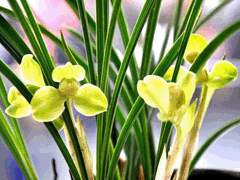
For orchid flowers, tradition holds that they must conform to the morphological characteristics of orchids, namely two whorls, six petals, and one column, with each whorl being three in number. If the number of petals in either whorl is more or fewer, it is regarded as a malformed variation, considered an oddity, and not valued. Orchid morphology is not only the characteristic that distinguishes it from other flowers, but also where the beauty of orchids lies; whether it can withstand the test of time is one of the important conditions. As the saying goes, thirty years east of the river, thirty years west of the river, while some traditional main
orchid
varieties of Jiangsu and Zhejiang have already existed for several hundred years. In this long historical evolution, they have withstood countless tests and have been passed down to the present, still standing invincible. Unlike some strange flowers that are prominent for a time and then plummet, with no hope of a comeback. The reason is self-evident: beauty and oddity are two different concepts. There is only aesthetic appreciation, not appreciation of oddity; only beauty selection, not oddity selection. The beauty of orchids is the eternal core.
The two whorls of an orchid are the outer whorl and the inner whorl. The outer whorl is the outer three petals, including one main petal (dorsal sepal) and two side petals (lateral sepals). The inner whorl is the inner three petals, including two column petals (petals) and one lip (labellum). The arrangement of these two whorls of petals reflects looseness outside and tightness inside, possessing structural beauty. The so-called looseness outside means that the main petal of the outer three petals thrusts upward, and the side petals open left and right, unrestricted and natural. Although the outer three petals are extended, they curve slightly inward and form a pocket; the main petal covers the column and column petals, playing a role of inner-outer correspondence. Therefore, if the outer three petals do not curl inward or lean backward, each acting on its own, they are inferior. The side petals are required to be level in a straight line, so that the main petal and side petals form an isosceles triangle. The isosceles triangle is a beautiful form, often used in the composition of painting and calligraphy. Side petals drooping are called "drooping shoulders," and drooping excessively is called "greatly drooping shoulders," forming an arrow-shaped triangle with the main petal, lacking beauty and appearing unstable, and are ranked as inferior. Among the shapes of the outer three petals, plum petal is first, narcissus petal second (another saying is narcissus petal first, plum petal second), and lotus petal third.
The so-called tightness inside means that the central palace of the inner three petals is compact and not loose. The column petals curl inward and form a pocket, tightly enclosing the column so that it is not exposed, and the flower shape appears very pretty and spirited. If the column petals spread open, commonly called "opening a skylight," it lacks restraint and destroys the overall beauty of the flower. There are many names for column petals, including silkworm moth petal, Guanyin petal, bean shell petal, clam shell petal, scissors petal, crab claw petal, cat ear petal, short round petal, palm-leaf fan petal, and chime-mouth petal. Although these names are quite vivid, some are difficult to understand. For example, silkworm moth petal takes the posture of a silkworm moth when it first emerges from the cocoon, but what is the posture of a silkworm moth emerging from the cocoon? How many people have seen a silkworm moth emerge from its cocoon? Even Wu Yingyang said it is not easy to understand. He understood silkworm moth petal as follows: "The base of the column petals is round, the tip is bluntly round, the edges curl and shrink into a pocket, and they embrace the column relatively closely, like the column petals of the Cymbidium goeringii Songmei and Lüying." Then Guanyin petal takes the image of the forehead of Guanyin Bodhisattva, which is another obscure reference; even among Buddhists, few can clearly explain Guanyin's forehead. Wu Yingxiang explained it this way: "The base of Guanyin petal is relatively narrow, the tip is broad and round, shrinking and curling into a pocket, embracing the column relatively tightly, even connected together, appearing oblong from the front, like the Cymbidium goeringii Longzi and Chunyipin."
Traditionally, silkworm moth petal is considered superior, Guanyin petal relatively inferior, and the rest are all inferior. In fact, it is not difficult to master the ability to identify these column petals. Since Songmei and Lüying are silkworm moth petals, and Longzi and Chunyipin are Guanyin petals, by adopting the method of matching them one by one, observing more and comparing more, practice makes perfect. If the images of the column petals of Songmei and Lüying and of Longzi and Chunyipin are firmly imprinted in your mind, what is there to fear about not being clear? The one below the center of the column petals is the lip. It also has many names, including Liu Hai lip, ruyi lip, large round lip, large spread lip, dragon-swallowing lip, large curled lip, large persimmon lip, and square-notched lip. The Liu Hai of Liu Hai lip is a fairy boy in folk myths and legends, with short hair hanging over his forehead. Later, the neat short hair left on the forehead by children and women was also called Liu Hai. The front end of Liu Hai lip begins to hang down like a waterfall from about 1/3 of the way, shaped like the Liu Hai hairstyle of children and women, such as the Cymbidium goeringii Songmei and Xishenmei. The ruyi of ruyi lip is a craft object carved from lingzhi-shaped material or other materials. The front end of ruyi lip is like the shape of the edge of a lingzhi mushroom cap, hanging flat and not curling, such as the Cymbidium goeringii Lüying and Fangzi. The lip is considered superior when short, round, and upright; pointed, narrow, or crooked ones are all inferior. As for the color of the lip, Cymbidium goeringii values white,Cymbidium faberivalues green. The red dots on the lip of Cymbidium goeringii may be one dot, two dots, or in a triangular arrangement, and may also be block-shaped or ingot-shaped;
Cymbidium faberi