The Beauty of Orchid Shoots: Another Perspective on Appreciating Orchids
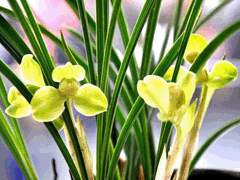 Perspectives and points of appreciation are extremely broad in the realm of art. Everyone has their own preferences and their own tastes. As long as they are healthy, there is no need to elevate one and disparage another; let each person have their spiritual freedom. Orchid shoots breaking through the soil, sturdy, pure, and full of vitality, like pearls and jade, are truly enchanting. Orchid shoots have their own beauty to appreciate.
Some orchid shoots look like ivory carvings, some like pearl grains, some like agate tips, some like emerald green jade. Most give people a feeling of purity, jade-like smoothness, sturdiness, and elegant simplicity. Pure and elegant like these "pearls and jades," flourishing with vitality - beautiful indeed, orchid shoots.
The purest orchid shoots, those containing no mixed colors whatsoever, not even the slightest trace of mixed color, can often produce solid-colored flowers - that is, flowers of a pure color, with no mixed-color spots, patches, or lines on the lip, whether white solid flowers, or red solid, yellow solid, light green solid, and so on - in short, pure-colored flowers. The color of the shoot often resembles the color of the flower: red shoots produce red flowers, white shoots produce white flowers. But there are also red shoots that produce pure whiteflowers, such as the red-shoot solid-color orchid in Zhongshan City, Guangdong. Things always have exceptions,orchidsare no different.
Orchid shoots are either blunt or pointed; some look like knife tips, some like peanut kernels. Orchid growers often prefer to select and plant those whose shoots look like peanut kernels, believing they may later produce large flowers, either lotus-petal type or plum-petal type, which would be more beautiful than ordinary orchids. Therefore, examining the color and shape of orchid shoots is also one of the secrets of orchid selection and breeding. Orchid growers have done much research on this. Every spring, when mountain orchids come to market, the stalls are filled with all kinds of newly collected mountain orchids. Buyers often direct their gaze to the orchid shoots of these mountain orchids, and some even carefully examine the shoots with a magnifying glass, hoping to make discoveries and predictions. There is no greater attention paid to orchid shoots than this. But apart from a very few orchid growers who can judge accurately and predict very well, buying at a cheap price orchid seedlings that will later produce superb flowers, most people still cannot judge accurately - thinking the shoots are very good, yet what blooms later is merely ordinary flowers. In this examining, hoping, and anticipating, in the shrewd foresight and careless misselection, there is also a wealth of life philosophy - it is even more painstaking than choosing a "successor" or choosing a romantic partner. The way orchid shoots mislead people is sometimes more dramatic than the way people mislead others in interpersonal relationships.
The ancients said: "Newborn things are ugly." I think this is only an observation of animals. Look at those kittens and puppies - some have not yet opened their eyes, some are covered in wrinkled skin, squeaking and crying, so ugly. Wait until they grow to maturity - young men and women, handsome lads and pretty girls - then they are beautiful. But with plants it is different. New shoots and tender seedlings, when they break through the shell or stem, are often pearl-like and jade-smooth, so beautiful. For plants, one could also say "newborn things are beautiful."
Although plants and animals both belong to living things, their manifestations are often completely different. Newborn animals are often ugly, while newborn plants are often beautiful - this is one point. Furthermore, animals often keep their reproductive organs (whether female or male) hidden, such as growing them in relatively concealed places. But plants are different - plants often display their reproductive organs (flowers, ovaries, pistils, stamens, fruits, etc.) openly, such as growing them in the most conspicuous places or appearing in the most conspicuous forms. Plants are ecologically far more sexual than animals. We do not go to appreciate animals' reproductive organs, yet we all go to appreciate plants' reproductive organs - appreciating their flowers, their pistils, their stamens, and so on. Is that not strange?
One of the perspectives for appreciating orchids can also be appreciating orchid shoots. This point, from the ecological characteristics of plants, is quite reasonable, and can also become a consensus among orchid enthusiasts.