Chats from the Banxin Garden (Part 3): Talking About Color in the Garden
Chats from the Banxin Garden (Part 3): Color
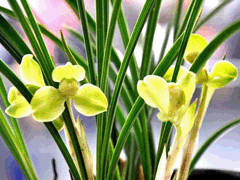 Color: The traditional view is that purity of color is paramount! Red, white and yellow are prized! Tender green is prized! Old green, yellow-green and the like are inferior!
In short, the color should be pure and bright - that is what is considered good! In fact, this all fits with the general public's sense of aesthetics!
The colored flowers currently produced in the Yunnan, Guizhou and Sichuan regions are numerous, and colored flowers often appear in other places too! But they often revert after reblooming to
flowers that are mainly in the green color range. Their instability restricts the development of differently colored flowers (here I will temporarily call color ranges other than the green range
differently colored flowers), and after the growing environment of some relatively more stable differently colored flowers changes greatly, their
color also changes to varying degrees! For this type of differently coloredorchidthere is considerable regional limitation, and at present there is still no
very convincing method to put forward - this is another hurdle! Before these few problems are solved, it seems the development of differently colored flower types
will not proceed very quickly! (in my personal opinion)
But most differently coloredflowershave rather poor stability, and the reason may be that the selection of coloredflowersstarted relatively late, and no theory has yet been formed for distinguishing
true colored flowers from false colored flowers!
At present the only method I know is that when selecting colored flowers, try as much as possible to choose ones where the color on the petals is uniform. Apart from the veins, which may be slightly different
in color, try not to have any other colors, and especially absolutely no green! The colored flowers selected this way are relatively
better in terms of stability. Because at present, in some relatively stable colored flowers, there is almost no other
miscellaneous color on the whole flower or the whole petal! Moreover, when a colored flower is made public, it should be stated how many times it has rebloomed, and if conditions permit, photographs of
each stage should all be taken well - this should be of great benefit to the study of colored flowers! Even if its color runs, one can still find
a clue in them, so as to improve the method of selecting colored flowers! This work, it seems, still has to be entrusted to orchid friends in the Yunnan, Guizhou and Sichuan regions
where colored flowers are abundantly produced!
Next is the currently rather popular term: compound-colored flower! Compound-colored flowers have many forms of expression, but in the traditional orchid appreciation
view this belongs to a major defect - impure color! Generally, the compound coloring of an orchid shows as a color at the base different from that of the petals
(mostly red and red-purple, while other colors such as yellow and white also occur but are not commonly seen!). Generally speaking, this kind of compound coloring is
stable, but once these deep colors are present, the color of the petals will generally be dark green!! Moreover, the color contrast is rather
poor, and the ornamental value is greatly reduced. There is also the case where the color at the tip of the petal differs from the petal color, generally
white or tender green! This kind of compound coloring is false; of the flowers of this type that I have seen, almost without exception they turn into
green flowers when they rebloom!
Basic requirements for selecting compound-colored flowers (personal opinion): the flower colors should contrast sharply and transition naturally. At present the most representative
and most stable are yellow-white compound-rimmed flowers, yellow-white claw flowers, green compound rims, green claws! Such flowers often correspond to leaf variegation,
generally displaying double art: leaf art and flower art! Such flowers have been seen inChunlan (Cymbidium goeringii),Huilan (Cymbidium faberi),Jianlan (Cymbidium ensifolium),Hanlan (Cymbidium kanran), all of them,
and although I have not seen other orchid species with my own eyes, I believe quite a few such flower forms exist there too! For red-purple and green compound-colored flowers, what is required is
high color contrast and clean boundaries in the transition, otherwise they look dirty, and even if stable, they are not pleasing to look at - I believe
they have no collectible value. (No one wants to see flowers they have grown called dirty!) Moreover, such flowers are especially numerous in Anhui
and the Henan area. Last year, when I looked at the orchids brought up by orchid vendors from Anhui and Henan, almost all were this kind of flower!!
In the development of colored flowers,Molan (Cymbidium sinense)is at the forefront, with quite a few relatively stable varieties, (Yufei, Xinniang, Hongniang and so on
!!) but after the climate and geographical environment change too greatly, there is also color-running to varying degrees! AndSijilanalso has quite a
few fine named colored flowers (Sishui Gang, Yuxue Tianxiang and so on). Among the traditional varieties of Sichuan orchids (Chunjian), the very famous "Red and White Two
Grasses" - but the large-scale discovery of colored flowers is also a recent matter! Yunnan'sLianbanneed not even be mentioned - so many colored ones... Guizhou's chun
lan has also produced a large batch of colored flowers in recent years! Appreciating colored flowers is indeed a broad-prospect way of appreciation, but perhaps in the future
after orchid friends see this type of flower, the main aspect they will care about is how its stability is! Moreover, colored flowers should as far as possible not
be bought by looking at photographs, because the color and luster of the flower shown in photographs taken with frontlighting and backlighting will differ greatly.
Among colored flowers there is also a major category, namely Suxin (plain-heart)! Suxin is possibly the most fully developed category among colored flower types.
Almost every orchid species has quite a few fine named varieties of this kind! Yunnan's Da Xue Su and Xiao Xue Su (representative varieties of Lianban white-flowered plain-heart),
Jin Ao Su (a representative variety of Huihua green-moss plain-heart) and so on! The key part of Suxin is the tongue, that is to say, there is no miscellaneous color on the tongue
! A true Suxin should have a uniform color on the tongue! Within the Suxin category there are also Peach-Cheek Suxin and Stinging-Hair Suxin! Peach-Cheek
Suxin: as the name suggests, it is like the blush on a young girl's face; if it is a red patch, then it is not Peach-Cheek! So Peach-Cheek Suxin means
there is a little blush at the edge of the tongue; if it is a red patch, then it is not, and at most it is called White Tongue! And Stinging-Hair Suxin is when there is a colored halo at any
position on the surface of the tongue; because its position is more obvious than Peach-Cheek Suxin, like hair or spots on a face (but very faint), it is rated even lower!
Among the Suxin of Huihua there are also distinctions such as green moss and yellow moss! The tongue of Huihua is very distinctive, like a human tongue covered all over with
taste buds, more obvious than in other varieties! And for Huihua Suxin, green moss is prized!
Addendum: Also, amongwild-collected orchidsthere are quite a few false colored flowers, formed because the place where they grew was rather dim; when they first open the color is yellow
or white, and after exposure to light it turns back to green. If it reblooms again, it will undoubtedly be green!
To be honest! I very much want to produce something with both pictures and text! Because the materials at hand are limited, I can only postpone it! Later I
will revise and edit this article and add materials! Please forgive me, orchid friends!