Why does Chinese Cymbidium kanran need to be re-understood?
A Re-understanding of Chinese Cymbidium kanran
 ACymbidium kanranRe-understanding
-- A speech delivered at the Chinese Cymbidium kanran Research Conference Liu Qingyong
Chinese people's understanding of Chinese Cymbidium kanran can be traced back roughly to the "Jinzhang Lanpu" of the Southern Song Dynasty. Although at that time there were no photographs or drawings of variousorchidsand the textual descriptions were not detailed, making it difficult to determine, yet among the varieties described in that book, the shadow of Cymbidium kanran can be faintly seen. A greater understanding of Cymbidium kanran should be a matter of the post-founding era. In the past twenty to thirty years, under the impact of multiple orchid booms, although Chinese people's understanding of Cymbidium kanran has continuously deepened, because among the various types of Chinese orchids Cymbidium kanran has always remained in a half-cold, half-hot state, therefore, Chinese people still need further understanding of Cymbidium kanran. The author has previously written several articles about Cymbidium kanran, and now based on recent insights into Cymbidium kanran, I will write a few points of re-understanding.
I. Cymbidium kanran is one of the most resource-rich species among all types of Chinese orchids
The distribution of Cymbidium kanran in our country can be divided into nine major blocks. 1. Wuyi Mountain Cymbidium kanran from Lishui and Longquan in Zhejiang to the Wuyi Mountain and Shaowu area. 2. Cymbidium kanran in southern Fujian, southwestern Fujian, and northeastern Guangdong, such as the area of Nanjing, Shanghang, Wuping, Jiaoling, and Pingyuan. 3. Cymbidium kanran from Yifeng in western Jiangxi to the Jinggang Mountain area. 4. Cymbidium kanran in southern Jiangxi, northern Guangdong, and southeastern Hunan from Xunwu to Xinfeng, Nanxiong, Renhua, Rucheng, and Zixing. 5. Cymbidium kanran in the border area of Hunan, Chongqing, and Guizhou. 6. Cymbidium kanran is produced in almost all of Guangxi. 7. Cymbidium kanran in southern Guizhou. 8. Cymbidium kanran in southern Sichuan. 9. Cymbidium kanran in southern Yunnan. These nine blocks have relatively concentrated Cymbidium kanran resources, and some populations are almost as dense as vegetation. Other mountainous areas south of 30 degrees north latitude in our country also have scattered distribution. North of 30 degrees north latitude, only reports ofCymbidium goeringii、Cymbidium faberihave been seen, with no reports of Cymbidium kanran. In summary, among the various types of Chinese orchids in our country,Cymbidium goeringiiand Cymbidium kanran have the most abundant resources, whileCymbidium tortisepalumCymbidium bicolorCymbidium sinensehave fewer resources. Cymbidium sichuanicum,Cymbidium faberiandCymbidium ensifoliumhave the next most resources.
In the past, we saw relatively few Cymbidium kanran in orchid markets, orchid shows, and orchid gardens, and thought that Cymbidium kanran had few resources. This is actually a misunderstanding of Cymbidium kanran. It should be said that Cymbidium kanran is an orchid species in our country that has not yet been fully developed, and is a cold-type orchid with great potential.
Among the Cymbidium kanran produced in the above areas, classified by fragrance type, they can be divided into strong-fragrance type, light-fragrance type (such as certain summer Cymbidium kanran), and non-fragrant type (certain Cymbidium kanran have no fragrance at all, which should be noted when selecting and breeding varieties). Classified by flowering season, there are winter Cymbidium kanran, spring Cymbidium kanran, and summer Cymbidium kanran. Classified by leaf type, there are broad-leaf (large-leaf) Cymbidium kanran and narrow-leaf (thin-leaf) Cymbidium kanran; there are thick-veined Cymbidium kanran and sunken-veined thick-leaf Cymbidium kanran. Other appreciation points are roughly the same as other orchid species, such as those with butterfly-shapedflowersare called butterfly-flower Cymbidium kanran, those with plain-colorflowersare called plain-color Cymbidium kanran, and so on.
II. Cymbidium kanran is the orchid species with the richest appreciation points among Chinese orchids
This point may be debatable. In any case, the development of Cymbidium kanran resources has not yet been sufficient. If fully developed and a large number of famous varieties appear, we will find that Cymbidium kanran has many appreciation points. At present, many articles have been published about the appreciation points of Cymbidium kanran, and many valuable opinions have been put forward. Can it be summarized as follows:
1. All expressions of Cymbidium kanran that conform to the general principles of life beauty, natural beauty, formal beauty, color beauty, and spiritual charm beauty are beautiful and can be appreciated.
2. All expressions of Cymbidium kanran that conform to the commonly used appreciation principles of other Chinese orchids are also beautiful, and can compare in beauty with the same type of appreciation points of other Chinese orchids. There is no problem that appreciating Cymbidium kanran with the appreciation points used for other orchids is inappropriate or wrong. For example, appreciating the lotus-petal flowers and plum-petal flowers of Cymbidium kanran (sporadic discoveries of true lotus-petal and true plum-petal Cymbidium kanran have already been made) with the same standards used for appreciating Cymbidium goeringii is equally beautiful, and appreciating the transparent-vein and spotted-stripe patterns of Cymbidium kanran with the same standards used for appreciating Cymbidium sinense is equally beautiful. They are all domestic orchids of the Orchidaceae family, Cymbidium genus, and many appreciation points are similar. Sometimes not discovering a certain type of appreciation point in a certain type of orchid for a time does not mean that this type of orchid does not have this type of appreciation point. For example, black flowers have not been found in Cymbidium kanran now, but other orchids have them, and Cymbidium kanran may very likely have them in the future.
3. Various Chinese orchids have common appreciation points, but it is undeniable that each also has its own strong appreciation points and unique appreciation points, and Cymbidium kanran is no exception.
Cymbidium kanran rarely has standard petal-type flowers. Regarding the appreciation of Cymbidium kanran, attention can be paid to the following aspects.
1. Look at its plant type and leaf posture; those with an imposing bearing, tall and elegant beauty, graceful and varied postures, and a gentlemanly appearance are good. Others such as crystal and dwarf varieties are appreciated the same as general orchids.
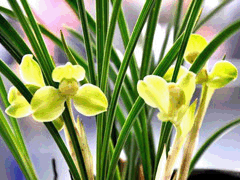
2. When looking at Cymbidium kanran flowers, attention can be paid to the lip petal. Japanese people place great importance on the lip petal when appreciating Cymbidium kanran. In appreciating the lip petal of Cymbidium kanran, in addition to appreciating the fringe lip, Ruyi lip, round lip, dragon-swallowing lip, gui-holding lip, etc. as beautiful just like when appreciating the lip petals of Cymbidium goeringii and Cymbidium faberi flowers, one can also appreciate the following types of lips based on the ecological characteristics of Cymbidium kanran:
(1) Broad long lip: the lip petal is particularly broad and long, like a hanging flag. The lip markings are elegant and beautiful.
(2) Broad round lip: the lip petal spreads out broadly and moistly into a semicircular shape. The lip markings are regular and brightly beautiful.
(3) Large pointed-corner lip: the lip petal forms a broad, large horn shape. The lip markings are regular and delicately beautiful.
(4) Broad shield lip: the fragrant petal is like a shield, strictly neat and dignified.
(5) Broad wasp-waist lip: the upper part of the lip petal is constricted at the waist, and the lower part is either broad and long or broad and long-cornered, shaped like a wasp's waist. This is a masterpiece of plants imitating animal forms in order to lure insects out for pollination.
The lip petal of Cymbidium kanran is often broader and larger compared with its sepal petals and petaloids, like the top petal of Paphiopedilum, thus becoming like a flag, emblem, badge, or trademark, and becoming a prominent appreciation point in its flower.
3. When looking at the sepal petals and petaloids of Cymbidium kanran, in addition to the extremely rare true lotus petals, plum petals, and narcissus petals that have been discovered being rated as top-grade, one can also appreciate its dragonfly petals (the petaloids form a pouch like dragonfly eyes, and the sepal petals are narrow and long like dragonfly wings), which can be rated as upper-grade or middle-grade. Appreciating the dragon-claw petals of its sepal petals, looking at their dynamic posture, such as the dynamic postures of flying birds and running beasts, and those with good color and texture can be rated as upper-grade or middle-grade. Furthermore, one can appreciate the white rim of its sepal petals and petaloids; this type of flower mostly appears in green-flower Cymbidium kanran, and Japanese people quite welcome this type of Cymbidium kanran with white-rimmed flowers.
III. The bottleneck hindering the development of Cymbidium kanran iscultivation。
The current situation of Cymbidium kanran is that there are quite a few good varieties, but the number of seedlings of each good variety is not large. Some good varieties collected from the wild cannot survive more than a few years of cultivation and then disappear, dying off. Regarding the popularized cultivation of Cymbidium kanran, further research is still needed. Summarizing the experience of cultivating Cymbidium kanran from various places, the following points can be used for reference.
1. The growing medium can be on the acidic side. The growing medium for other Chinese orchids is neutral (neither alkaline nor acidic, and they can also be cultivated well). Some production areas of Cymbidium kanran are in red sandy soil zones, which are acidic. Of course, excessively acidic is also not acceptable.
2. The air should be on the humid side, and the inside of the pot should be on the dry side. Cymbidium kanran fears excessive moisture inside the pot.
3. The growing medium should be on the soft side. Generally, it cannot be cultivated entirely with orchid stone (hard growing medium); some humus soil should be added.
4. The orchid pot should be relatively tall. Cymbidium kanran plants are generally relatively tall with long root systems, so the bucket pots commonly used in Sichuan are suitable. If using the traditional open-mouth pots used in Jiangsu and Zhejiang for cultivating Cymbidium goeringii, they are too short, and if using plastic trumpet pots, the lower part is too narrow; neither is suitable for the growth of Cymbidium kanran roots.
5. The light intensity should be on the shady side.
IV. Regarding the promotion of Cymbidium kanran.
There is now a Chinese Cymbidium kanran Research Conference, and also a Chinese Cymbidium kanran website. Specialized promotion is very beneficial to the development of Cymbidium kanran. Orchid shows in various places should not neglect the evaluation and selection of Cymbidium kanran, so as to facilitate the further promotion of this type of orchid. The spring of Cymbidium kanran is about to arrive. May Cymbidium kanran enthusiasts nationwide strive to promote it and welcome the arrival of the spring of Cymbidium kanran.