Complete Archive and Detailed Explanation of the Jiepei Mei Orchid Variety
Complete Archive of Jiepei Mei
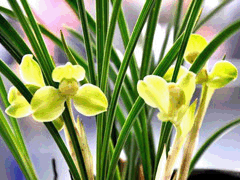 Jiepei Jiepei Mei" in the Shen father and son's "Orchids" it is recorded: "A red-shell type green-flowered plum-petal variety. History: selected in the early Republic of China by a person surnamed Zhang from Shanghai. Characteristics: the three petals are emerald green, with tight edges, short feet and round heads, a white jade hold-heart, a large ruyi tongue, and slender flower scapes. When the flower bud first opens its petals the flower shape is somewhat small, gradually growing larger as it opens, and the flower posture is upright and strong. The leaves are narrow and slender, arching in shape; it propagates quickly and blooms vigorously."
Regarding the selection of "Jiepei Mei", most orchid authors state that it was "selected in the early Republic of China by a person surnamed Zhang from Shanghai." The record in "Three Hundred Questions on Chinese Orchid Art" is also the same: "The red Hui plum 'Jiepei', also known as 'Jianggao Mei'. Selected in the early years of the Republic of China by an orchid lover surnamed Zhang from Huxi (Shanghai). The term 'Jiepei' comes from the Tang dynasty poet Yang Shen's ci poem 'Ode to the Orchid': 'Fragrance carried filling the sleeves, as if meeting Jiepei, the river immortal scattering worldly ties.' This was cited for the naming." "Fifty Years of Orchid Growing Experience", Wu Yingxiang's "Chinese Orchids", "Nai'an Ju Orchid Growing Notes", "Jiangsu and Zhejiang Orchids and Huis", "Orchid and Hui Treasure Mirror" and others mostly adopt this record. But we should note that "Three Hundred Questions on Chinese Orchid Art" only explains "Jiepei". Then how should this "Jianggao Mei" be explained?
Regarding the time of selection of "Jiepei Mei", the 1937 publication "Orchid Splendor" has a record: "Jiepei Mei, this variety was a famous flower discovered by the notable Mr. Zhang of Huxi (western Shanghai) in the Jiwei year, and only bloomed after four years of cultivation." The book "Summer Orchids" compiled by the elderly Mr. Guan Wenchang lists both "during the Republic" and the "Jiwei year" 1919 in the book. It should be said that the earliest orchid work recording "Jiepei Mei" is the 1930 "Continued Orchid and Hui Tongxin Record" by Feng Zicai of Shangyu. In this orchid work, in <Fang Tu Jiu Wan>, Mr. Feng recorded this Hui flower, calling it "Jianggao Jiepei Mei" and listing it under red Hui lotus-form narcissus. Please see: "Jianggao Jiepei Mei, a red Hui lotus-form narcissus. In the Yimao year of the Republic of China it emerged in Shanghai and was obtained by Mr. Zhang Jiangzhi. It was divided and gifted to Mr. Hui Yuting and Mr. Zhu Nianci. I obtained it through Wang Zhangyou. The color is green, the edges tight, the flesh thick, the shoulders level, with silkworm-moth hold-heart and a large ruyi tongue. When blooming it goes from small to large; it is an excellent variety." A line-drawing illustration is left. What is recorded in the "Anonymous Orchid and Hui Atlas" is basically the same as in the "Continued Orchid and Hui Tongxin Record", though in the text "Zhang Jiangzhi" is recorded as "Zhang Jiangsan", which is likely a clerical error.
"The Yimao year of the Republic of China" is 1915 AD. The selector was Mr. Zhang Jiangzhi of Shanghai. Then, is the selection time of "Jiepei Mei" recorded in "Orchid Splendor" the time of "only blooming after four years of cultivation"? Otherwise, this 1919 date would be a coincidence. Mr. Zhang Jiangzhi can no longer be verified today, but what should be certain is that this person was a Hui flower enthusiast in Shanghai at the time. The two people Hui Yuting and Wang Zhangyou we have already introduced in the Hui flowers "Xian Mei", "Yushan Mei",Spring Orchid"Cui He" and other places, so we will omit them here; the person Zhu Nianci cannot be verified. In modern China there was a very famous Mr. Zhu Nianci, a native of Jiashan, a contemporary Chinese arts and crafts master, a fan-face calligrapher, skilled in true-gold fan-face calligraphy, whose main works are known for ten-thousand-character fans. However, this Zhu Nianci was born in 1922, and by the time the "Continued Orchid and Hui Tongxin Record" was completed in 1930 he had only just turned eight, so he obviously does not match.
The explanation of "Jiepei" in "Three Hundred Questions on Chinese Orchid Art" shows some insight, because Yang Shen's ci poem is "Ode to the Orchid". Historically there are many stories and poetic sources for "Jiepei". As for where the namer took it from, it is hard to say. Among ci tune titles there is a "Jiepei Ling"; in the Yuan dynasty there was also the story of "Zhu Xiaoji pitying talent and untying her pendant". Zhu Xiaoji was born in Suzhou. During the reign of Emperor Shun of Yuan her family declined and she was sold to a family surnamed Yu. Later she became acquainted with Zheng Hanqing, the most famous talented scholar of the late Yuan in Jiangnan, who wrote eighteen zaju plays including "Fu Nü Li Hun". Zhu Xiaoji and Zheng Hanqing fell in love at first sight. Zhu Xiaoji married Zheng Hanqing and went with him to Hangzhou. Later the young master of the Yu family abducted Zhu Xiaoji. Zhu Xiaoji was indescribably grief-stricken and indignant, cut off her beautiful hair, and damaged her clothing, declaring "I would rather die than suffer humiliation!" Zheng Hanqing rescued her from danger by every means and brought her to settle in Minzhong. That year their friend Chen Bofu on West Lake specially wrote a poem and sent it to them, which included the lines: "Why need autumn leaves serve as matchmaker, the red duster in the painted hall would pity talent; the young lord of Xingyang passed leaving his whip, the fair one of Xiangpu came untying her pendant." Can we not explain the naming of "Jiepei Mei" according to this story? Let us look further on.
In Song ci poetry, Li Qingzhao in a ci poem <Duo Li. Ode to White Chrysanthemum > has a passage: "Gradually autumn wanes, snow-pure and jade-slender, endlessly lingering toward people. As if grief congealed, like Han Gao untying the pendant, as if tears sprinkled, like the round fan inscribing a poem." Here "Han Gao untying the pendant" refers to the story of Zheng Jiaofu meeting two immortal maidens at Han Gao in Chu territory who untied their pendants and gave them to him. In "Biographies of Immortals" volume one "The Two Daughters of the River Concubine" it says: "The two daughters of the River Concubine, it is not known where they were from. They traveled out to the banks of the Jiang and Han rivers and met Zheng Jiaofu. He saw them and was delighted, not knowing they were divine beings. He said to his servant: 'I want to go down and ask for their pendants.' ... Then with her hand she untied her pendant and gave it to Jiaofu. Jiaofu, delighted and enamored, placed it in his bosom at the center of his chest. After going some dozens of paces, he looked at the pendant, but his bosom was empty with no pendant. He turned to look at the two daughters, and they had suddenly disappeared." The "Han Gao untying the pendant" mentioned here and the "Jiang Gao untying the pendant" mentioned in the "Continued Orchid and Hui Tongxin Record" should be interconnected. "Traveled out to the banks of the Jiang and Han rivers" - here "Jiang" and "Han" should express the same meaning. Chu territory is where the Han River and Yangtze River meet. Therefore saying that the name "Jianggao Jiepei Mei" was taken from "Biographies of Immortals" volume one "The Two Daughters of the River Concubine" has a certain rationale. Moreover, the record in "Three Hundred Questions on Chinese Orchid Art" that "the red Hui plum 'Jiepei', also known as 'Jianggao Mei'" also has a relatively comprehensive and reasonable explanation, avoiding the limitation of explaining only "Jiepei Mei" while dropping "Jianggao Mei". It also corroborates that the "Continued Orchid and Hui Tongxin Record" and the "Anonymous Orchid and Hui Atlas" calling it "Jianggao Jiepei Mei" indeed has a basis. As for the ins and outs of "Jiepei Mei", we will stop here for now. It is time to talk about the orchid qualities of "Jiepei Mei".
The leaf posture of "Jiepei Mei" curves and droops, presenting a ring-drooping shape. The leaf color is deep green with obvious luster, a medium-fine leaf shape, with a "v"-shaped leaf groove, the leaf tips slightly long and pointed, reaching up to 1cm in width, and leaf length around 40--50cm. The flower bud when first emerging from the soil is pinkish red, gradually turning green, with light red-purple vein lines. The front tip of the flower bud is clearly hollow, and the bud sheath has a white edge. The small stamen head shape is the "centipede clamp style" of the clever-variety category among the "five gates and eight styles" (some also consider it the "small flat-cut style" of the clever-variety category). The flower scape is green and slender, with a scape height of about 45cm. The small hairpins are long and well spaced, purple-red, bearing 9--11 flowers. The flower bud is slightly small when emerging from the sheath, and as the flower opens over several days the petal width increases. The outer petals present a contracted-base flared-corner form, with tight edges, level shoulders and thick flesh. The main petal is in an upward-covering state, with an emerald green color. The hold-heart is the famous white jade hold-heart, slightly parted so the stamen column is visible; classified by the form of the hold petals, it should belong to the silkworm-moth hold-heart. Because the small flower stalks are purple-red and the petals are a white jade hold-heart, there is the saying 'red hairpin and green jade'. The tongue is in the large ruyi shape, with purple-red patches inside the tongue. "Jiepei Mei" is a diligent plant and diligent bloomer, with strong reproductive capacity and vigorous growth, and when it blooms it is richly fragrant, with an upright and beautiful flower posture, much loved by orchid growers. Nowadays orchid people classify it among the plum-petal flowers, mainly determined by the silkworm-moth hold-heart and ruyi tongue of the central structure; the "Continued Orchid and Hui Tongxin Record" listed it under lotus-form narcissus mainly based on the contracted-base flared-corner form of the outer petals. If one looks only at the long feet of the outer petals and the slightly pointed tips, such classification also has a certain rationale.
Jingjiang City, Jiangsu Province, holds the nationwide reputation for "Jiepei Mei". Hence there is the name Jingjiang Jiepei. It is said that Jingjiang has tens of thousands of "Jiepei Mei" plants. In the article "Jingjiang Jiepei Tops the World" by Mr. Lu Mingxiang of Yuxiu Orchid Garden in Jingjiang City, Jiangsu Province, it says: "Jingjiang people growing Jiepei has a long legendary history, and it is a long story. In the early Republic of China, a Jingjiang money-house boss Liu Rongqiu exchanged several varieties including Jiepei from the Rong family of Wuxi at the price of 'one dan of rice for one plant'. Unfortunately, during the War of Resistance they were plundered completely by the Japanese devils. Fortunately, the son of the boss of the Jingjiang Yuheng distillery, named Liu Xinzhi (then instructor at the Jingjiang County sports field, later a physical education teacher at Jingjiang County Middle School), had introduced several pots of orchids including Jiepei from Liu Rongqiu before the outbreak of the War of Resistance. In 1937 Jingjiang was occupied by the Japanese devils. When Liu Xinzhi fled as a refugee he took nothing except his beloved several pots of orchids. After the victory of the War of Resistance he returned to Jingjiang and continued to cultivate them, putting them in the People's Park greenhouse each winter to overwinter. In 1965 the director of the People's Park, Liu Luping, obtained four pots of famous orchids including Jiepei from Liu Xinzhi on several occasions, treasuring them like a great prize, cultivating them with care, and focusing on developing orchids in the park. During the Cultural Revolution orchids became 'fragrant flowers and poisonous weeds' and were listed as targets for destruction by the Red Guards. The park hid the orchids here and there, and only then was Jiepei Mei preserved. After decades of development, the number of Jiepei Mei in Jingjiang People's Park increased greatly, and now there are nearly ten thousand plants. In the "Jiangsu Provincial Gazetteer · Landscape and Garden Gazetteer" it is recorded: 'The director of Jingjiang People's Park, Liu Luping, specially established an orchid garden and collected famous varieties, ... among which the possession of Jiepei Mei ranks first in the country. In May 1987, Jingjiang Jiepei for the first time participated in the China Flower Expo held in Beijing and won the Quality Exhibit Award.' At the same time Jiepei Mei also spread widely among orchid lovers in Jingjiang, and its folk collection quantity also ranks first in the country. Those with larger quantities, such as Liu Luping, had several thousand plants, and ordinary ones also had several hundred plants. It can be said that in Jingjiang, anyone whogrows orchidsmust own several pots of Jiepei.
Among the thousands of pots of Jiepei in Jingjiang, there are also some with peculiar forms that are quite eye-catching. For example, what Jingjiang orchid friends call 'Big-flower Jiepei' has leaves wider than 1cm, shallower leaf grooves in a "u" shape, a higher leaf frame, and a leaf clump more imposing than Jiepei. The flower bud has a mercury-red sheath, and the upper part is not tight with a hollow head reaching more than 1cm. Its flowers are larger than ordinary Jiepei, yet the flower form is similar to Jiepei, and the stamen column is also visible on the back of the hold-heart. Another example is what Jingjiang orchid friends call 'Drooping-leaf Jiepei', whose leaf width is also relatively wide at about 1cm, with a ring-drooping leaf posture, shallow leaf grooves, and the upper hollow head of the flower bud also reaching more than 1cm. The flower stalk when first emerging is black-purple, turning green relatively late. Its flowers are also larger than ordinary Jiepei, yet the flower form is also similar, and the stamen column is visible on the back of the hold-heart.
At the 2000 Hangzhou Orchid Exhibition, our city's Liu Luping (vice chairman of the Jiangsu Provincial Orchid Association) submitted four pots of Jiepei for exhibition, of which three pots won awards. It is said that at award evaluation there was considerable controversy, with most judges believing that among these four pots only one was Jiepei and the other three were not Jiepei."
The "peculiar forms" of "Jiepei Mei" that Mr. Lu Mingxiang speaks of, on the one hand, are because different cultivation environments, the strength or weakness of the grass, the level of temperature, and the different humidity in the pot at flowering time will produce different blooming forms; on the other hand, I personally think whether other varieties exist among them. Of course, the "other varieties" I speak of do not refer to those newly named new varieties, but to traditional old varieties. It is said that "Jiepei Mei" currently has 18-20 new appellations externally. According to feedback from orchid friends, in recent years at orchid exhibitions the "Yixing Mei", "Yixing Hui Mei", "Jingxi Mei", "Gucheng Mei", "Gengquan Mei", "Liuchun", "Jin Mei", "Cuidi", "Yongyan", "Yongchun Mei" and so on seen are very similar in flower quality to "Jiepei Mei". Of course, similar flower quality does not necessarily mean it is "Jiepei Mei". Let us set aside the "new varieties" for now.
"Yixing Mei" should be "Xianlu". "A Brief History of Orchids and Huis": "Xianlu is also called Yixing Mei, also called Later Shanghai. Three petals with long feet and round heads, parted central structure, goat-horn wrap hold-heart, tongue long and not curling. Dealers use it to pass off as Former Shanghai Mei."
"Gengquan Mei" is also called "Zhenpin". The Shen father and son's "Orchids": "Selected in 1930 by He Gengquan of Wujin, Jiangsu, and named Gengquan Mei at the time; in 1941 it was planted again by Mr. Xie Duanshan of Suzhou and bloomed again. Because its flower form and bearing belong to a rare variety, it was then given the new name 'Zhenpin'; afterward the orchid world once called it 'Dicui' (same name but different object as the 'Dicui' that was lost in the late Qing dynasty). Three petals with round heads, slightly tight edges with pointed tips, contracted base, soft wrap silkworm-moth hold-heart, parted central structure, small ruyi tongue, slender and upright flower scape. It is one of the rare and precious varieties among modernHui orchids. The author has since 1934 cultivated many pots." Some also say this variety was selected by Zhu Gengquan of Changzhou.
"Jin Mei", the Shen father and son's "Orchids": "Selected in 1948 by Mr. Jiang Jinhuai of Wuxi. Three petals with large heads, tight edges, fine contracted base, silkworm-moth hold-heart, small round tongue. Flower color emerald green, flower appearance dignified and elegant." According to Mr. Jiang Jinhuai's introduction, this variety was obtained from a basket consignment when he went to Hangzhou to visit Zhu Youren.
"Yongchun Mei", "Orchid and Hui Tongxin Record": "Red Hui Yongchun Mei: a new variety of the Dinghai year. Produced in the sand-stone mountain of Fuyang. The flower is similar to Yuanzi, but with tighter edges. Brought by the mountain trader A Yong, obtained by prefect Wu Youyun, and mailed to me to be given a name. I considered that the flower resembles Yuanzi; Yuan means the head of spring, Fuyang is also called Fuchun, and it was found by A Yong, hence the name Yongchun. The flower light turns green, the flesh thick and glutinous; it is an excellent variety. The leaves are broad and ringed, slightly narrower than Yipin. Four stems of grass, all spread on the pot surface, then the flowers are taller and more spirited, even better." According to Mr. Yan Xiongfei of Tongzhou: "The fine Hui flower Yongchun Mei was produced in the sand-stone mountain of Fuyang, Zhejiang. When I divided the pot a month ago, a piece of mercury-red appeared from the orchid soil at the flower bud. The flower bud is unusually large, jade-moist and pearl-round. A traditional variety lasting nearly 120 years is about to bloom again! In cultivating this Hui, use slightly less water and give slightly more fertilizer, only then can the plants be strong and show flowers!"
"Liuchun" came from Yixing, cultivated by Gu Shuqi, a red-green plum Hui, three petals with round heads, soft hold, round tongue, green color, level shoulders, tall scape.
"Cuidi", in the winter of 1948, collected by Zhang Jinsheng of Shaoxing at Tianmu Mountain, cultivated by Gu Shuqi, a red-turning-green plum petal, three petals with long feet and round heads, parted central structure with thick glutinous substance, hard hold dragon-swallowing tongue, green color, level shoulders.
Most of the others were selected and recorded relatively late, so we will not introduce them one by one. The reason we introduce these old Hui flower varieties is that, apart from the phenomenon of "Jiepei Mei" being used to substitute for them, could it be that among "Jingjiang Jiepei" there do not exist these or some old variety as mentioned above? The "Big-flower Jiepei" and "Drooping-leaf Jiepei" that Mr. Lu Mingxiang mentions in the article "Jingjiang Jiepei Tops the World" are indeed worth pondering. I cannot recall which gentleman once said: "There are two kinds of Jiepei: one is the common one on the market, and another is not many. At the time Ding Yongkang got it from Changshu and later brought it to Nantong. At that time in Nantong the former sold for 500 yuan per plant, and the latter for 800 yuan per plant. Huiflowersare very deep in knowledge, and it is not easy to understand them!" I personally believe there is only one kind of "Jiepei Mei". No matter how the blooming form differs or is similar, one variety cannot become two varieties or three varieties; it can only indicate that other old varieties are mixed in among them, only that they have not been carefully separated out. What I say is not meant to imply deliberately using "Jiepei Mei" to substitute for old varieties with ulterior motives, nor to excuse creating new names. The online Yangxian Lanchi (screen name) once said a passage: " With the expansion of Hui orchid exchanges in various places in recent years and the improvement of the general orchid friends' level of understanding, they have also gained a clear understanding of the different blooming forms of Jiepei. However, one thing to note is that there are still people today using Jiepei to pass off as other varieties to deceive people, which is truly wrong. When one's level of understanding is not high, getting a variety wrong is understandable and forgivable, but some flower dealers buying Jiepei at low prices and then passing it off as other varieties at high prices to deceive people is unforgivable!" I only hope that orchid lovers who love Huis can all earnestly clarify this variety, for the present of the orchid world and also for the future.
In Japan, apart from "Orchid Splendor", the 1992 (Japanese Heisei 4) "Chinese Spring Orchid Inscription Mirror", the 1973 (Japanese Showa 48) "Chinese Spring Orchid Inscription Mirror", the 1979 (Japanese Showa 54) "Hui Orchid Inscription Mirror" and the "Single-Stem Nine-Flower Inscription Flower Collection" respectively include the variety "Jiepei Mei".
We will not discuss the past plant prices of "Jiepei Mei". In May 2003, the price per plant was around 500 yuan, and now a year has passed, and the plant price is already around 1000 yuan. Of course, compared with other old Hui flower varieties, this one is already a low-priced variety.
"Jiepei Mei" won the gold award at the 13th China Orchid Expo in Dali City, Yunnan in 2003; at the Orchid Exhibition of the First China Orchid Culture Expo in 2004, the "Jiepei Mei" submitted for exhibition by Chen Yaoxiang of Wuxi City, Jiangsu won the bronze award.
In the "Continued Orchid and Hui Tongxin Record" there is an accompanying poem for "Jianggao Jiepei Mei": "Its appearance is plum blossom yet it is not plum, if not plum how could it seize the plum's foremost place. In the remote Xiaoxiang it is called king, with pure aspiration and fragrant conduct, escaping the common mold."
Excerpted from "Orchid Treasure Classic"