After passing the three tests, cymbidium orchids send up new shoots in abundance and grow vigorously
After the "three tests," cymbidium orchids surge with new shoots
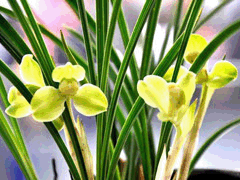 Cymbidium orchid (Cymbidium faberi), also known as Jiuzi Lan, Jiujie Lan, Xia Lan, and Xing Lan. In recent years, as cymbidium orchid shows in places like Jiangsu and Zhejiangcymbidium orchidhave increased day by day, people through viewing and judging have been deeply impressed by its sturdy leaf posture, many flowers rising above the leaves, overflowing delicate fragrance, and elegant bearing with the air of a scholar-official,cymbidium orchidenthusiasm has grown ever higher, and prices have climbed all the way. Thus the issue of the sprouting rate of famous cymbidium orchid varieties has become a hot topic of discussion among orchid enthusiasts. So how can the sprouting rate of cymbidium orchids be improved? Through 4 years of practice, I believe one must pass the "three tests" well. 1. Pass the introduction test well; strong seedlings and good roots are the foundation. As the saying goes, "deep roots, lush leaves." A good root system is crucial to plant growth and development, and this is especially true for cymbidium orchids. Practice has proven that if a cymbidium orchid's roots are poor, even a large seedling will not have a high sprouting rate, and even if it does sprout, the shoot is prone to dying young. Therefore, when introducing famous cymbidium orchid varieties, on the premise of ensuring the variety is true, one must choose large plants with good roots and strong seedlings. Although the price is higher, they adapt to the pot easily, and with proper care, there will be many shoots and strong seedlings, giving a high return. 2. Pass thecultivationgrowing medium test well; paying attention to adjusting for "evenness" is very important. Cymbidium orchids have many leaves and many flowers, a small pseudobulb, and limited stored nutrients. The large amount of nutrients needed for their vegetative and reproductive growth is mainly drawn from the soil through a well-developed root system. This determines that the growing medium forcultivatingcymbidium orchids must have complete nutrients, and one should strive to make it both air-permeable and free-draining, while also retaining fertilizer and moisture, that is, paying attention to the word "even." Therefore, in selecting and blending the growing medium, it is best to use a mixed medium suited to local conditions, so that the advantages complement each other and the effect is good. In my practice of growing cymbidium orchids, I have explored a three-in-one growing medium of scarab beetle frass, sieved granularorchidsoil (shaped like millet grains), and weathered stone (river sand, sieved coal-ball ash), making it air-permeable, moisture-retaining, free-draining, and complete in nutrients. Using this homemade growing medium, paired with a suitably sized tall pot for appropriately deep planting, covering the pseudobulb with 2-3 cm of growing medium, using a drink bottle burned with holes at the bottom of the pot as a drainage cover, filling the surrounding area with bricks to a height of one third of the pot's height, so that the bottom of the pot is both air-permeable and moisture-retaining, I achieved very good results: the sprouting rate of old famous cymbidium orchid varieties reached over 90%, and without fertilizing, they all grew into strong plants in the same year, which is encouraging. 3. Pass the environment test well; strive to create a small environment suitable for cymbidium orchid growth. In nature, most cymbidium orchids grow on sunny slopes at higher altitudes with moderate temperatures, good ventilation, and ample sunlight. After artificialcultivationthe great wide world becomes a small world, and we need to strive to create a small environment suitable for their growth. In view of the cymbidium orchid's fondness for sunlight, whether grown in a courtyard or on a balcony, it is best to place it on an orchid rack that is ventilated on all sides, and in spring, autumn, and winter let it receive as much light as possible, providing ample driving force for photosynthesis to create more nutrients for the cymbidium orchid's growth; to increase air humidity, balcony cymbidium growing should also adopt various measures such as water troughs to add humidity, spraying water on the pot surface, and humidifiers to increase humidity, so that the relative air humidity is preferably no lower than 40%. Only when the environment is suitable can cymbidium orchids have many shoots and strong seedlings, and year after year naturally hold fragrance. The sprouting rate of cymbidium orchids cannot be forced; for cymbidium orchids with poor roots and weak seedlings, one must never blindly use sprouting agents to force shoots, otherwise it is like drinking poison to quench thirst, with endless trouble. Although the sprouting rates of different cymbidium orchid varieties differ, overall, as long as one accurately grasps their habits, "prescribes the right remedy," and strengthens management, the encouraging scene of cymbidium orchids surging with shoots after the "three tests" will surely become reality.