A detailed explanation of orchid growth characteristics: a comprehensive understanding of orchid growth habits
The boundless sea of orchids --- growth characteristics of orchids
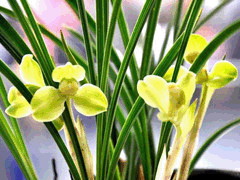 Plants of the Cymbidium genus are mainly composed of leaves, pseudobulbs, sheath leaves and fleshy roots. Both the leaves and sheath leaves have latent buds at their junctions with the pseudobulb. The sprouting of these latent buds is controlled by apical dominance; latent buds above the swollen part of the pseudobulb are less likely to sprout, while latent buds below the swollen part of the pseudobulb are more likely to sprout. Latent buds can sprout into vegetative buds or reproductive buds, and this is greatly influenced by light intensity and bud position. When light is insufficient, the production of photosynthetic products decreases, reducing the carbon/nitrogen ratio in the plant body, which easily leads to small, thin pseudobulbs and failure of flower bud formation. Usually, latent buds located at lower nodes are more likely to sprout into vegetative buds, while latent buds located at upper nodes on the pseudobulb often develop into flower buds and form inflorescences. If a latent bud differentiates into a vegetative bud (leaf bud), it then unfolds leaves, and after the leaves have fully expanded, it begins to accumulate nutrients, causing the pseudobulb at the base of the bud to begin rapidly swelling and form a second-generation pseudobulb; therefore, several plants are often seen connected together. Cymbidium goeringiiAfter the pseudobulb has swollen, if nutrient supply remains sufficient and appropriate low-temperature stimulation occurs, the latent bud can successfully differentiate into a flower bud and can smoothly send up a stem and bloom in winter and spring. The entire growth cycle, from latent bud sprouting and growing into leaves, flower bud differentiation and completion of flowering, to the next year's vegetative bud sprouting again, lasts about one year. In addition to the above factors such as bud position and apical dominance that affect the sprouting of pseudobulbs in Chinese cymbidiums, how to promote rapid pseudobulb swelling to achieve rapid propagation is the key point of greatest concern to orchid growers. The following introduces light, temperature, nutritional requirements andcultivationmedia and other factors as follows: (1) Light. Chinese cymbidiums are shade plants with relatively low light requirements. Generally, shade nets are often used together with simple facilities forcultivation, but under excessive shading, although the leaves are longer, dry matter weight decreases, causing the pseudobulbs to be small and thin and to develop poorly, and even resulting in failure toflower. The ideal shading level is about 50~75% of full sunlight, and the average light intensity is preferably about 10000~20000 lux. (2) Temperature. Temperature has a very important influence on the sprouting rate of latent buds on Chinese cymbidium pseudobulbs, leaf differentiation and growth, and flower bud differentiation and flowering. Low day/night temperatures (20/15°C) are most favorable for leaf differentiation and pseudobulb development, but are poor for latent bud sprouting. To promote faster latent bud sprouting and rapid leaf elongation, high day/night temperatures (25~30/20~25°C) are better, while for stem emergence and later flower bud development, 25/20°C is best; too low and flower buds cannot form, too high and deformed flowers are easily produced. After flower bud differentiation, if continuous high temperature ( >30°C) occurs, the flower bud cannot send up a stem and elongate; it needs cool temperatures of 20/15°C for the flower bud to elongate rapidly. (3) Nutritional requirements. For Cymbidium plants, among the elements, nitrogen fertilizer has the greatest effect on their growth. Although the demand for phosphorus and potassium fertilizer is not as high as for nitrogen fertilizer, they both play important roles in pseudobulb plumpness and flowering, so neither should be neglected when fertilizing, and attention should be paid to supplementing trace elements. In addition, there is an interaction between fertilizer amount and light intensity. Under acultivationenvironment of 10000~20000 lux, the effect of fertilization is not significant, but under lower light intensity (below 10000 lux), fertilization can compensate for the effect of low-light stress on vegetative growth. At present, many fertilizer products are available on the market. From the perspective of fertilization effect, chemical quick-acting liquid fertilizers can be absorbed quickly by plants after application and are the fastest-acting topdressing. Slow-release granular chemical fertilizers have a fertilizer effect lasting 1~2 months and are convenient and labor-saving to use, but the imported unit price is relatively high, and cultivation costs will increase slightly. In recent years, various organic granular fertilizers have also become available for selection. When using them, two points should be noted: 1. Fertilizer must be fully fermented to avoid damaging orchid plants due to heat generated by fermentation after application. 2. Some organic fertilizer products are combined with microbial fertilizers and will produce mycelium after application; it is advisable to observe their reaction when growing together with orchid plants before deciding whether to apply them on a large scale.