Appreciation Points of Outer-Petal Butterfly Orchids - Lanfengtang Miscellany: Appreciating Butterfly Orchids
Lanfengtang Miscellany on Appreciating Butterfly Orchids - Outer-Petal Butterfly Orchids
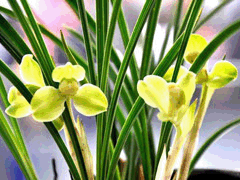 Cymbidium goeringii (Spring Orchid)The leaf shape of Chinese and foreign butterfly orchids has neither the ethereal elegance of plum-petal and fairy-petal orchids nor the imposing presence of lotus-petal orchids, but if observed carefully, one can still discern features that distinguish them from other types, and the flower buds of outer-petal butterfly orchids are also quite distinctive. Below I willCymbidium goeringii (Spring Orchid)discuss my understanding and experience regarding the leaf shape and flower buds of outer-petal butterfly orchids.
(1) Leaves: Although most of the old cultivars of Cymbidium goeringii outer-petal butterfly orchids recorded in the registers have lotus-petal-type petal spread, their leaf shape is slightly more slender than that of lotus-petal plants, and leaf texture varies from thick to thin. However, regardless of thickness, width, or length, the leaves share one common trait: poor symmetry. In most outer-petal butterfly orchids, the midrib of the leaf is slightly off-center, sometimes markedly so, and the asymmetry at the leaf tip is even more pronounced. Within the same leaf, the lateral veins differ in thickness, the spacing between lateral veins and midrib is unequal on the two sides, and the spacing between lateral veins and leaf margin is also unequal. The grooves on the leaf surface are likewise asymmetrical, uneven in depth and width, and have a directional tendency. The marginal serrations along the leaf edge are unevenly arranged. On the same leaf, the serrations on the two edges differ in thickness, and sometimes the rear half of one side of a marginal leaf may show no serrations or interrupted serration rows, but toward the leaf tip, the serrations on both sides become noticeably thicker. The greater the difference in serration shape between the front portion and the rear half of a marginal leaf, the larger the proportion of lip-like (labellum-like) transformation in the side petals of that outer-petal butterfly orchid.
(2) Sheath: The leaf sheath of outer-petal butterfly orchids also has a slightly off-center midrib, so the sheath tip often appears curved or slightly slanted. The uneven distribution of veins on the sheath is similar to that of the leaf veins. The sheath generally has few sand-like speckles (sha yun) but is rich in color.
(3) Bud: For the flower bud of outer-petal butterfly orchids, shape is emphasized more than color and sand-like speckles. Generally, long bud sheaths predominate, with fewer sand-like speckles, and the color on the bud is divided by the midrib into areas of deeper and lighter shade. If some bud sheaths have no obvious color, one can examine the translucency of the bud sheath, which also shows slight differences divided by the midrib. The overall roundness of the flower bud is poor, with irregular raised points and depressed points, manifested both between adjacent veins and in localized areas of the overall bud. The midrib of the bud sheath is slightly off-center, the spacing and thickness of lateral veins are unequal, the intercalary veins (jia jin) vary in length and thickness, the vein pattern is uneven, and the running veins are not straight and smooth.
(4) Shoot: The new shoots of outer-petal butterfly orchids often emerge pointed and slender, with the shoot tip slightly slanted, but this does not affect the direction of shoot emergence. If the bud color is deep, the shoot color is also deep; if the bud color is light, the shoot usually bears only faint color.
(5) Stem: The pseudobulb (lu tou) of outer-petal butterfly orchids is relatively round and neat, with slightly flattened-round shapes being the majority.
The above is purely my personal view, for reference only. I welcome everyone's corrections and additions regarding any errors or shortcomings. Thank you.