What are the characteristics of Dangshan He, an excellent lotus-petal variety of Lianban Lan (Cymbidium tortisepalum)?
 LianbanLan has quite a few lotus-petal varieties. Looking through many monographs on Yunnan orchids, one gets the sense that they are too numerous to count, but for various reasons, among them those that have become truly famous and areorchidwidely recognized among enthusiasts, and that also have a certain amount of market circulation, are not many. Dangshan He, however, is fortunate to be one of those that is both loved by the broad community of orchid growers and occupies a considerable share in theLianbanLan petal-type flower salesLianbanas one of the excellent lotus-petal varieties.
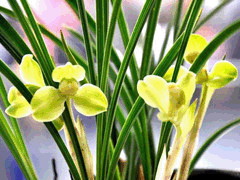
Dangshan He, also known as He-type White Lianban, has leaves about 40-70CM long and about 0.8-1.2CM wide. The leaf tips twist and droop, the leaf texture is rather hard, the leaf sheaths are tight, and the leaves have a dehydrated look. The plant form is sturdy, with 5-8 leaves per plant. The buds of new shoots are plump, thick and round, purplish-red in color, and white-red after emerging from the soil. The flower buds are round and bulging, shaped like bullet heads when in the bracting stage. It blooms from December to February of the following year, with 2-4 flowers per scape. The main and secondary petals are round and broad, and the perianth is pinkish-white with six or seven light yellow veins, with a contracted base and flared angles; the keel petals are large mussel-shell keels, tightly closed, without an open window; the large round lip has rather concentrated spots, large in block size, and brightly red in color.
This variety was discovered in the mountains in 1995 in Shidian County, Baoshan City, Yunnan. This place is located on the east bank of the Nujiang River and is one of the main production areas of Yunnan Lianban Lan andChunlan, where many excellent varieties have appeared. It is one of the birthplaces of high-grade petal-typeflowersof Lianban Lan, such as Chushui Furong, Yipin He, Zhuangyuan Mei, Kunhua He and others, all of which come from this place.
This variety first appeared publicly in spring 1996 at the orchid exhibition in Baoshan Prefecture (now Baoshan City). At that time there was only one clump of 5 plants. It is a standard-form lotus-petal flower, beautiful and dignified. It is said that when it was exhibited, Mr. Sun Zhiyong took a fancy to it and sought to buy it, but the flower owner politely declined because Mr. Sun was not from Baoshan. Since Mr. Sun could not obtain it through a face-to-face purchase, he had to spend the following years, through other local orchid growers, adopting a "nibbling" policy and gradually bringing the vast majority of this flower into his possession, and he named it "Dangshan He" after his own Dangshan Prefecture Orchid Garden. "According to Mr. Sun, Dangshan He is so far one of the three varieties he has named after his orchid garden; the others are Dangshan Die and Dangshan Hongsu (Douban)." (See "A Comprehensive Understanding of the Fine Lianban Lan Variety - Dangshan He," author Erhai.) From this, one may perhaps see Mr. Sun's fondness for this variety.
In addition, according to what Mr. Sun Zhiyong and the author said, when this variety was purchased from Baoshan, it was done in the name of his elder brother, Mr. Sun Jianyong.
This variety has won the Silver Award at the 13th China (Dali) Orchid Expo, the Silver Award at the 14th China (Yuxi) Orchid Expo, the Gold Award at the 3rd Yunnan Province (Baoshan) Orchid Expo, the Silver Award at the First China Heqing Orchid Culture Tourism Festival, and the Silver Award at the 2008 China Yunnan Orchid Network Spring Orchid Exhibition, among others.
Registered in December 2006 by Ma Zhihong and Yang Hongxin.
This variety is robust in nature and easy to grow, relatively resistant to diseases, and has a high shoot production rate. Ifcultivatedproperly, the shoot production rate reaches about 100%-200%, and the flowering rate is also relatively high, so it can appear frequently at orchid expos over the years, which helps the broad community of orchid growers to know and promote it.
Mr. Erhai, a Dali orchid grower, has the following evaluation of this variety:
"Advantages: 1. Small quantity. Based on analysis of information from all sides, by the end of this year the social stock of this flower will be around 5,000 plants. 2. High quality. It is recognized among Lianban as a relatively standard-form, broad-leaved, medium-to-large lotus-petal flower. 3. Anti-counterfeiting. It is the most famous representative of dehydrated grass among Lianban. Perhaps it is said that among Lianban Lan there is dehydrated grass, and dehydrated grass easily produces large lotus-petal flowers; these conclusions come from Dangshan He! 4. Low price. When I was answering questions from some orchid growers, I said that in 1997 the transaction price of what is now He Zhi Guan was 50,000 yuan/plant, while the transaction price of Dangshan He at that time reached 10,000 yuan/plant. The price ratio of the two was five to one, but now the price ratio of the two is 50 to 2, that is, 25 to 1 (medium plants)! I dare not say there is room for appreciation, but there should not be much room for price decline.
"Disadvantages: 1. Slow to regain strength. Once Dangshan He has been divided too much and weakened, it is impossible to get it back to strong plants within one or two generations. In order to maintain its rugged leaf shape (the purpose being to let it produce good blooms), you must pay the price of producing fewer shoots. 2. Slow to mature. New shoots of Dangshan He cannot mature within one year, or rather it is very difficult for them to mature. However, this flower has one characteristic: when a new shoot grows to its fifth leaf, the next generation of new shoots will emerge from the soil. This is a typical case of pregnancy before marriage, and can make up for the shortcoming of slow maturation. 3. If it is divided too much and weakened, do not expect it to bloom well for you. Petal-type flowers are not like strange flowers; no matter how you divide them, they will still produce good blooms. To keep Dangshan He blooming well, first, you must maintain strong plants with leaves more than one centimeter wide; second, the potted plant must have more than five plants. This again requires paying the price of producing fewer shoots. The petals of this flower are medium in thickness, so the flowering period is relatively short (about 20 days). When the plants are weak, the petals may even be too thin, resulting in reversion, though this is rare. 4. Short flowers. This is a shortcoming of this flower that cannot be changed, but compared with Chunlan it is much better, and moreover, by sleeving it the height can be increased by about 5 centimeters." (See "A Comprehensive Understanding of the Fine Lianban Lan Variety - Dangshan He," author Erhai.)
Mr. Ma Zhihong has the following appreciation of this variety:
"...The outer petals are moderate in proportion, with contracted bases and flared angles; the keel petals are large mussel-shell keels, tightly closed, without an open window, and matched with a large round lip with brilliantly red color spots, making the entire center of the flower extremely compact with natural transitions. But what is slightly regrettable is that the outer petals of the flower still appear somewhat insufficiently tight at the edges, and the flower's staying power is correspondingly insufficient. At the same time, after being open for a long time, the lip tends to curl backward, making it seem somewhat lacking in confidence when compared with He Zhi Guan, the king-level representative of standard lotus-petal Lianban Lan! Overall, the entire flower of Dangshan He is graceful and luxurious, plump and dignified, elegant and harmonious in color, and distinctive in temperament. It is the great lady of the lotus-petal flowers of Lianban Lan." (See "The Ancient Dangshan Temple Still Has Its Crane, the Famous Buddhist Lotus Fragrance Drifts Over - The Complete File on Dangshan He.")
This variety is now distributed in all the main orchid areas of Yunnan, and has also been introduced outside the province in Sichuan, Zhejiang, Guangdong and elsewhere, as well as overseas in Japan. Mr. Ma Zhihong's "The Ancient Dangshan Temple Still Has Its Crane, the Famous Buddhist Lotus Fragrance Drifts Over - The Complete File on Dangshan He" states: "In early 2005, after the famous Japanese orchid artist Mr. Sumihisa Sato saw Dangshan He, he was also captivated by its flower appearance and posture, and decided to make it the first-choice variety for promotion in Japan and South Korea, and over more than a year afterward introduced more than 30 commercial plants of Dangshan He." And according to the Yunnan Orchid Network article of July 12, 2006, "Orchid growingcelebrities Li Guanghong and Yang Kai conducted a 7-day inspection of Japan's orchid industry," the article reported: "Mr. Yang Kai said: In Japan, Lianban Lan has a very broad acceptance... The famous Lianban variety Dangshan He and Chunlei have very good sales there."
Although there are many petal-type varieties of Lianban Lan, few are relatively widespread, because among the several petal-type flowers that have become famous at present, most are rather expensive, and ordinary orchid enthusiasts can only sigh while looking at the flowers. This variety, however, is excellent in quality, with a quantity of only about five or six thousand plants, and is moderate in price, relatively acceptable to ordinary orchid enthusiasts. In the words of some orchid growers, it has "relatively good cost performance," so it is relatively well recognized by the broad community of Yunnan orchid enthusiasts, and market transactions are relatively active.