A Guide to Appreciating Chinese Huilan Orchids: A Detailed Explanation of Orchid Appreciation Methods
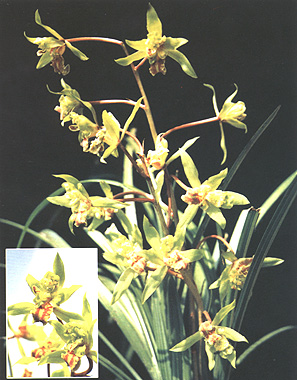
I. ChinaHuilan's Historical Culture
The character "hui" in huilan already appeared in the "Chu Ci" by Qu Yuan, the great poet of the State of Chu during the Warring States period. His verse says: "Having cultivated lan in nine wan (one wan equals twelve mu -- translator's note), and planted hui in a hundred mu." The "hui" mentioned here "can only be understood as a kind of fragrant herb with an excellent scent; whether it refers to what we today call huilan remains disputed. What can be confirmed as the "hui" of what we today call huilan is the hui in "one stem with one flower and abundant fragrance is lan, one stem with five to seven flowers and insufficient fragrance is hui" from "Shu You Fang Ting" written by the Song dynasty poet and calligrapher Huang Tingjian. During the Song dynasty,cultivationChunlanand huilan as ornamental plants were already very popular, and it became necessary to make some distinctions among these fragrant herbs. Huang Tingjian's two sentences settled the matter definitively and became the basis for later generations to distinguishChunlanfrom huilan. Modern plant taxonomy also based on this named the orchid that blooms in late springwith flowerson one stem with multiple flowers as huilan. If Huang Tingjian only distinguished lan and hui by their characteristics, then Zhu Kerou's "Di Yi Xiang Bi Ji" of the Qing dynasty already noted the differentcultivationmethods for lan and hui. He said: "Hui by nature loves sunlight, and needs the sun for three of the first half-day's hours... As for lan, one or two hours of morning sun is enough." During the Qianlong, Jiaqing and Daoguang reigns of the Qing dynasty, huilan already had many famous varieties, such as Da Yi Pin, Cheng Mei, Guan Ding, Shanghai Mei, Pan Lu Hai, Dang Zi and others. Some of these famous huilan varieties were already recorded in Xu Naihe's "Lan Hui Tong Xin Lu" during the Tongzhi reign of the Qing dynasty. For example, Da Yi Pin, the foremost of the famous old huilan varieties, is called a superior grade in "Lan Hui Tong Xin Lu," with a poem praising it: "With the bearing of a scholar and the talent of an exiled immortal, guests vie to praise it as the leader; since entering Jiangnan its reputation has doubled, a thousand pieces of gold cannot easily buy this flower's crown." And Bao Weisheng's distinctions and explanations of lan and hui petal shapes in "Yi Lan Za Ji" from the early Qing dynasty opened the door to the formal beauty and aesthetics of huilanorchidflowers. Until the appearance of large numbers of huilan butterfly flowers and exotic flowers in the era of reform and opening up, for nearly one to two hundred years, the aesthetics of huilanorchidflowers particularly emphasized petal type, and this influence was very broad, becoming a traditional concept in huilan aesthetics. In the 12th year of the Republic of China (1923), Wu Enyuan of Yuhang compiled "Lan Hui Xiao Shi," which further collected and summarized the traditional varieties and new varieties of the time, and divided them into three major categories: red-sheath hui, green-sheath hui, and red-green hui. In 1959, the Hangzhou orchid cultivator Mr. Yao wrote the book "Orchid," which on these foundations added butterfly flower types and pure-hearted flower types. After the 1980s, large numbers of new huilan varieties were developed, and orchid growers everywhere, based on new discoveries, added exotic flower types and colored flower types to huilan. By this point, huilan had become a vast and distinctive branch of Chinese orchids.
Huilan was transmitted to Japan and Korea during the Qing dynasty and the Republic of China period, and especially in the 1930s and 1940s, Japanese people collected large quantities of Chinese huilan and shipped them to Japan for cultivation. Meanwhile, in China, due to years of war and, after the founding of the People's Republic, two or three rounds of man-made destruction over several decades, by the end of the last century, when the nation prospered and orchids flourished, and a wave of orchid enthusiasm emerged domestically, some traditional huilan varieties could no longer be found in their own country and had to be bought back from Japan. The development history of huilan also reflects from one side the rise and fall of the nation.
II. Appreciation of Chinese Huilan
Huang Tingjian, the great poet and calligrapher of the Northern Song dynasty, said in his "Shu You Fang Ting" that "lan resembles a gentleman" and "hui has the bearing of a scholar-official." These two sentences opened the path to huilan appreciation. Li Yu, a literary figure and flower enthusiast of the early Qing dynasty, wrote a dedicated essay "Hui Lan," saying: hui "the reason it yields to lan is not in the flower or the fragrance but in the leaves... hui's leaves suffer from being too long... and are afflicted by being too fat." Overall, if cultivated well, huilan plants are taller than Chunlan, and the flower stems are also larger and taller, with more flowers, very magnificent and brilliant, with fragrance overflowing everywhere. Therefore, those who understand the art often appreciate lan and hui together, while those who just enjoy the spectacle often value hui and slight lan. In recent years, the price increase of huilan has often exceeded that of Chunlan, and the reason largely lies in this. This is the general appreciation of huilan.
Since the emergence of the petal-type theory, huilan appreciation has paid special attention to distinguishing flower petal types, valuing plum petals and narcissus petals as precious, with the column and lip being valued for being round, tight and thick in substance, and the outer three petals (sepals) being valued for being broad and of glutinous substance. Most of its famous varieties have these petal types. Lotus petals are very rare in huilan, and in recent years the discovery of lotus-petal-like varieties has been very popular. Ordinary bamboo-leaf-petal huilan are as common as weeds, and apart from a few brilliant colored flowers, they receive little praise. The huilan butterfly petals and exotic flower types that have appeared in recent years are brilliantly colorful and dazzling, and those with many petals and lips and vivid colors are especially sought after, commanding very high prices. Pure-hearted types are also much loved. Things are precious for being rare; since huilan mostly have yellow-green flowers, if red-flowered, purple-flowered, black-flowered or creamy-white-flowered huilan appear, they are also highly valued, and those with vivid colors are even better. Those with petals and sepals of thick, glutinous, jade-like substance are also often fine specimens. Huilan flower stems are thick and large with many flowers, so when appreciating them one should also note whether the arrangement of the individual flowers along the entire stem is well-spaced and graceful, and whether the fragrance is mellow and beautiful. Those with elegant leaf variegation are also fine specimens, and occasionally one finds those with leaf variegation, flower variegation and petal type all together, which are especially favored.
The traditional famous varieties of huilan include the Old Eight: Da Yi Pin, Cheng Mei, Shanghai Mei, Guan Ding, Yuan Zi, Ran Zi, Pan Lu, Dang Zi; the traditional New Eight: Lou Mei, Cui E, Ji Pin, Qing Hua Mei, Jiangnan Xin Ji Pin, Duan Mei, Cui Mei, Rong Mei. New famous varieties include: Tianjiao Mudan, Sixi Mudan, Luyun Mudan, Yuandong Qidie, Luyi Qidie, Loutai Die, Ying Die, Bubugao, Qunying Huicui, Xianhe Jipin, Jianhu Zhimei, Quanzhou Mei, Cuitao Xianshou, Shi Die, Lingnan Baihe, Jinling, Huilan Shuijing Hua, Zijuan, Yuewang Mei, Juhua Su, Duoyun, Zheding, Duan Hui Mei, Duan Xiu Mei, Die Cui, Chun Hui Qianshou Guanyin, and many others.