The Story of the Famous Cymbidium faberi Cultivar Jiepei Mei and the Three Lius of Jingjiang
The Three Lius of Jingjiang and the Cymbidium faberi Jiepei
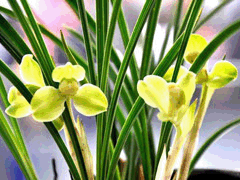 The Three Lius of Jingjiang andCymbidium faberiJiepei
The orchid world generally holds that the Cymbidium faberi Jiepei was selected in the late Qing Dynasty and early Republic of China period by a person surnamed Zhang from Shanghai. It is said that the earliest orchid publication to record "Jiepei" was the Xu Lan Hui Tong Xin Lu (Continued Records of the Shared Spirit of Orchids and Cymbidiums) by Feng Zicai of Shangyu. In this orchid publication, Mr. Feng<芳吐九畹>described this cymbidium flower: "Jianggao Jiepei Mei, a red cymbidium lotus-form narcissus. ... The color is green, the edges are tight, the flesh is thick, the shoulders are level, the silkworm-moth stigma, and the large ruyi tongue. When it blooms, it gradually grows from small to large; it is an excellent variety." With its ring-shaped leaf posture and its upright, vigorous, spreading and elegant flower appearance, Jiepei is deeply loved byorchidgrowers. It is hailed as the Song Mei among Cymbidium faberi.
Jiepei was introduced to Jingjiang in the 1920s. First, the banker Liu Rongqiu obtained the Jiepei variety from the Rong family of Wuxi at the price of "ten dan of rice for three plants" (not the falsely spread "one dan of rice for one plant"). Unfortunately, during the War of Resistance Against Japan, the Japanese invaders looted Jingjiang City, and the Cymbidium faberi Jiepei cultivated by Liu Rongqiu was also plundered completely. Fortunately, Liu Xinzhi, the son of the owner of the Yuheng Distillery in Jingjiang (then a instructor at the Jingjiang Sports Ground and later a physical education teacher at Jingjiang County Middle School), had introduced a pot of Jiepei from Liu Rongqiu before the outbreak of the War of Resistance. When the Japanese devils looted Jingjiang City, Liu Xinzhi abandoned all his family property and carried with him only a few pots of his belovedorchidsas he fled from place to place, and only in this way was the Cymbidium faberi Jiepei preserved. After the victory of the War of Resistance, Liu Xinzhi returned to Jingjiang and continued to cultivate Jiepei. Although Liu Xinzhi took every possible care of Jiepei, for various reasons the number of Jiepei did not increase much until before the Cultural Revolution. In 1965, his clan younger brother Liu Luping, then principal of Jingjiang City Chengbei Primary School, was assigned by the organization to work at Jingjiang City People's Park. In winter, Liu Xinzhi asked Liu Luping to place Jiepei in the People's Park to overwinter. Liu Xinzhi knew that Liu Luping lovedorchids, and for three consecutive years, each time in the following spring when theorchidswere brought out of the room, out of personal friendship he gifted a total of 18 plants of Jiepei to Liu Luping. Liu Luping treasured them like a precious treasure and cared for them carefully. Soon afterward, Liu Luping was appointed director of Jingjiang People's Park, so he presented the Jiepei given by his clan brother Liu Xinzhi to the park, and opened an orchid nursery in the park to collect famous varieties. When the Cultural Revolution broke out,orchidswere listed as fragrant flowers and poisonous weeds and became a target of destruction by the Red Guards. To save Jiepei from being destroyed, Liu Luping hid the park's orchids here and there, and only thus did Jiepei Mei escape disaster. After the Cultural Revolution ended, Liu Luping reorganized the park's orchid nursery and trained flower workers. By the time he retired in 1985, the orchids of Jingjiang People's Park had developed to a considerable scale; the total number ofCymbidium goeringii, Cymbidium faberi,Cymbidium ensifoliumreached 1,410 pots, among which there were 331 pots of Cymbidium faberi, the vast majority being Jiepei.
On the other hand, the few pots of Jiepei that Liu Xinzhi kept for himself developed relatively slowly. In 1984, before his death, he was very concerned about those few pots of orchids. When Liu Luping went to visit his clan brother Liu Xinzhi on his sickbed, Mr. Xinzhi gave him one pot of Jiepei with 6 plants.
In 1985, Liu Luping retired from the post of director of People's Park and returned home. Together with his wife Sheng Yunyi, who had retired earlier, he established Yunwei Orchid Garden and carefully cultivated the Cymbidium faberi Jiepei given by his clan brother Liu Xinzhi before his death. Several years later, he spent 30,000 yuan to buy 100 plants of Jiepei from Jingjiang People's Park, and at the same time raised funds to buy famous spring and cymbidium orchid varieties from major orchid nurseries in Jiangsu and Zhejiang for cultivation. Because he had previously accumulated relatively rich experience in orchid growing, Yunwei Orchid Garden always insisted on traditional methods, using mountain soil as the growing medium, self-made green organic fertilizer and a natural environment (moving them indoors to avoid the cold only from Frost's Descent to Grain Rain) to cultivate Jiepei and other Chinese spring and cymbidium orchids. The orchid plants are robust and full of vitality, and are famous far and near. Up to now, Yunwei Orchid Garden alone has about 4 hundred pots and nearly ten thousand plants of just the single Cymbidium faberi variety Jiepei.
After the orchid became the city flower of Jingjiang, the ranks of orchid growers continued to grow. Now there are more than one hundred orchid nurseries, large and small, in Jingjiang. In Jingjiang, those who grow orchids must first grow Jiepei; the Cymbidium faberi Jiepei has become the leading star of Jingjiang's orchid gardens.
The nearly one-hundred-year history of Cymbidium faberi Jiepei since it revealed its beauty to the world is closely linked with the nearly one-hundred-year history of the Chinese nation. When the nation is weak, orchids decline; when the nation is prosperous, orchids flourish. Jiepei responds to this!