Orchid Hydroponics Method: An Alternative Way to Grow Orchids
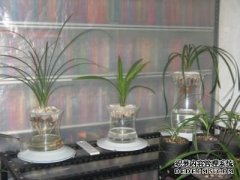
Whenever I mentionorchidsand hydroponics, I think of theseorchidsbeing sent to the chopping block~! I have grown hydroponic orchids many times and used many different chemicals, but in the end it always ended in failure~! But then one time, I accidentally succeeded.
In the first half of this year, right when it was time to collect mountain orchids, I tossed an ordinary plant onto the edge of a ditch, but after a few months I found that this orchid had not died - instead it had grown new roots and new shoots. Thinking about it carefully, this is what we call air culture, because it fell right by the ditch edge where it basically got no light, the moisture by the ditch was especially high, and lots of moss had grown on the soil. But this orchid happened to land right on the moss, and with sufficient humidity it managed to survive~! Later I took it home, but found its roots were covered with green stuff that was probably small moss. Since this plant was collected from the mountain in the first half of this year, its roots had generally been broken off, but it grew new roots from the broken parts that extended into the water. Not only did the roots not rot, but the new roots grew very well. My previous orchid roots would rot after just one or two weeks in water. I think the main reason is that the green stuff was protecting it. A few days later I planted that plant in a fish basin, and up to now it not only hasn't died but has even produced flower buds. Since this plant is a common flower, I didn't manage it - just gave it a little water. A lot of spots have grown on the leaves. But today I accidentally knocked over the orchid pot, so I photographed it to show everyone~!! Am I bragging? Just look at the roots and you'll know.
The orchid hydroponics method does not use soil or othercultivationmedia, but instead soaks orchid roots directly in water containing a nutrient solution for growth. It is a new type ofcultivationmethod that has changed the traditionalorchid growingreliance on soil planting, and has rewritten the claim that orchids dislike moisture. Because roots absorb nutrients more evenly in water than in a medium, they grow more robustly, with more shoots and better quality. The specific operation method of orchid hydroponics is introduced as follows:
Orchid hydroponics is simple and easy to learn, and easy to master. It mainly consists of six steps:
1. Choose a dedicated hydroponic flower pot. For hydroponic orchid growing, use a dedicated hydroponic flower pot with no holes at the bottom and a double-layer inner and outer mesh nested pot design (water capacity between 1.5 kg and 6 kg). The outer pot holds the nutrient solution, and the inner pot is a square mesh screen with a mesh size of 2cm×2cm. The ribs between the mesh holes support the pseudobulbs and hold the fixing material for the orchid plant, such as small stones or sponge.
2. Transplant the orchid plant. Pull up the orchid plant grown in soil, remove rotten roots and old roots. If there are too many roots to fit into the inner screen, use scissors to cut off some roots close to the pseudobulb, then rinse the mud and dirt stuck to the roots with clean water.
3. Disinfect. Before planting into the hydroponic pot, it is best to disinfect once. Use potassium permanganate at 100 PPm, immerse the whole plant in the potassium permanganate solution for 10-15 minutes, then take it out and rinse off the potassium permanganate solution with clean water.
4. Plant into the hydroponic pot. Divide the roots into two to three groups and insert them into two to three mesh holes. Use your hand to gently pull the roots that have passed through the mesh holes, so that the pseudobulb fits closely against the central cross-shaped ribs between the mesh holes.
5. Fix the orchid. Use one hand to hold the orchid plant upright, and with the other hand place clean 3cm×5cm small stones (the kind used for pouring cement floors) around the plant to fill the inner screen, then shake slightly, and the orchid plant will be fixed in the center of the inner screen (sponge can also be used as the fixing material for the orchid plant).
6. Add the nutrient solution. Rinse the fixing stones once more with clean water. Fill the outer pot with clean water (drinking water can be used as the planting water), and add orchid nutrient solution to the water (Meihui brand hydroponic orchid nutrient solution). In this way, the transplanting work is complete.
Hello everyone! Speaking of scientific orchid growing is too much for me - let's all learn together. Actually, hydroponic orchid growing is very simple. This kind of pot is sold at flower and bird markets. I don't use any special nutrient solution either, just add a little when fertilizing the orchids, usually 1000 times compound fertilizer or 1000 times monopotassium phosphate. There is just one thing: you must not soak all the orchid roots in water. As long as there is water at the bottom of the pot, that's enough.