Orchid multi-flower and flower orientation regulation methods, shared by Xijinqiao
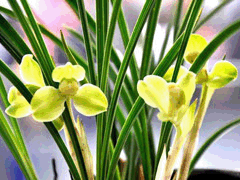 OrchidsMulti-flower and flower orientation regulation -- Xijinqiao
http://bbs.guolan.com/topic.aspx?topicid=142592
Actually, as forgrowing orchidsI am still just a rookie. Although I have been in contact with orchids for ten years, it was only in the past two or three years, after my hardware facilities improved, that the orchids I grow have shown some improvement. This year's Song Mei and Xi Shen are also what I consider my proudest, so I brought them online to show off, wanting to win a little applause, but the praise from orchid friends was something I had not expected, and it made me deeply uneasy. Titles like "China's number one orchid grower" are truly more than I dare accept. The National Orchid Network hides dragons and tigers, with experts as numerous as clouds. Asking me to introduce experience really seems like showing off one's axe skills before Lu Ban. But since the warm feelings of my orchid friends are hard to refuse, I will briefly say a few words. If there is anything inappropriate, please criticize and correct it, and let us discuss it together, just as a way to throw out a brick to attract jade. 1. Producing more flower buds: To makeorchid plantsproduce more flower buds, the premise is to grow the roots well and keep multiple shoots connected. To grow the roots well, first, according to theorchid'sgrowth habits, simulate the orchid's wild growing environment (it is best to go up the mountain in person to observe its growing environment). The four key elements of temperature, humidity, ventilation and light should be adjusted in a timely manner throughout theorchid plant'sentire growing process (during high temperatures, mainly cultivate in shade). Second, for beginnersgrowing orchids, the potting medium should be light. My potting medium ratio is: 20% Xiantu, 10% ceramsite, 70% Zhijinshi, with a few grains of Magic Fertilizer applied on the pot surface. Other fertilizers (especially foliar fertilizers) should be used as little as possible. Third, because every orchid friend'scultivationenvironment is different, watering cannot all be the same. Remember one point:orchid plantslike moisture. Regarding watering time, Yuyao orchid-growing senior Wang Shuping said in a book: after watering orchids, they should be kept in shade for one day. This gave me great inspiration. Therefore, when the temperature is above 10°C, I choose to water at night. After watering, dry the leaf surfaces as quickly as possible. Once the roots are well grown, you can use as little medicine as possible, or even none. Generally, using it two or three times a year for prevention is enough. In the bud-setting season every July and August, widen the day-night temperature difference and control watering once or twice, but it must not become too dry. 2. Management after bud setting: After orchid plants set buds, attention should be paid to keeping them appropriately in shade, maintaining humidity at around 80%, the temperature must not be too high, and the potting soil must not be too wet. In winter, the temperature should be kept below 20°C as much as possible, and then undergo sufficient vernalization, otherwise the flower stalk will not grow tall the following year. 3. Flowering: The best flowering temperature forCymbidium goeringiiis 10°C——18°C, and forCymbidium faberiit is 16°C——24°C. Orchid plants should be kept dry before the flower bud pulls its stalk, kept moist after the stalk begins to pull, and after the flower bud opens, choose dry or moist cultivation depending on the variety. To make the flowering direction uniform, first make as much use as possible of the plant's phototropism so that the flower buds face the same direction, then a few days before the flower buds open, depending on the condition of the pot surface, manually adjust and fix the flower buds whose orientation does not match what is desired (one or two days is enough). As for how to fix them, each orchid friend can use their own creativity. You are welcome to post them online to show off. The above is purely my personal view, for reference and exchange only. If there is anything inappropriate, corrections are welcome.