Some Thoughts on Growing and Cultivating Song Mei -- Following the SF Trend
 Some Thoughts on Growing and Cultivating Song Mei -- Following the SF Trend
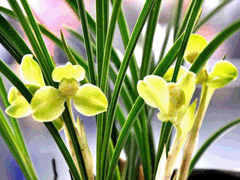
Igrow orchidspurely as a hobby. Although it has been off and on for more than ten years since I started growing wild-collected orchids, growing old cultivars is something I have only done in recent years. In November 2008, thanks to the kindness of local orchid enthusiast Teacher Chen, Zhuji Ai Lan Ren (his nickname on the Lanjiao website), I obtained from him four plants of Song Mei in flower whose provenance came from the Hangzhou Flower Nursery, one mother plant with two new leads and one grandfather-generation plant. The flower photo the following year is as follows:
In spring 2009 it produced 2 double leads, 8 plants in total, and the plant condition is as follows:
It produced 1 flower. At the end of September it was divided into two groups of 4 plants and 3 plants (with 1 flower) and planted separately. The 1 grandfather-generation plant was split off singly and planted in the same pot as the group of 3 plants. This pot of grass was exhibited at the Fourth Zhuji City Orchid Exhibition
and afterward was kept all along in an orchid friend's open-air orchid garden. In 2010 the grandfather-generation plant that had been split off singly produced double leads, but because it was an old single plant producing double leads, the new plants were rather weak, with 3 leaves and 4 leaves respectively. The other group of 3 plants produced 2 plants and 2 buds, one of which was a double flower. As follows:
After bringing it back from the orchid friend last month, I removed the singleflower'sflower bud. The plant condition is as follows:
The other group of 4 plants was placed on my own balcony and produced two double leads, 8 plants in total. Perhaps because it produced too many plants, it did not bloom this year. I did not take plant photos, and will add them later. From the 4 plants introduced in 2008, after two years of growing and cultivation, there are now 16 plants in total, without losing a single leaf or a single plant, which I am very gratified about. Hehe, the productivity is not bad at all.
My growing environment: an open south balcony on the second floor, with good ventilation and light. From the end of May to the end of October, single-layer 50% black shade netting is used; from November to April of the following year, full light. In summer the highest temperature exceeds 38°, and in winter the lowest temperature is about minus 3° or so.
Pots and growing medium: crushed brick, pine bark, and black soil at about 30% each, plus a small amount of coconut husk. Purple clay pots. The first two growing materials were collected by myself, hehe.
Fertilizer, water, and pesticide management: because the growing medium contains bark and black soil, no root fertilizer was applied in the first two years, and each spring and autumn 0.1% monopotassium phosphate foliar fertilizer was sprayed once. I prefer somewhat dry cultivation, generally a thorough watering about once every 5 days in summer, about once every 10 days in spring and autumn, and about once every 20 days in winter. In 2009 I sprayed thiophanate-methyl once. In 2010, because I went out to work and my wife took care of the flowers at home, no pesticide was used even once.
Plant condition: almost no black spots or scorched leaf tips, the widest leaf about 1 cm, the longest leaf 29.3 cm. The leaf texture is thick and substantial.
Personal thoughts: Song Mei readily produces plants, and often produces double leads, blooms frequently, especially medium and large plants. Somewhat dry and somewhat lean cultivation is better. The above are my shallow views on growing and cultivating Song Mei for the first time, shared with orchid friends.