Why does Cymbidium kanran produce new shoots slowly? A brief analysis of the reasons
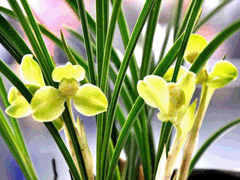 A briefCymbidium kanrananalysis of why it produces new shoots slowly
http://www.dfac.cc/showtopic-108-382481-0-0-1.htm
Although Cymbidium kanran is the youngest member of the Chinese orchid family, with its graceful leaf shape and elegant flower form it is attracting more and moreorchidenthusiasts, and its slender figure, like a lotus emerging from water, makes many orchid growers' eyes light up. At present, the biggest bottleneck hindering the development of Cymbidium kanran is none other than its low shoot production rate. That Cymbidium kanran produces new shoots slowly is the consensus of all orchid growers, and it is also the main reason many growers say Cymbidium kanran is hard to cultivate. Below, combining the growing environment of Cymbidium kanran and its own physiological habits, I will briefly analyze several reasons why Cymbidium kanran produces new shoots slowly. I. Growing environment I once collected orchids in the mountains for many years. Because this area is rich in Cymbidium kanran resources and I mainly collected Cymbidium kanran, I know a thing or two about its growing environment. Cymbidium kanran generally grows in dense evergreen broad-leaved forests or mixed bamboo-and-tree forests, and the vast majority grow from the mid-slope downward, with very few growing at the mountain top. Such an environment determines that Cymbidium kanran has relatively few opportunities to receive light. Although the leaves of Cymbidium kanran are relatively broad, because it grows deep in dense mountain forests, the leaves still carry out very little photosynthesis, and so the products of photosynthesis are also few. Not much organic matter accumulates, so sprouting is naturally restricted. It is precisely this environment that gives Cymbidium kanran its deep green, glossy leaf surface. Even after Cymbidium kanran is taken down from the mountain, we cannot use the method of increasing light to stimulate its sprouting potential, because shade-loving is a characteristic of the species Cymbidium kanran. We cannot sacrifice the beautiful appearance of Cymbidium kanran--its bright leaves--in pursuit of a higher sprouting rate. Appropriately increasing light a little should be fine, but if overdone, not only will the leaf surface of Cymbidium kanran be damaged and the leaves turn yellow, it may also cause physiological dysfunction, or even death of the seedlings, with the loss outweighing the gain. Cymbidium kanran requires a relatively high degree of shading, and this is also the consensus of orchid growers. II. Flowering Cymbidium kanran is afloweringorchid species that flowers freely, and one stem bears multiple flowers; in many-flowered varieties such as large-leaf Cymbidium kanran, sometimes a single stem can bear more than a dozen flowers. Large-leaf Cymbidium kanran generally comes into flower at around three or four shoots, and fine-leaf Cymbidium kanran can also be seen in flower at around two or three shoots. It is also common to have two flower stems on the same shoot, and theCymbidium kanranflowering period is long. Precisely because of this, the little photosynthetic product that Cymbidium kanran has is almost completely exhausted when it flowers. Where is there any more nutrition left to support producing more shoots? III. Flowering period The flowering period of Cymbidium kanran is mostly concentrated in autumn and winter. Locally (Yifeng, Jiangxi), large-leaf Cymbidium kanran mostly flowers from late October to November each year, and fine-leaf Cymbidium kanran mostly flowers from late November to December each year; of course, some flower earlier and some a little laterflowering. And this period is precisely the wonderful time when all things rest and recover, yet Cymbidium kanran is still struggling hard to offer people its last share of fragrance. Let us sort out the annual growth course of Cymbidium kanran here: taking large-leaf Cymbidium kanran as an example, locally, from about mid-to-late May to early June each year, leaf buds emerge from the soil one after another, and from about mid-to-late August to early September each year, flower buds also emerge from the soil one after another (the emergence times of leaf buds and flower buds are based on the majority; a small number emerge earlier or later). If the flower buds have already had about one month of differentiation time before emerging (when flower buds differentiate, the temperature is slightly higher, so differentiation proceeds faster; leaf bud differentiation time should be longer, because the temperature during that period is relatively lower and growth is slower), then the flower bud differentiation of Cymbidium kanran should generally be around July each year. In this way, the annual growth course of Cymbidium kanran becomes clear: after spring begins, as the temperature slowly rises to May and June, the leaf buds of Cymbidium kanran begin to differentiate slowly until they emerge; then in July the flower buds begin to differentiate, in August and September the flower buds emerge one after another, in September and October the flower stems keep growing taller, and after October they bloom one after another, until the flowers fade and the plants enter winter dormancy. Oh Cymbidium kanran, Cymbidium kanran, during the growing season of the year, you work ceaselessly, using your little bit of nutrients to raise your children, and in the wonderful period when you are about to enter winter rest, you dedicate your last drop to humanity. In the cold winter days, in the blue, rippling sea of orchids, we feel your waves of fragrance again and again, and even more feel your mother-like strength and greatness! Of course, the factors affecting the low sprouting rate of Cymbidium kanran are not limited to these few; we still need to keep discovering, researching, and discussing them. Breaking through the bottleneck of the low shoot production rate of Cymbidium kanran is the pursuit and expectation of every Cymbidium kanran enthusiast! The above views are purely one person's opinion, and the various growth stages and dates involving Cymbidium kanran are limited to this locality or this orchid garden, and do not represent other Cymbidium kanran production areas. Yifeng Orchid Garden (Tianxia Wushuang) 2010 8 23