Interpreting the Lan Hui Tong Xin Lu: Three Chapters on Watering Orchids with Dew, Mounding the Roots, and Applying Fertilizer (1)
Interpreting the "Dew Watering," "Root Mounding," and "Fertilizing" Chapters of the Lan Hui Tong Xin Lu (1)
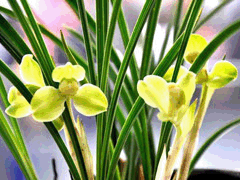 Interpreting the "Dew Watering," "Root Mounding," and "Fertilizing" Chapters of the Lan Hui Tong Xin Lu (1)
Interpreting the "Dew Watering" chapter of the Lan Hui Tong Xin Lu. Those who love HuilanChunlanshould study it carefully. It is helpful
Today let us first talk about the "Dew Watering" chapter ============
The "Dew Watering" chapter says: Whenever Huilan flowers have luxuriant leaves but do not produce flower buds, and fertilizer has no effect, one must collect dew during the Great Heat period and water the flowers with it, and they will immediately set buds. The method of collecting dew: make a large flag from grass cloth, first soak it thoroughly in clean water and wring it dry, then in the early morning brush it across the seedlings in the field; when the dew has all been gathered on the flag, wring it out and brush again, or store it in a jar or keep it in a bottle, accumulating as much as possible. Water with one bowl every morning, and after more than ten mornings in a row, the effect will always be seen.
===== Huilan grows well with luxuriant leaves, but simply will not set flower buds, and applying fertilizer has no effect either, so what should be done? On early mornings during the Great Heat period, use the collected dew to water one bowlful on the orchid pot, and after autumn the flower buds will be seen emerging from the soil. In September the weather gradually turns cool, and this is also the season when Huilan sets buds. From bud set to flowering, Huilan sits in the pot for a full 5-6 months; the length of time is enough to make one anxious. Especially those who have not seenflowersare even more impatient. If by September or October there is still no sign of flower buds, one's feelings can well be imagined. The "Dew Watering" chapter tells us that during the Great Heat period, when there is dew in the fields in the early morning, one should collect it and water one bowlful in the morning; after more than ten days in a row, flower buds can be seen emerging. That is what it says, but where can one go to collect dew these days? So-called dew is the water droplets formed by the temperature difference between the ground and the air in the early hours, and it contains many trace elements; first, it is about being light and clear, and second, it is about timing. I think if H2O water + many trace elements = dew, then it is easy to handle. Everyone knows that because water has a relatively strong dissolving capacity and ionizing capacity, it can make the water-soluble substances in the plant body assume a dissolved state and an ionized state, maintaining the electrolyte balance in the plant body; and because water has relatively strong fluidity, it plays a role in nutrient transport and in the excretion of metabolites in the plant body during the processes of absorption, digestion, and circulation within the plant. If trace-element fertilizer is added to tap water, can it not likewise play the role of dew? The key is when you use it. Because watering is a routine task in raisingorchids, according to what the "Dew Watering" chapter says, one should, during the Great Heat period, after withholding water, water one full bowlful every morning in succession. I once explained that Huilan likes dryness because its native habitat is at high altitude, where apart from dew there is seldom rain, and when rain comes in early autumn, it sets flower buds. The Great Heat period happens to border on the Beginning of Autumn, and it is also the period of greatest consumption for Huilan since the start of summer, so supplementing trace-element fertilizer at this time is very beneficial. According to this idea, last year I used Xishuo at a 6000-fold dilution and watered 200 ml every day before the Beginning of Autumn. This year in March-April, there was not a single pot of Huilan that did notflower. Xishuo is similar to what is now called nano trace-element fertilizer, containing more than 80 kinds of natural trace elements, with 80 million active bacteria per gram, and it is extremely easy fororchidsto absorb. This method works for Huilan;Chunlanhow about it? Orchid friends might as well give it a try! (To be continued)
[/size][/color]