Notes on caring for a rootless cold orchid (Cymbidium kanran), sharing orchid-growing experience
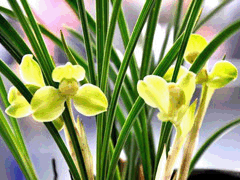 Orchid-growing notes: rootlesscold orchid (Cymbidium kanran)
http://www.dfac.cc/showtopic-17-292548-0-0-1.htm
I came across a rootless cold orchid from an orchid enthusiast in Jiangxi. The entire plant's leaves were scorched and burnt-looking along the edges, and when it was taken out of the pot to examine the roots, it turned out that not a single section of root was good; most were already hollow, and the few sections that still had some flexibility, after careful observation, were confirmed to be roots that had already failed. The new shoot, however, had beautiful bright yellow speckled variegation that shows up first. It was the first time I had seen such a pure yellow speckled plant, and I liked it very much.
I weighed it in my mind for a long time. Although the plant had no roots and the leaves also showed signs of dehydration, it was clear this was due to excessive fertilizer. The original plant was still fairly robust, and the number of shoots was not small either. Relying on many years of cultivation experience, and because I liked it so much, I still decided to buy it.
Orchid plantThe pruning and cleaning really took a lot of effort: scorched tips, hollow roots and rotten roots were all removed. Based on past practice, a rootless plant must first produce shoots in order to survive; only when new shoots sprout will new roots emerge. If a large clump is potted up, the old shoots usually turn yellow and decline because water transport is poor. Perhaps this is the working of Sun Tzu's "sacrifice the pawn to save the chariot"! So I resolutely divided the plant into three clumps according to how open the rhizome connections were, to urge the old back-bulb shoots to send up shoots and roots, and to encourage the new shoot at the front with failed roots to produce new roots.
During the lean cultivation I also insisted on withholding water. The reason is that an orchid that has lost water has impaired function, and too much water easily causes waterlogging; and this withholding often forces it to struggle for survival and sprout to preserve itself. After potting up on 2008-12-9, the two back-clump pots of orchid plants showed little overall improvement, and the leaves still appeared dehydrated; but the pot of cold orchid at the front with the new shoot, apart from a small amount of scorched tips on the leaf tips, encouragingly finally showed plump leaf tissue, and on close inspection the originally shrunken pseudobulbs had eased, and my heart felt light and cheerful.
Cold orchids are difficult to grow, and getting cold orchids to send up shoots is even more difficult. Cold orchids grow slowly, and being able to produce two seasons of new shoots in a year is already quite rare. Precisely because growth is so slow, one often sees new shoots mature while the grandfather generation has already grown old.
(To be continued)