What soil and fertilizer to use for cultivating colored-flower orchids
Soil and fertilizer for cultivating colored-flower orchids
 Soil and fertilizer for cultivating colored-flower orchids
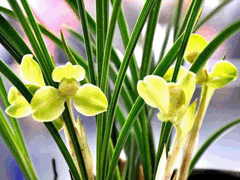
Among the Chinese orchid species, colored-flower orchids have always been a controversial strain; they bloom differently from one year to the next, and stable colored-flower orchids of course remain high in price and never come down, while some newly collected colored-flower orchids, although their color was quite good at the time, after being grown at home, the change in color is greatly discounted to a certain extent: red flowers are not red, yellow flowers are not yellow.
We know that "all things grow relying on the sun"; everything with life needs its illumination and the nourishment of rain and dew, and orchids are no exception. As the saying goes, "more sun makes better flowers," which is exactly this principle. Yet modern orchid growing is mostly done on balconies, where not all plants can get sunlight; some orchid shelters, though well built, have too much shading, which to a certain extent is also one of the reasons the color of colored-flower orchids does not come out fully.
Colored-flower orchids mostly come from Yunnan, Guizhou and Sichuan, and these places are mostly dominated by red soil; red soil is also the main factor in colored-flower orchids having outstanding color. When growing orchids at home, there are certain limitations in choosing red soil; some orchid enthusiasts simply cannot buy good red soil, and in some places one can only buy red immortal soil as a growing medium (of course, it is not that red immortal soil is bad), but it is not the best. The best red soil should be volcanic stone from Tengchong, Yunnan. This growing medium is red to the point of purple, rich in various minerals needed by orchids, and good in air permeability and water drainage. It is an essential growing material for colored-flower orchids.
To make colored-flower orchids bloom well, there is another growing medium, namely burnt plant ash (but it must not be burned too much; when it has just burned through, put the fire out), but do not add too much.
Mix several kinds of growing media that can be used for orchids together; the growing medium must be loose, air-permeable and water-draining, and the plant ash should be placed as close to the top as possible, so as to avoid it being too fine and, with too much water, rotting the roots. After flower buds form, from July to August, apply as much monopotassium phosphate and ferrous sulfate as possible (mixed with water according to the proportions on the instructions) as fertilizer water. Note: light fertilizer applied frequently will have an unexpectedly good effect.