Orchid Buds Chitchat: Chatting About Orchid New Buds When Bored
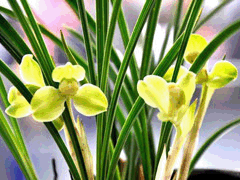 Talking About Orchid Buds When Bored
Orchid buds always stir the heart of every orchid grower, because when orchid buds emerge from the soil, we see hope and find a sense of achievement. Orchid buds breaking through the soil truly make us happy, because when small buds appear, it means we have gained something from growing orchids, though of course this gain still requires much greater hardship. I have always believed that for orchid enthusiasts who have only been growing orchids for a few years, newly emerged orchid buds are a textbook for learning about and understanding orchids. Although judging orchid varieties by their buds has some reference value for appreciating orchid cultivars, it is not necessarily always accurate. However, by combining other characteristics of the orchid plant, such as plant type, leaf tip, leaf sheath, veins, and patterns, we may be able to infer whether an orchid plant is a fine-flowered type or an ordinary-flowered type, and infer whether this flower has more gambling potential than other orchid plants. Therefore, carefully observing the shape, color, color change after budding, and whether there is a white tip of orchid buds is a lesson that we orchid growers need to learn and master. Generally speaking, orchid buds are green, especially pure white ones, and most will produce pure-color flowers. Of course, there are also red buds that produce pure-color flowers, such as Yumeisu among Cymbidium goeringii. Its small buds are purplish red, but the flowers it produces are peach-colored pure flowers. Those whose small buds have white tips will mostly produce fine flowers, and orchid buds that are somewhat round and bulging may produce lotus-petal flowers. However, this is only one of the tricks in selecting fine orchids, not the only one. For example, the plants of lotus-petal flowers are basically lotus-type plants, but lotus-type plants do not necessarily produce lotus-petal flowers. However, now with the effects of new high technology, differences in eastern and western regions, and different cultivation methods, some small buds may turn out differently. Let me state first that what I am randomly typing today only represents the opinion of me, an orchid-growing novice. If anything is wrong, please forgive me. After several years of growing orchids, my feelings about the small buds of certain old varieties are as follows: the small buds of Songmei are light green; the bud tips of Jiyuan are slightly thick and purplish red; the small buds of Longzi are green with red patterns; the small buds of Wangzi are light green with sheath vein patterns, and the bud tips have red coloring; the new buds of Dafugui are purplish red; the small buds of Huanqiu are green with a slight purple tinge, and so on. As for the others, I will not elaborate in detail, because I feel that I can only understand them in my mind and cannot put them into words, and novice orchid growers must figure them out and observe them themselves. Generally, after small buds emerge from the soil, until the orchid buds open, there will be a period when they seem to pause and stop growing, usually between one week and several weeks, because during this time the orchid buds are developing new roots. Moreover, I think it is better to keep things slightly dry during this period, forcing the new roots of the small buds downward toward the moist area below, so they tend to grow downward. Try not to use fertilizer, because if fertilizer is used at this time, it is easy to damage the new roots. Try to let them receive more light to promote photosynthesis in the orchid leaves, manufacture nutrients, promote orchid root growth, and minimize the pause in growth. In this way, the newly grown orchid buds generally tend to become strong plants in the same year, and may produce several generations of plants, all becoming mature plants in the same year. Of course, to make small buds become strong plants, we still need to give them corresponding management after the small buds emerge. Preventing pests and diseases, maintaining temperature differences, strengthening ventilation, and so on still require us orchid growers to make continuous efforts. Because the orchid buds have already emerged, but growing them into seedlings is not yet successful!!
http://www.shorchid.com/lhbbs/dispbbs.asp?boardID=8&ID=13551&page=7