A Detailed Guide to Flower Quality and Flower Retention Control in Cymbidium ensifolium
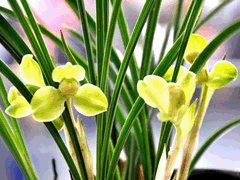 A Brief Discussion on Flower Quality and Flower Retention Control in Cymbidium ensifolium
The flowering season of Cymbidium ensifolium has arrived, and orchid enthusiasts always want their beloved orchids to bloom with flowers they are pleased with. I am no expert; I am just showing off my slight skills by first sharing some of my experiences with flower quality and flower retention in Cymbidium ensifolium, hoping to draw forth better ideas from others.
Flower quality: The determining factor for the flower quality of Cymbidium ensifolium is the internal cause, namely the variety of the flower. However, the flower quality of Cymbidium ensifolium is quite flexible, and human control factors (external causes), such as proper handling during the budding stage, can allow the internal cause to be better expressed and produce better flowers. As for human factors, here is how I handle it:
One: Grow strong seedlings whenever possible, as strong seedlings can produce good flowers. For lotus-petal types (including lotus-type narcissus), this is especially important. For lotus-petal types to bloom well, it is best to have three or more strong seedlings, so that the flowers produced are large and full of spirit (this year I have a pot of six strong seedlings of Jinzhou Honghe, and the flowers it produced were truly a delight to the eye). As for plum-petal types (including plum-type narcissus), it depends on the specific variety. Some varieties can bloom very well from strong seedlings (such as Yipin Mei), while some varieties actually do not bloom at their best from strong seedlings. As the saying goes, a strong plum may produce a narcissus, which probably refers to this type of variety. In this regard, my approach is basically: for medium-flower-type plum petals (flower diameter below 3.5cm), use strong seedlings to bloom as much as possible; for large-flower types, use medium seedlings to bloom. This is because flowers that are too large tend to become unstable.
Two: Temperature: Regardless of the type of Cymbidium ensifolium, a flowering temperature between 25 and 28 degrees is most suitable.
Three: Light: After the flower buds form, appropriately increasing light is beneficial for the flower stem to grow taller and for the flower buds to develop strongly, and it is also good for color (except for plain-hearted white-flower types).
Four: Humidity: From bud formation to the small budding stage, I personally think keeping humidity at around 70% is more suitable. This is also beneficial for the flower stem to grow taller and for the flower buds to develop strongly. After the small budding stage, humidity can be gradually reduced to around 50%.
Five: Watering: From bud formation to the small budding stage, you can water as usual. After the large budding stage, you can extend the watering interval. For example, if you normally water every 2 or 3 days, you can extend it to 4 or 5 days.
Six: Fertilizing: For lotus-petal flowers, apply a fish emulsion flower-boosting fertilizer once after the buds form. For plum petals, it depends on the situation. If the seedlings are weaker and the buds are smaller, apply once; in other situations, no fertilizer is needed (for the same reason as with strong seedlings).
Seven: Other: After the buds form, observe frequently. If there are pests (especially thrips), kill them immediately. Some plum petals have a high degree of masculinization, so pay attention to whether the outer petals are hooked onto each other. If they are, gently pry them apart with a toothpick to prevent the outer petals from becoming crooked when the flower opens.
Flower retention: The flower retention of Cymbidium ensifolium is mainly determined by the variety. This is because petal thickness (which affects whether the petals become unstable and elongate after the flower has been open for a long time), tongue shape (which affects whether the tongue droops or curls backward after the flower has been open for a long time), and the shape of the column (which affects whether the column opens or becomes crooked after the flower has been open for a long time) are basically all determined by the variety. The influence of human factors is very small. What I can do is only:
One: Control water and reduce environmental humidity to prevent the outer petals from elongating.
Two: Reduce light and keep things shadier, to prolong the flowering time.
Three: Stop fertilizing during the flowering period to preserve the flower's shape as much as possible.
However, it must be especially pointed out that the flowering period of Cymbidium ensifolium is also exactly when spring shoots are growing vigorously, so while orchid enthusiasts take measures to control flower quality and flower retention, they should also comprehensively consider the impact on the growth of spring shoots.
Since my understanding of Cymbidium ensifolium is still very limited, the above is merely some of my own experiences, and there may be many unreasonable and unscientific points in it. The main purpose of posting this is to draw forth better ideas, and I ask experts and connoisseurs to kindly offer their guidance!
http://www.dfac.cc/showtopic-10-268560-0-0-1.htm