Detailed Explanation of Cultivation and Management Techniques for High-Grade Variegated Orchids
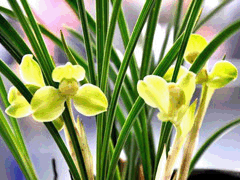 A Brief Discussion on the Cultivation and Management of High-Grade Variegated Orchids
http://www.dfac.cc/showtopic-17-236839-0-0-1.htm
I am passionate about leaf-variegated orchids and have been growing them for four or five years. During this time, I have had successful experiences,
as well as lessons from orchids I lost. Most of the ones I grow are crystal, center-striped, picture-pattern variegated, and high-grade line-variegated orchids. When growing them,
I manage them all together. In my day-to-day care routine, I have paid attention to the following aspects:
1. There must be a certain amount of light. In winter and spring, the light is scarce and weak, so only half shading is needed; in summer and autumn, the blazing sun is like
fire, and the shading density should be 85-90, with only a little scattered light needed to prevent the variegated tissue from being scorched by the sun.
2. In fertilizing, use less nitrogen fertilizer and more phosphorus and potassium fertilizer, avoid excessive nitrogen fertilizer, and do not apply magnesium fertilizer. Spray less foliar fertilizer with high
nitrogen content or containing magnesium; applying too much will cause chlorophyll to increase sharply and mask the variegated tissue, making the leaf variegation weaken and degenerate.
3. The spatial humidity should be a bit higher than for non-line-variegated orchids, to prevent the variegated tissue from drying out and scorching.
4. As far as possible, plant them connected together; it is not advisable to divide them into separate plants, to prevent weaker growth and a tendency to degenerate.
5. This type of variegated orchid is not as wild and robust as non-line-variegated orchids; its growth and development are comparatively weaker, and the roots
are not very strong. Therefore, strengthen root cultivation to make the plant strong; when the plant is strong, the variegation is bright.
6. It is not advisable to apply high-concentration pesticides and chemical fertilizers, to prevent pesticide and fertilizer damage.
7. It is best not to touch the leaves of high-grade variegated orchid plants with your hands, to prevent contaminating the variegated tissue.
The above aspects are not really experience, but merely a little understanding from my own learning while doing over these past few years.
Comparing past and present, I share this with everyone for mutual encouragement and learning. I also hope everyone will reply to the thread. I ask the experts in growing leaf-variegated orchids to criticize and correct me; I will keep striving and humbly learn to grow well the variegated orchids I love! Thank you!!!