My Views on Fertilizing Orchids: Yu Ke's Orchid Growing Part Three
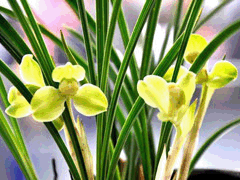 [Yu Ke's Orchid Growing Part Three]   My Views on Fertilizing Orchids
http://www.dfac.cc/showtopic-17-231188-0-0-1.htm
Orchids are grasses, so they need fertilizer! But how to use fertilizer - everyone has their own clever tricks, and I just want to simplify the issue so nobody has to read through something too exhausting! Organic and inorganic fertilizers: For fertilizing orchids, organic fertilizers are extensively described in ancient books, such as: bean cake, soybean water, deer dung, silkworm droppings, golden juice, hundred-herb juice, chicken feather water, urine sand, fishy water ----- some even describe watering with human milk; you could say the methods are varied and bizarre. Modern people have chemical fertilizers - simple, clean, efficient! But problems arise at the same time: even the best chemical fertilizer has incomplete nutrients and excessive amounts of some nutrients. So organic fertilizers are highly praised by orchid lovers, and I myself also prefer organic fertilizers, because organic fertilizers have comprehensive nutrients and are mild in nature, but I only use one kind ---- fermented rapeseed cake fertilizer liquid, watered twice each spring around the time of budding, and once before dividing plants in autumn. Inorganic fertilizers are now plentiful on the market, and many wear a veil of high technology, but lift the veil and it is nothing more than different ratios of nitrogen, phosphorus and potassium, and different contents of some other trace elements; only heaven knows how big the differences in their effects on orchids are! I myself am rather lazy, because the potting mix I prepare contains pine bark and mountain soil granules and other components, so ordinarily I basically cannot be bothered to use inorganic fertilizers, and the orchids still grow quite robustly. The negative effects of foliar fertilizer: Modern orchid-growing methods almost all include introductions to using foliar fertilizer. In my early orchid-growing days I also often used foliar fertilizer. Since I majored in chemistry, there would absolutely be no deviation in the concentration ratio of foliar fertilizer. In the early period of use I indeed highly praised foliar fertilizer, and the effects were immediate, for example after using urea I would find new leaves growing noticeably faster within a few days, but after a period of time the problems appeared. All foliar fertilizers, while bringing benefits to orchids, also bring negative effects. For example, urea may cause leaves to grow wildly, potassium dihydrogen phosphate may cause leaves to age prematurely, Lan Jun Wang causes orchid leaves to grow too quickly, glucose causes leaves to become too wide and too thick, and so on. The newly grown leaves are long and strong, but they lose the charm and natural feeling of orchid leaves, and after using foliar fertilizer, orchid leaves are very prone to fertilizer burn in high-temperature weather. Therefore in recent years I no longer use any foliar fertilizer when growing orchids; the leaves that grow are clean, fresh and natural, most leaves have sealed tips, and even the leaf spot problems that were previously difficult to solve almost no longer appear. Some issues that must be noted when using fertilizer: [1]: Organic fertilizer must be fully decomposed until there is no foul smell. [2]: Fertilizer should be applied lightly, not heavily. [3]: After using inorganic fertilizer, you must water back. [4]: Do not fertilize outside the orchid's growing period; do not fertilize in high or low temperatures! [5]: When using inorganic fertilizer, you must choose fertilizers with different nutrient ratios according to the orchid's different growing periods. [6]: Granular slow-release fertilizer must not be used in excess, otherwise it can easily cause irreversible losses. Having said so much about fertilizer problems, I think the best way to grow orchids is to use less fertilizer or no fertilizer, but how do you ensure the nutrients the orchids need? The key is actually still the potting mix. We must prepare a potting mix that has complete nutrients and can continuously release nutrients during the orchid's growing period. Traditional orchid growing uses mountain soil, and the nutrients in the soil are already sufficient. If in mixing granular potting mix we add pine bark, mountain soil granules, dried cow dung and other organic components, they can slowly release the needed nutrients during each growing period of the orchid, and growing orchids becomes simple.
[Original]
Orchids grown in mountain soil, with organic fertilizer three times a year, grow incredibly strong!
Song Mei, looking at the leaves you can tell the nutrients are sufficient! Quite a lot of mountain soil granules were added; the result of 5 seedlings in one year!
Lü Yun [original species], potting mix with added pine bark.
Lü Yun babies have arrived!