How Many Times Can Orchids Sprout New Shoots in a Year? A Detailed Explanation of Sprouting Frequency
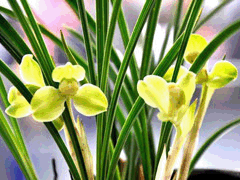 How many times can orchids sprout new shoots in a year?
http://www.dfac.cc/showtopic-18-310902-0-0-1.htm
Under suitable temperature, humidity, light, and proper nutrition, most species of Chinese orchids can generally produce 2 to 3 rounds of new shoots. Usually, under suitable growing conditions and environment, it takes about 90 to 120 days for a Chinese orchid to go from the emergence of a new shoot to forming a plant. In the course of growing orchids, people have found that whenever new shoots emerge from the soil in early April, the second round of new shoots breaks through the soil by mid-to-late June. The first batch of new shoots basically matures after 80 to 90 days of growth. The second batch of new shoots, after growing for a total of 120 days from July to October, also forms strong plants. Calculating on this basis, growing 3 batches of new shoots within the 365 days of a year is theoretically possible. In reality, however, this is not the case, because seedlings from the previous year often have not grown to full size and need to continue growing the following spring, which delays the emergence of new shoots until May or June. By the time the new shoots emerge and grow, they coincide with the high-temperature season from July to September, when the orchid plants grow slowly. After summer and the brief autumn, when the temperature gradually drops after mid-November, the orchid's vegetative growth slows down, so within the year the immature new seedlings can only wait until the next year. Year after year, every year a batch of seedlings fails to reach full size. From this we can see that the sprouting of new orchid shoots is related to the climatic conditions suitable for orchid growth. The number of times new shoots sprout depends on how many days in a year can be created that are suitable for reasonable orchid growth; the more days provided, the more batches of shoots will emerge. In the middle and lower reaches of the Yangtze River, the 24 solar terms are distinct throughout the year. In a normal year, from Grain Rain to Summer Solstice is relatively suitable for orchid growth, totaling 75 days. From White Dew to Cold Dew is 45 days, also suitable for orchid growth, totaling 120 days. This time is sufficient for orchids to go from new shoots to large mature seedlings. Why is it that sometimes even one round of seedlings per year cannot grow to maturity? The reason must be problems in management and cultivation. In fact, growing 2 batches of seedlings a year is not difficult. For example, by using the 30 days of early spring and the 60 days of summer (with artificial cooling), another growth cycle for a batch of seedlings can be obtained. Therefore, improving the orchid-growing environment and artificially creating a microclimate suitable for orchid growth can make orchids produce more new shoots.
http://www.dfac.cc/showtopic-6-310898-0-0-1.htm
How to make orchids both produce more shoots and bloom more is actually a matter of scientific management. In the course of many years of cultivating Cymbidium goeringii, the author believes that many factors affect the flowering of Cymbidium goeringii, but the most critical among them is mastering four main aspects, namely: cultivating strong seedlings, increasing light, rational fertilization, and mastering watering. 1. Cultivating strong seedlings. Generally, Cymbidium goeringii grown for flower appreciation should not be divided into single seedlings for propagation when repotting; it is best to plant three seedlings together in one pot, as only then can strong seedlings be produced. 2. Increasing light. Light is the main factor affecting orchid growth and flowering. Plants rely on sunlight for photosynthesis, producing the nutrients indispensable for their growth; both the growth of Cymbidium goeringii and the formation of flowers require sufficient light. Sunlight helps orchid leaves carry out photosynthesis, manufacture food, and supply the orchid seedlings for growth and flowering. Except in summer and early autumn, when direct sunlight must be avoided, Cymbidium goeringii should receive more sunlight in the other seasons. This not only makes the orchid seedlings healthy and sturdy but also strengthens the pseudobulbs and promotes shoot propagation. Vigorously growing orchids are relatively more likely to produce flower buds. 3. Rational fertilization. Both the accelerated growth of Cymbidium goeringii and the development of flower buds depend on fertilization, and timely and appropriate fertilization is very important. Fertilization should vary according to the different growth stages of the orchid plant. Cymbidium goeringii has two main growth stages, namely the vegetative growth stage and the reproductive growth stage. For new shoots and small seedlings, before the pseudobulb grows to half maturity, most of the nutrients produced by photosynthesis are used for the growth of the orchid plant and little is stored; this is the vegetative growth stage. During this stage, slightly more fertilizer should be applied, but among it phosphorus and potassium fertilizer should be relatively less, so as to make the plant strong. The vegetative growth stage is generally from the end of April to early July, and a high-nitrogen fertilizer should be applied once every half month. After the vegetative growth stage comes the reproductive growth stage. At this time, the carbohydrates and proteins produced by photosynthesis are stored in the pseudobulbs and leaves in preparation for flowering or new shoot growth; during this period, more phosphorus and potassium fertilizer is needed. The reproductive growth stage is generally from mid-July to the end of August, and a high-phosphorus fertilizer should be applied once every half month. 4. Mastering watering. Water is one of the material foundations of plant growth, but the amount of watering should have a limit. Watering should not be done at fixed times; rather, the right moment should be seized. Water when dry, and water thoroughly when watering; when the orchid pot is dry, it should be watered. This is the basic principle of watering. When watering, note that the water temperature should be as close as possible to the temperature inside the orchid pot at the growing site. In summer and early autumn, watering can be done in the morning and evening, while in winter it should be done at noon; the purpose is to reduce the temperature difference between the water and the orchid pot. Cymbidium goeringii should generally be watered a little during the growth stage, but before the flower buds have formed, watering should be strictly controlled.